

Web Device Binding: Coarse Fingerprints Link Visits for Fraud Teams


Last updated on October 11, 2026 · 11 min read
Device binding web is persistent device fingerprinting that recognizes returning visitors and surfaces anonymity signals so teams can prioritize and investigate high-risk traffic. It works by collecting dozens of browser and network attributes that stay stable across sessions, which lets fraud and product teams flag multi-accounting, account takeover, and trial abuse even when a visitor clears cookies or switches IP addresses.
TL;DR:
- Use deterministic account or session identifiers when available, then fall back to probabilistic fingerprints for unauthenticated visits or after cookie clearing.
- A 4.5 month deployment flagged 897 of more than 205,000 sessions; flagged traffic showed a 5.83% account takeover rate within 72 hours, versus 0.43% overall.
- Keep extraction in milliseconds and payloads small; browser permission limits on high entropy hints mean signal pipelines must degrade gracefully.
- Start with a small, privacy aware signal set and compare flagged with unflagged sessions; validate confirmed fraud before enforcing blocks.
- Monitor cluster drift, retrain when thresholds are crossed, and send borderline scores to step up authentication rather than blocking customers outright.
Table of Contents
- What device binding means and where it fits in a fraud stack
- Signals and telemetry used for persistent device identification
- How persistence works: cookies, fingerprinting, and probabilistic linking
- Performance, privacy, and engineering constraints to design for
- Implementation checklist: minimum viable device-binding deployment
- Detection patterns and metrics: what success looks like
- Operational best practices: drift, retraining, and false-positive control
- What device binding gets wrong in most roadmaps
- Getting device binding running with ShieldLabs
- FAQ
- Sources
What device binding means and where it fits in a fraud stack
In this context, device binding has nothing to do with binding a login credential to a single phone or hardware key. We mean persistent device fingerprinting: a technique that builds a stable identifier from browser and network characteristics so a web property can recognize the same device across visits without relying on a cookie or a login event.
It works alongside, not instead of, the signals a fraud stack already has. Authentication tells you who logged in. Cookies and session tokens tell you what happened during one visit. Behavioral analytics tell you how someone typed or scrolled. Device binding adds the one layer that survives when the others get wiped, closing the gap between sessions.
Three use cases drive most adoption:
- Catching multi-accounting, where one person opens several accounts to farm promotions or bypass limits.
- Flagging account takeover, where a device never seen on an account suddenly logs in.
- Scoring free-trial and referral abuse, where the same device returns under a new identity to claim a reward again.
Signals and telemetry used for persistent device identification
A device fingerprint is only as strong as the signal set behind it. Most production systems combine client-side attributes with network-level telemetry and explicit anonymity markers, because any single category can be spoofed on its own.
- Client-side attributes: canvas and WebGL rendering hashes, installed fonts, screen and hardware specs, and User-Agent Client Hints.
- Network and transport signals: IP address ranges, autonomous system data, and TLS fingerprints such as JA3 or JA4 that reveal the underlying client library regardless of the claimed browser.
- Anonymity indicators: VPN and proxy usage, Tor exit nodes, Apple Private Relay, anti-detect browser detection, and automation frameworks.
- Consistency checks: comparing the claimed user agent against runtime graphics, timezone, and feature behavior to catch mismatches typical of spoofed environments.
Anti-detect browsers, virtual machines, and automation toolchains tend to reveal themselves through small divergences between what they claim and how they actually render, and 10 browser fingerprinting techniques break down the most common vectors teams rely on. A production deployment of coarse-grained fingerprinting found that flagged sessions carried an 5.83% chance of account takeover within 72 hours, compared with 0.43% across all sessions. That gap is the core argument for building a wide signal set rather than leaning on any single marker.
How persistence works: cookies, fingerprinting, and probabilistic linking
Cookies are deterministic: a cookie match is exact, but it disappears the moment the cookie is cleared. Fingerprinting is probabilistic by nature: it compares a visit's attributes against prior visits and produces a confidence score rather than a guaranteed match.
That distinction shapes how teams should use each layer.
- Use deterministic keys (logged-in user ID, session cookie) whenever they're present, since they carry no ambiguity.
- Fall back to probabilistic fingerprint matching when cookies are absent, cleared, or the visitor is unauthenticated.
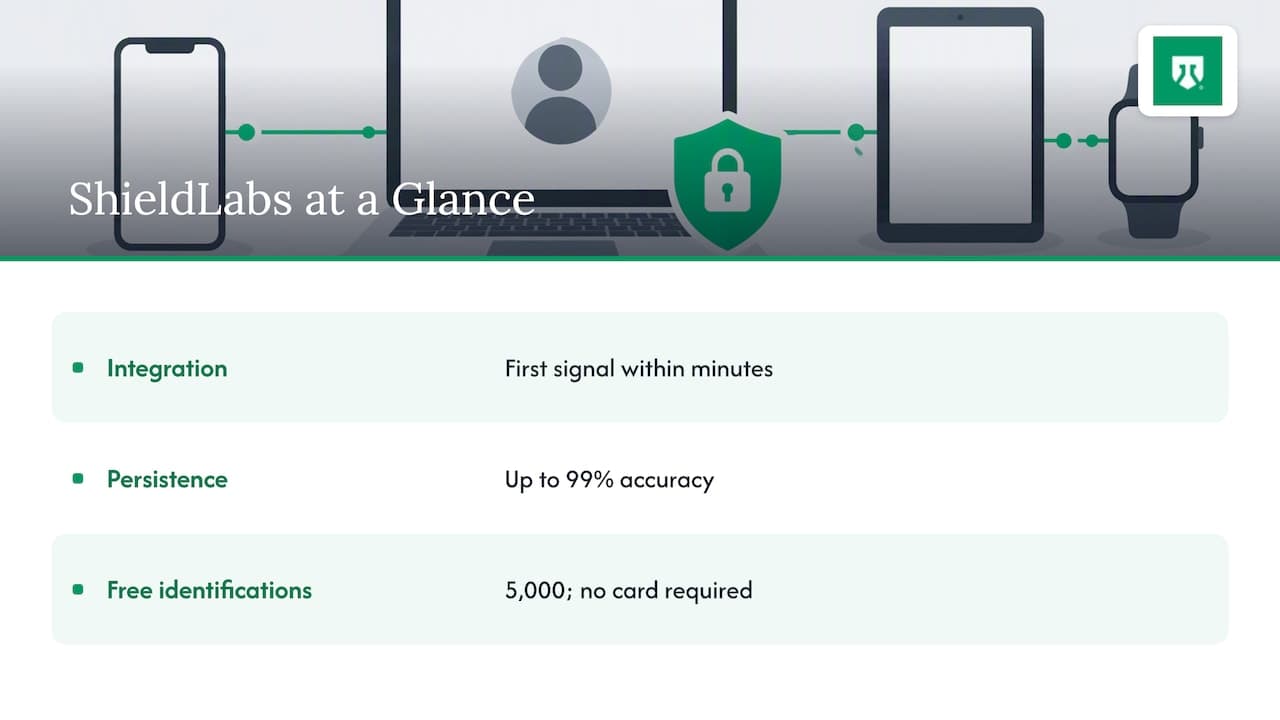
- Treat "up to 99% persistence" as a measured production rate, not a universal guarantee, and validate it against your own traffic before trusting it operationally.
Persistence becomes useful once visits are linked across time. A device that logged into five different accounts in a week is a multi-accounting signal. A device that never touched an account before suddenly authenticating successfully is an account takeover signal. The Browser Polygraph research treats fingerprinting as a persistent key effective even against cookie clearing and IP rotation, which is exactly what makes cross-visit linking possible at scale.
Performance, privacy, and engineering constraints to design for
Fine-grained fingerprints that collect every available browser attribute sound more accurate on paper, but they cost more to extract, generate larger payloads, and drift faster as browsers update. Coarse-grained fingerprints trade some theoretical precision for speed, smaller footprints, and better stability, which is why they fit high-throughput web traffic better.
- Keep client-side extraction fast: target a script that runs in milliseconds, not seconds, so it never becomes a page-load bottleneck.
- Keep the payload small: a lean, selectively chosen attribute set reduces both bandwidth and the odds any single attribute triggers unnecessary privacy scrutiny.
- Plan around browser privacy changes: User-Agent Client Hints now gate high-entropy values behind explicit permission, and browsers are actively reducing how much the plain user-agent string reveals, which shrinks the signal surface available to any fingerprinting approach.
Pro Tip: Build your signal pipeline to degrade gracefully, since a browser that withholds a high-entropy hint today may withhold more tomorrow.
Implementation checklist: minimum viable device-binding deployment
Getting from zero to a working deployment is a sequence, not a single integration step.
- Install the client-side snippet or SDK and confirm the ingestion pipeline writes signals into a queryable storage schema.
- Start with a small, privacy-aware signal set rather than every attribute you can collect.
- Run an A/B test comparing flagged versus unflagged sessions to measure detection lift before expanding scope.
- Set up drift detection and a retraining cadence, since browser updates and new anti-detect tooling shift the signal distribution over time.
- Validate against known fraud cases to control false positives before enforcing any decision on the flag.
Track a short set of KPIs from day one:
- Identifications processed per day.
- Share of traffic landing in high-risk bands.
- Conversion rate from flagged sessions to confirmed account takeover.
The low-latency checks fraud teams use for anti-detect browsers are a practical starting point for step one.
Detection patterns and metrics: what success looks like
The clearest benchmark for prioritization comes from a 4.5-month production deployment covering more than 205,000 sessions, where 897 were flagged as suspicious. Within that set, flagged sessions showed a 5.83% rate of account takeover within 72 hours, against 0.43% across the full traffic pool, a gap wide enough to justify routing flagged sessions to manual review or step-up authentication before anything else.
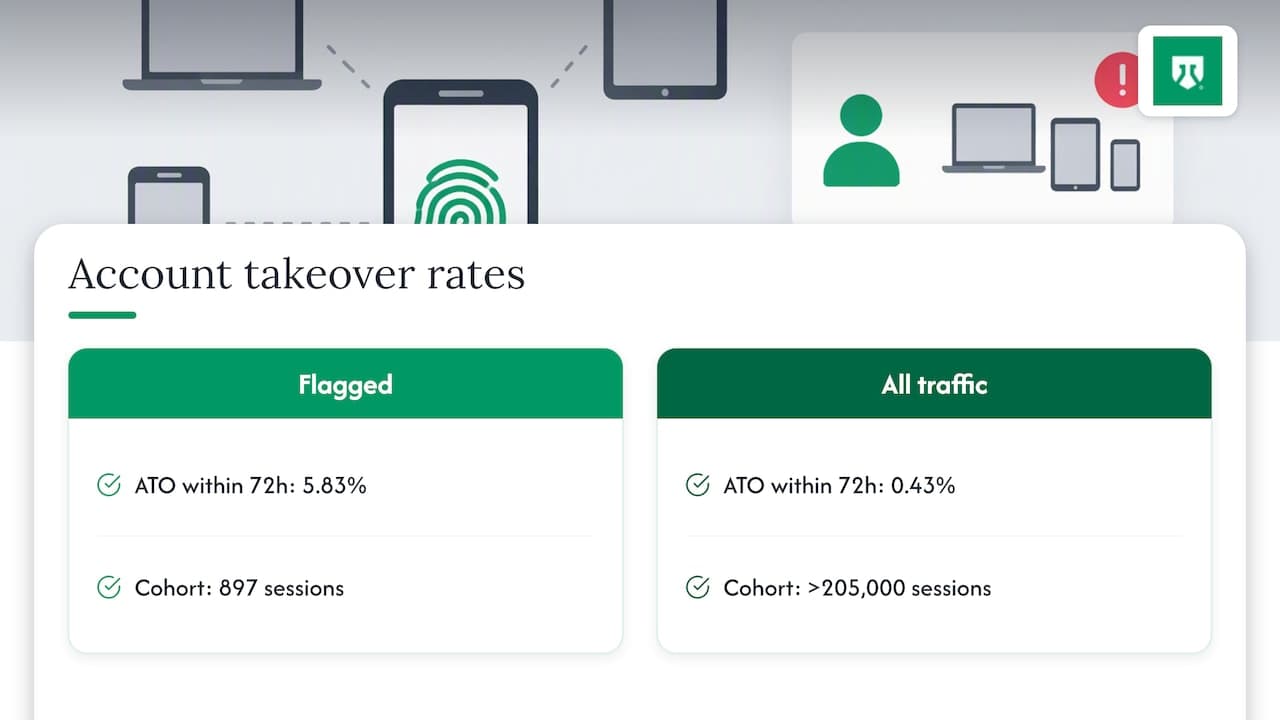
Measuring your own lift means instrumenting both sides: log every flagged session's downstream outcome, not just the flag itself, and compare it against a baseline of unflagged traffic over the same window. Watch for sample bias (a small flagged pool skews results) and concept drift (today's fraud patterns shift as tooling evolves), both of which argue for ongoing validation rather than a one-time measurement.
Operational best practices: drift, retraining, and false-positive control
A fingerprinting model that worked well last quarter can quietly degrade as browsers update and anti-detect tooling adapts. Watching for that decay is an operational habit, not a one-time setup task.
- Track cluster stability over time, since weakening clusters often signal that new browser variants have entered your traffic.
- Schedule retraining when drift metrics cross a threshold rather than on a fixed calendar.
- Use adaptive decisioning: route borderline scores to step-up authentication instead of an outright block, which keeps friction proportional to risk.
- Expose the underlying signals behind every score, so your team can audit why a session was flagged instead of trusting a black box.
Pro Tip: Pair every high-risk flag with the specific signals that produced it, since that detail is what turns a review queue into a defensible decision log.
Adaptive authentication built on device signals, covered in the device signal for step-up, is one of the more practical ways to apply this without over-blocking legitimate users.
What device binding gets wrong in most roadmaps
Most teams treat device binding as a one-time integration: install a script, get a score, move on. That misses the part that actually determines whether the system stays useful, which is the discipline of watching drift and revalidating signals as browsers and anti-detect tooling change underneath you.
The teams that get real value start narrow. A small, well-understood signal set that you can explain to a fraud analyst beats a sprawling fingerprint nobody can audit. Coarse-grained signals, short validation windows, and full visibility into what produced each score matter more than chasing theoretical precision. Detection supplies the signal. Your product code still decides the action, and that split is worth protecting as you scale.
— Jeff
Getting device binding running with ShieldLabs
Our platform is based on the approach this article describes: coarse-grained, auditable device recognition rather than a brittle, fine-grained fingerprint that breaks with every browser update. Integration starts with a single JavaScript snippet, backed by server-side SDKs and an OpenAPI specification for anything a snippet can't reach, so most teams see their first signal within minutes.
Identification can persist with up to 99% accuracy despite cleared cookies, incognito mode, and IP rotation, and every score includes the signals behind it so your team keeps the decision in your own code. Anonymity detection covers VPNs, proxies, Tor, and Apple Private Relay, alongside anti-detect browser detection and traffic-quality analytics broken down by acquisition source.
Pricing is published and flat, starting with 5,000 free identifications and no card required.
FAQ
What is device binding on the web?
Device binding on the web is persistent device fingerprinting: a technique that recognizes a returning browser or device across visits using stable attributes rather than cookies or logins. It supports fraud detection use cases like multi-accounting, account takeover, and trial abuse by linking visits that would otherwise look unrelated.
How accurate is device fingerprinting at recognizing returning visitors?
Accuracy depends on the signal set and deployment, but persistent identification can reach up to 99% in production even after cookies are cleared or IP addresses change. Teams should validate this rate against their own traffic rather than assume it holds universally.
Does clearing cookies defeat device binding?
No. Device binding is built specifically to survive cookie clearing, incognito mode, and IP rotation, since it relies on browser and network attributes instead of stored identifiers. That resilience is the main reason fraud teams use it alongside, not instead of, cookie-based tracking.
How does device binding handle privacy regulations?
Device binding should rely on coarse-grained, privacy-aware signals and respect browser-level permission gating, such as the high-entropy hints restricted under User-Agent Client Hints. Specific legal obligations vary by jurisdiction, so teams should confirm requirements with their own counsel rather than treat any vendor's approach as a compliance guarantee.
What's the difference between coarse-grained and fine-grained fingerprinting?
Coarse-grained fingerprinting uses a smaller, faster set of attributes that stays more stable as browsers update, trading some theoretical precision for speed and resilience to drift. Fine-grained fingerprinting collects more attributes for marginally higher precision but costs more to extract and breaks down faster when browser APIs change.
Sources
- Browser Polygraph: Efficient Deployment of Coarse-Grained Browser Fingerprints for Web-Scale Detection of Fraud Browsers
- User-Agent Client Hints API - Web APIs | MDN
Recommended
Related articles
How to Detect AI Agents on a Website
Detect AI agents on a website by separating operator identity, automation evidence and authorization. Protect accounts while permitting useful public crawling.

Fraud Detection API for Web Apps: From Browser Signal to Backend Decision
Integrate a fraud detection API into web signup and login with browser collection, verified server results, signed webhooks and clear timeout handling.

Fraud Analytics: Reading Device and Risk Patterns in Web Traffic
Use fraud analytics to investigate risk signals, account events and traffic sources. Read dashboard units correctly and join evidence to real outcomes.