

Fraud Teams: GDPR Fingerprinting With Explainable Signals


Last updated on October 1, 2026 · 14 min read
Device fingerprinting used strictly for fraud detection and prevention can be lawful under GDPR and the ePrivacy rules that sit alongside it, provided it's necessary, proportionate and kept separate from marketing or analytics. In this context, "gdpr fingerprinting" means persistent device identification and risk scoring, not tracking for ad targeting. The operational takeaway: isolate the security pipeline and expose the signals behind every risk score so decisions can be audited.
TL;DR:
- Fingerprinting used strictly for fraud detection can be lawful under GDPR if it is necessary, proportionate, and kept separate from marketing and analytics data.
- Combining signals such as device attributes, network metadata, anonymity indicators, and automation flags improves detection accuracy and counters evasive tactics.
- Keeping the security pipeline isolated and documenting purpose, necessity, and data retention helps demonstrate compliance and handle subject rights effectively.
- When used beyond fraud prevention, fingerprinting requires explicit user consent obtained through clear, purpose-specific requests, and cross-border transfers need valid mechanisms like standard contractual clauses.
- Operational best practices include rigorous threshold tuning, monitoring at the channel level, explainable scoring with signal transparency, and handling evasion tactics by combining multiple signals and checking internal consistency.
Table of Contents
- How device fingerprinting works for fraud detection
- Lawful use under GDPR and PECR: the necessity test and a compliance checklist
- Operational best practices for resilient, compliant fingerprinting
- Evasion tactics and the limits of fingerprint matching
- Data subject rights and fingerprinting data
- Consent practices when fingerprinting isn't exception-covered
- Cross-border transfers of fingerprint data
- Enforcement actions tied to fingerprinting under GDPR
- Balancing detection effectiveness with privacy overhead
- Where ShieldLabs fits for teams building this pipeline
- Sources
- FAQ
How device fingerprinting works for fraud detection
A fraud-focused fingerprint is built from dozens of signals collected on each visit, not a single identifier. Browser and device attributes, network and IP metadata, and anonymity indicators combine into a profile that a detection system scores for risk.
The signal categories that matter most for fraud teams include:
- Browser and device attributes: screen resolution, installed fonts, WebGL rendering, time zone and other configuration details that vary between real devices.
- Network and IP metadata: autonomous system information, hosting versus residential ranges, and geolocation consistency.
- Anonymity signals: VPN, proxy, Tor exit node and Apple Private Relay detection, since fraud rings frequently mask their origin.
- Automation flags: headless browser markers, scripted input patterns, and anti-detect browser detection that indicate a session isn't a normal human visit.
Persistence is what separates a fraud-grade system from a basic cookie. Deterministic matching ties known identifiers together, while probabilistic matching tolerates cleared cookies, incognito sessions and IP rotation by weighing the combination of signals rather than any one of them. This is also where identifiability becomes a legal question. The EDPB's anonymisation guidance notes that combinations of device attributes can identify an individual even when no single attribute does, which means a fingerprint used for fraud scoring is personal data and has to be treated that way, not waved off as anonymous. More detail on how these signals are captured is covered in ShieldLabs' breakdown of fingerprinting techniques.
A workable integration typically runs a client-side snippet that collects signals, a server-side scoring step that turns them into a risk value, and a webhook or SDK call that lets the customer's own application decide what to do with that score. The scoring layer should always return the contributing signals alongside the number, not just a verdict.
Pro Tip: Log the signal breakdown for every score, even the low-risk ones. When a dispute or audit comes up, you want the evidence trail already sitting in your database rather than trying to reconstruct it after the fact.
Lawful use under GDPR and PECR: the necessity test and a compliance checklist
Regulators have drawn a fairly clear line here. The ICO's guidance on PECR exceptions states that device fingerprinting used solely to prevent or detect fraud can fall under the communication and security exception, meaning it may not require prior consent when it's strictly necessary for that security purpose. That exception doesn't remove GDPR obligations. Necessity, proportionality and data minimization still apply, and the ICO's 2026 storage and access technologies guidance draws a firm distinction between fingerprinting for security and fingerprinting for advertising or analytics.
Detection systems that publish the signals behind each risk score materially improve operational debugging and reduce costly false positives for growth teams. Transparency isn't just a compliance nicety, it's what lets your team defend a decision when a legitimate customer gets flagged.
Before relying on the security exception, a fraud or security team should be able to check off:
- Purpose documentation: a written record of exactly which fraud types the fingerprinting addresses (account takeover, multi-accounting, promo abuse, and so on).
- Necessity and balancing test: evidence that less intrusive methods wouldn't achieve the same detection outcome.
- Decision logging: a record of what data was collected, why, and how long it's retained.
- DPIA consideration: a formal Data Protection Impact Assessment when the fingerprinting is systematic and covers large volumes of visitors, since that scale raises the risk profile significantly.
Practical guidance from Usercentrics' summary of ICO and PECR rules reinforces the same point from a different angle: the exception is purpose-specific, and it doesn't travel with the data once collected.
Operational best practices for resilient, compliant fingerprinting
The technical architecture matters as much as the legal analysis. A few patterns consistently separate teams that run into compliance friction from teams that don't.
- Isolate the security pipeline. Fraud fingerprinting data should sit in its own storage with its own retention policy and least-privilege access, never merged with marketing or product analytics databases.
- Build feedback loops from human review. Every escalated case that a fraud analyst resolves should feed back into threshold tuning, so the system learns from real outcomes rather than static rules.
- Handle concept drift deliberately. Software updates and routine device changes alter fingerprints legitimately. A grace window approach to matching updates a device profile when the changed signals match an expected update pattern, and only treats a device as new when multiple unrelated signals shift at once.
- Monitor at the channel level. Track false-positive rates and repeat-offender patterns by acquisition channel, not just in aggregate, so a single noisy campaign doesn't get miscategorized as a system-wide fraud spike.
- Keep scoring explainable. Every risk score should arrive with the signals that produced it, so an analyst or an auditor can see exactly why a session was flagged.
Pro Tip: Set your matching thresholds slightly conservative at first, then tighten them once you have a few weeks of human-reviewed outcomes to validate against. Loosening a rule later is far easier than explaining why it wrongly blocked paying customers.
Evasion tactics and the limits of fingerprint matching
Fraud actors adapt fingerprints deliberately: rotating attribute values, running anti-detect browser detection targets, or automating sessions to mimic human variance. None of this makes fingerprinting useless, but it does mean single-signal matching alone isn't reliable.
Research on fingerprint inconsistencies in evasive bot traffic found that bots altering their fingerprints to evade detection often produce inconsistent attribute combinations, for example a browser version that doesn't match its claimed rendering engine. Detecting those inconsistencies, rather than only matching known-good fingerprints, cuts evasion substantially while keeping false positives low.
Practical responses that follow from this:
- Combine signal families. Network, device and behavioral signals together lower the odds of a single spoofed attribute slipping through.
- Check for internal consistency, not just identity, since a mismatched attribute set is often a stronger fraud indicator than any single flag.
- Apply progressive enforcement. Route ambiguous, inconsistent cases to human review rather than an automatic decision.
- Treat automation flags as one input among many, since a legitimate visitor can occasionally trip an automation heuristic.
Data subject rights and fingerprinting data
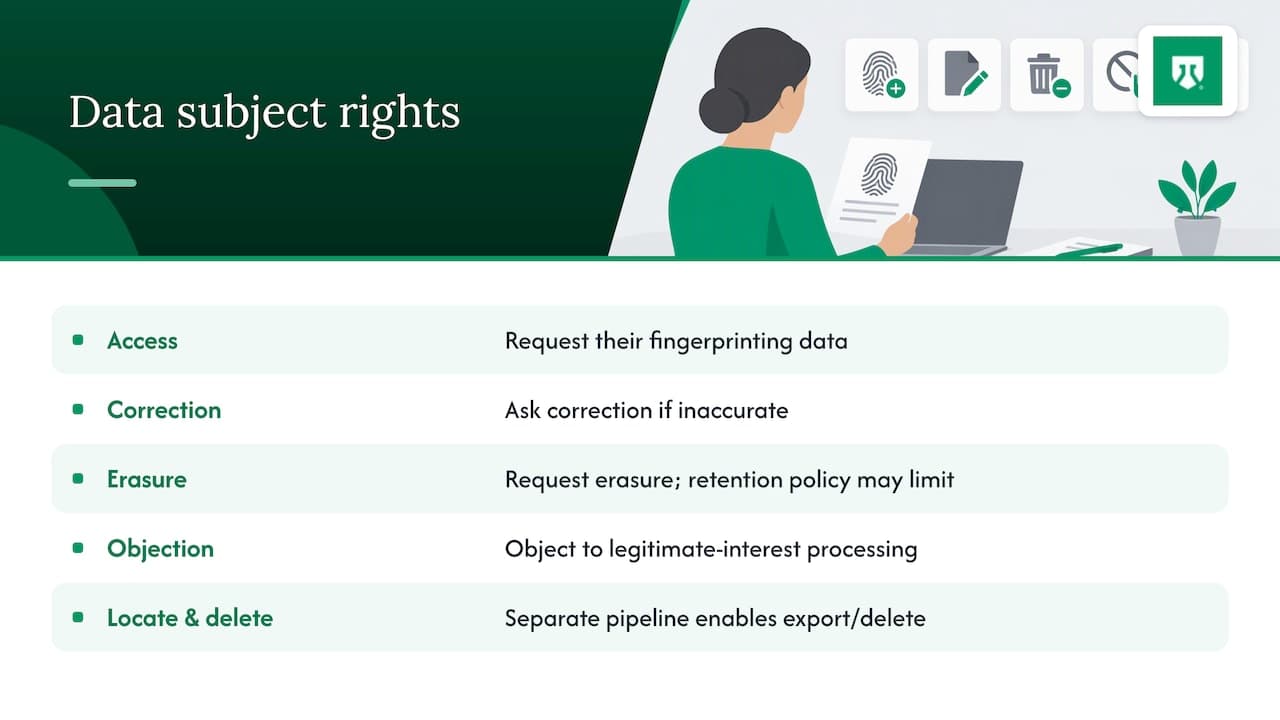
Because a fingerprint used for fraud scoring counts as personal data, the standard GDPR rights apply to it the same way they apply to a name or an email address. A visitor can request access to the fingerprinting data held about them, ask for correction if it's inaccurate, or request erasure once the fraud-prevention purpose no longer justifies keeping it.
The erasure right isn't unconditional. A business can generally retain fraud-related records, including the signals behind a past decision, for as long as the retention policy documented in its necessity assessment specifies, since ongoing fraud prevention is itself a legitimate basis for limited retention. What changes the calculus is scope: retaining a flagged session's data to defend an account decision is different from retaining every visitor's full signal history indefinitely.
Objection rights matter here too. A visitor can object to processing based on legitimate interest, and the business then has to weigh that objection against its documented necessity case. This is precisely why the compliance checklist in the earlier section matters operationally, not just on paper. A team that has never written down why it needs a given signal will struggle to respond to an objection or an access request with anything beyond a shrug.
Handling these requests well starts with knowing where fingerprinting data lives. A pipeline that keeps security data separate from marketing systems, as covered above, makes it possible to locate, export or delete a specific visitor's fingerprint records without touching unrelated systems.
Consent practices when fingerprinting isn't exception-covered
Not every use of device fingerprinting qualifies for the security exception. When fingerprinting extends beyond strict fraud detection, for example into broader risk profiling that touches advertising or personalization, consent becomes the relevant legal basis instead.
Valid consent under GDPR has specific requirements that a lot of cookie banners fail to meet: it has to be freely given, specific, informed and unambiguous, with a real option to refuse. A pre-checked box or a banner that makes "accept" the only easy option doesn't clear that bar.
For teams that need consent for any portion of their fingerprinting use, a few practices hold up better under scrutiny:
- Separate the consent request from the fraud-prevention processing. Bundling them into one blanket agreement muddies which legal basis actually applies to which data use.
- Explain the purpose in plain language, not a generic reference to "improving your experience."
- Log consent state per purpose, so a visitor who consents to analytics but not personalization is treated accordingly across systems.
- Re-request consent when the purpose changes, rather than relying on a stale agreement from months earlier.
The safer operational posture, and the one this article has emphasized throughout, is to keep fraud-detection fingerprinting inside the security exception wherever the necessity test supports it, and reserve consent flows for anything that goes further.
Cross-border transfers of fingerprint data
Fingerprinting data collected from visitors in one region and processed or stored in another triggers the same international transfer rules that apply to any other personal data under GDPR. A fraud detection pipeline that routes signals through infrastructure outside the visitor's region needs a valid transfer mechanism, typically standard contractual clauses or reliance on an adequacy decision covering the destination country.
This is easy to overlook in fraud tooling specifically because the data looks technical rather than personal. A device fingerprint doesn't read like a name or a health record, but the EDPB's anonymisation guidance treats identifiable device combinations as personal data regardless of how technical they appear, and that classification travels with the data across borders.
For a business operating across multiple markets, the practical steps are the same ones that apply to any cross-border processing: map where fingerprinting data is actually stored and processed, confirm a transfer mechanism is in place for each destination, and document that mapping alongside the necessity assessment. A fraud pipeline with servers in several regions should be able to show, on request, exactly which visitor data moved where and under what safeguard.
Enforcement actions tied to fingerprinting under GDPR
Regulators have shown consistent willingness to act against fingerprinting used outside its stated purpose, particularly where fingerprinting substituted for cookies without the consent that would otherwise be required for tracking. The pattern across enforcement guidance is less about fingerprinting itself being unlawful and more about purpose creep: data collected under a security or functional justification later used for advertising or broader tracking without a valid legal basis.
The ICO's final guidance on storage and access technologies was published specifically to close ambiguity around this, making clear that the security exception protects narrowly defined fraud-prevention use and does not extend to fingerprinting deployed as a cookie substitute for marketing purposes. That guidance itself is a response to years of regulatory attention on exactly this kind of purpose drift.
For a fraud or security team, the practical lesson isn't a specific fine figure to memorize. It's that the enforcement risk concentrates at the boundary between security and marketing use, which is exactly why the separation rule covered earlier in this article carries real regulatory weight, not just architectural tidiness.
Balancing detection effectiveness with privacy overhead
The instinct to collect every available signal is understandable, but it's usually the wrong call. A narrower, well-documented necessity case holds up better under scrutiny than a sprawling one, and it's easier to defend when a visitor objects or a regulator asks questions.
Phase your rollout: start with the signals you can justify today, measure their effect on real fraud outcomes, and expand only when the data supports it. Transparent, signal-level scoring isn't just good compliance practice, it's what lets a growth team catch a false-positive problem before it costs them clean traffic.
— Jeff
Where ShieldLabs fits for teams building this pipeline
Building a fraud-grade fingerprinting pipeline from scratch means solving persistence, anonymity detection and explainable scoring all at once, which is a lot of engineering time before you catch a single fraudulent session. Such detection layers can be available as self-serve products with published pricing, allowing evaluation without a sales call.
- Persistent identification recognizes a returning visitor with up to 99% accuracy despite cleared cookies, incognito mode and IP rotation, detailed on the visitor identification product page.
- Explainable risk scoring returns the signals behind every score, covering anonymity indicators like VPN, proxy, Tor and Private Relay use alongside device and network signals.
- SDKs and integration guides for React, Next.js, Vue and several backend languages get a first signal flowing in about five minutes.
- Published pricing starts with 5,000 free identifications and no card required, scaling through Starter, Growth and Scale plans listed on the pricing page.
Teams can check current plan details and trial the free tier directly on the ShieldLabs pricing page.
Sources
FAQ
Is device fingerprinting legal under GDPR for fraud prevention?
It can be, when it's strictly necessary for detecting or preventing fraud and stays within that purpose. The ICO's PECR guidance confirms fraud-specific fingerprinting can meet the communication and security exception, but GDPR's necessity and minimization principles still apply on top of that exception.
Does fingerprinting for fraud detection require consent?
Not necessarily, if it falls within the narrow security exception and is used solely for that purpose. The moment the same fingerprint data gets reused for marketing, personalization or analytics, consent becomes the required legal basis for that additional use.
What counts as a Data Protection Impact Assessment trigger for fingerprinting?
A DPIA is generally warranted when fingerprinting is systematic and covers large-scale visitor traffic, since that combination raises the risk to individuals' rights. Documenting the necessity and balancing test alongside the DPIA gives a business a defensible record if a regulator asks.
Can fingerprint data be transferred internationally under GDPR?
Yes, provided a valid transfer mechanism is in place, typically standard contractual clauses or reliance on an adequacy decision for the destination country. A device fingerprint is treated as personal data for transfer purposes even though it looks technical rather than identifying at first glance.
How does ShieldLabs handle explainability in its risk scores?
ShieldLabs returns the specific signals that produced each risk score, covering anonymity, network and device attributes, rather than a single opaque verdict. That lets a fraud team's own code audit and tune decisions instead of relying on a black-box output.
Recommended
Related articles

Calculate Fraud Detection Pricing With ShieldLabs' 5,000 Free Tier
Estimate fraud detection costs with a buyer-focused pricing workbook and worked examples. Validate your projection using ShieldLabs' 5,000 free...

Map JA3/JA4 to Endpoints: CAPTCHA vs Device Fingerprinting for Teams
Practical, implementation-first guidance for fraud and security teams. Map JA3/JA4, client hints, WebGL and behavioral signals to endpoints, and trigger...

Stop Sybil Attacks Without KYC: Evidence-First Prevention for Marketplaces
Build an evidence-first defense for marketplace Sybil attacks: payment-weighted reputation, graph-based detection, device and anonymity signals, plus...