

Stop Sybil Attacks Without KYC: Evidence-First Prevention for Marketplaces


Last updated on September 27, 2026 · 12 min read
Preventing Sybil attacks in marketplaces requires a layered, evidence-first model that weights endorsements by independent transaction receipts, graph-based reputation propagation, and operational rate limits. There is no single control that closes the gap on its own; following best practices to stop rental application fraud can provide useful cross-industry insights into fraud-check patterns that complement Sybil attack defenses. The first practical step is instrumenting settlement and transaction receipts, then building a payment-weighted reputation flow on top of that data, before layering in graph analysis and identity-cost controls.
TL;DR:
- Building reputation systems that weight endorsements by transaction value and account history significantly weakens Sybil attack influence.
- Layered controls like progressive trust rules, identity penalties, and account clustering prevent attackers from easily escalating their influence.
- Incorporating signals such as device fingerprinting, VPN flags, and anti-detect detection enhances the accuracy of identifying manufactured identities.
- Graph algorithms and probabilistic models remain highly effective at detecting Sybil networks even when the attacker population matches the number of honest users.
- Using telemetry-based tools to recognize shared infrastructure and behavior patterns provides a crucial edge in preventing sophisticated Sybil campaigns.
Table of Contents
- What a Sybil attack is and why marketplaces are vulnerable
- How Sybil attacks work: stages and common variants
- Research-backed detection methods: graph algorithms, Bayesian inference, and graph ML
- Layered prevention model for marketplaces
- Engineering checklist: telemetry, offline tests, and rollout
- Applied example: visitor identification and anonymity signals in the defense stack
- What the research actually supports
- Putting these defenses into practice with ShieldLabs
- Sources
- FAQ
What a Sybil attack is and why marketplaces are vulnerable
A Sybil attack occurs when one operator creates many fake identities to gain influence disproportionate to their real footprint. In a marketplace, the goal is usually to inflate reputation scores, manipulate discovery and ranking algorithms, or fabricate liquidity that does not actually exist. The underlying problem was formalized in The Sybil Attack, which framed identity creation as a cost problem: when producing a new identity is cheap, an attacker can always outnumber legitimate participants unless the system anchors trust to something scarce.
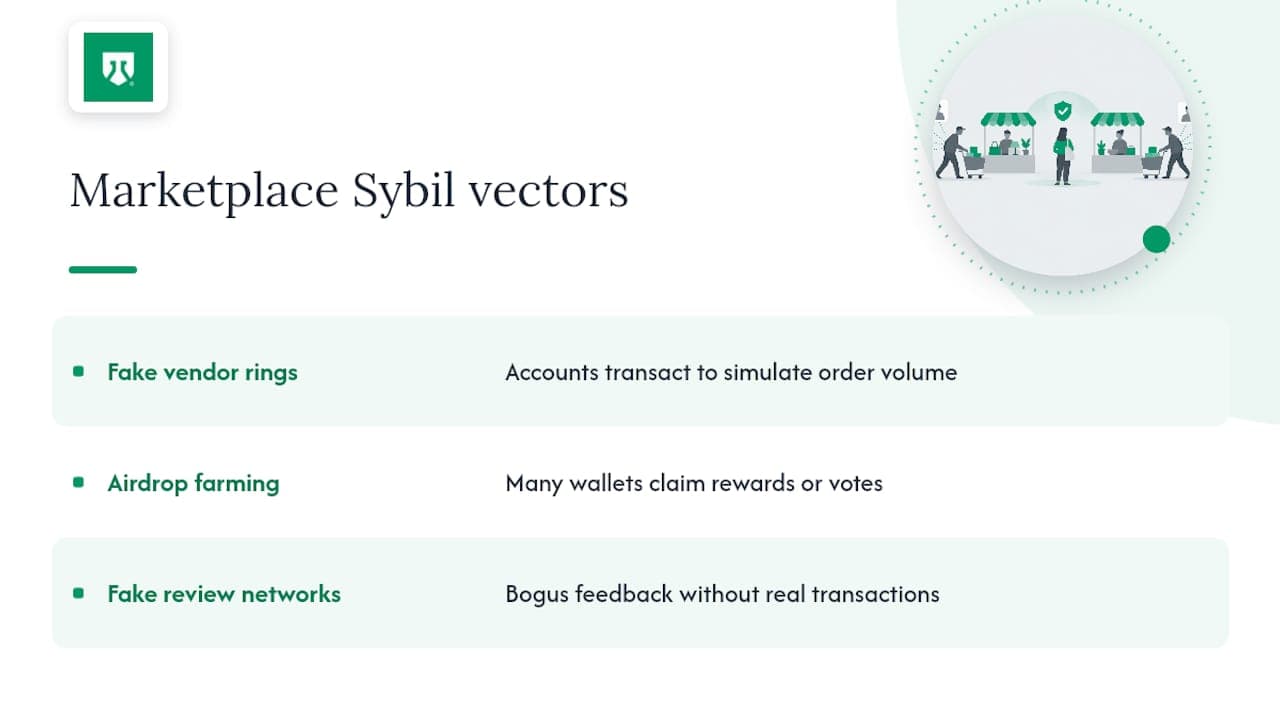
Marketplaces are exposed in three specific ways. Fake vendor rings create clusters of accounts that transact with each other to simulate order volume and boost search ranking. Airdrop-style farming, common in crypto and Web3 marketplaces, spins up wallets or accounts to claim rewards or votes tied to participation counts rather than real usage. Fake review networks pad seller reputation with feedback that never followed a genuine transaction. Each of these exploits the same weakness: a reputation or ranking system that counts identities or events without checking whether they carry independent economic weight.
How Sybil attacks work: stages and common variants
Sybil campaigns against marketplaces tend to follow a predictable arc.
- Manufacture identities. The attacker creates accounts using disposable emails, rotated IP ranges, and often anti-detect browser configurations to avoid device-based deduplication.
- Seed activity. New accounts perform small, low-risk transactions or reviews to build a plausible history before larger action.
- Infiltrate. Accounts begin transacting with each other or with a target seller to accumulate reputation edges.
- Amplify. The network votes, reviews, or trades in coordinated bursts to move a ranking, rating, or reward outcome.
Within that arc, several named variants recur:
- Ballot stuffing floods a listing or seller with positive feedback from controlled accounts to inflate rank.
- Bad-mouthing targets a competitor with coordinated negative reviews to push them down in search results.
- Whitewashing lets a penalized identity abandon its history and re-enter as a fresh account with a clean reputation score.
- Indirect or financial manipulation uses circular payments between controlled wallets or accounts to simulate transaction volume without real economic exchange.
Telemetry that flags these patterns includes synchronized timestamps across supposedly unrelated accounts, unusually dense mutual-rating clusters, and sudden bursts of inbound edges to a single seller or listing that arrive faster than organic traffic would produce.
Research-backed detection methods: graph algorithms, Bayesian inference, and graph ML
Graph-based reputation propagation, the family of methods behind PageRank and EigenTrust, treats trust as something that flows through transaction or endorsement edges rather than something counted directly. Because a Sybil identity has few or no legitimate incoming edges from established participants, its influence stays low no matter how many fake accounts point back at it.
Sybil resilience under simulation: agent-based simulations show graph-based methods keeping reputation accuracy above 0.97 even when the Sybil population equals the honest population, far outperforming simple averaging schemes. That resilience comes from weighting paths rather than counting votes.
A second family, Bayesian inference, takes a different approach. SybilInfer starts from a known set of honest seed nodes and propagates probability estimates across the social graph, returning a likelihood that each node is a Sybil rather than a binary label. That probabilistic output is useful when a marketplace wants to rank accounts by suspicion rather than issue hard bans on ambiguous cases.
More recent graph neural network and graph attention network approaches, including SybilGAT, improve on purely structural methods when a platform has large labeled graphs to pretrain on and when structural signals are more reliable than behavioral or content signals, which attackers can imitate more easily.
Feeding any of these models well requires the right raw material:
- Transaction edges between accounts, including direction and frequency.
- Payment value per edge, not just the presence of a transaction.
- Recency of each edge, since old activity should carry less weight than recent activity.
- Device and anonymity signals attached to each account, since shared devices or masked networks often connect nodes that otherwise look unrelated.
Layered prevention model for marketplaces
No single layer stops a determined Sybil campaign, so the practical model stacks several independent controls.
Evidence-first reputation. Instead of counting reviews or trades, weight each endorsement by the reputation and transaction value of the party giving it. Bazaar's max-flow risk network bounds the total fraud a malicious actor can execute by tying risk to prior transaction history rather than identity count, which means creating more Sybil accounts does not increase the attacker's fraud capacity. A related approach, sometimes called TraceRank, weights payments by the payer's own reputation so that a flood of low-reputation payments cannot outrank a smaller number of high-reputation endorsements.
- Favor signed settlement receipts over self-reported activity when computing reputation.
- Apply payment-weighted or value-weighted scoring so volume alone cannot game rank.
- Normalize for wash trading by discounting circular payment patterns between the same small set of accounts.
Progressive trust and anti-whitewash rules. New identities should start with low transaction caps that rise gradually as they accumulate independently verified activity. Reputation should decay over time, and any account that abandons its history and re-registers should face stricter re-entry requirements than a first-time user, which removes the incentive to whitewash a penalized identity.
Correlated identity penalties. Score accounts that share devices, networks, or behavioral fingerprints as a single risk unit rather than as independent participants, and rate-limit new admissions from clusters that show low counterparty diversity.
Optional identity-cost anchors. Refundable bonds or deposits raise the cost of manufacturing identities, but they add friction and require clear governance on refund conditions, since a poorly designed bond program can discourage legitimate new users as easily as it discourages Sybils.
Pro Tip: Apply temporal decay to every reputation edge; a transaction from three years ago should never carry the same weight as one from last week.
Engineering checklist: telemetry, offline tests, and rollout
Turning this model into a shipped system follows a repeatable sequence.
- Capture the right signals. Log transaction graph edges, payment amounts, timestamps, account age, referral chains, and device or network anonymity indicators for every account.
- Run offline experiments first. Inject synthetic Sybil rings into historical data, replay it through candidate models, and measure detection AUC and false positive rate before touching production traffic.
- Simulate attacker economics. Estimate how much the new controls raise the cost of running a Sybil campaign, since the goal is deterrence, not perfect detection.
- Roll out in stages. Start monitor-only, move to soft enforcement with transaction caps and throttles, and only then apply hard enforcement, with rollback triggers if false positives spike.
- Support flagged users. Give a manual review or appeal path for accounts caught by soft enforcement before they hit hard limits.
| Metric | What it tells you |
|---|---|
| Detection latency | How quickly a Sybil cluster is flagged after formation |
| False positive rate | Share of legitimate accounts incorrectly restricted |
| Retention impact | Change in legitimate user activity after enforcement |
| Attacker cost increase | Estimated rise in effort or spend needed to run a campaign |
Applied example: visitor identification and anonymity signals in the defense stack
Graph and behavioral models are only as good as the account-level signals feeding them. Some fraud detection platforms identify visitors and return a risk score built from numerous signals, including anti-detect browser detection, VPN and proxy flags, and device persistence with high accuracy across cleared cookies and rotated IPs. Those signals map directly onto the telemetry that graph algorithms and progressive trust caps need to work.
- Anti-detect browser and proxy detection surface accounts likely running from masked or rotated infrastructure, a common trait of manufactured identities.
- Device persistence links accounts that share a browser fingerprint even after cookies are cleared, feeding the correlated-identity penalties described earlier.
- Explainable risk scores show the underlying signals behind each verdict, so a team can audit why an account was flagged before applying a trust cap or throttle.
The score and signals are inputs. Enforcement, whether that means a transaction cap, a review hold, or a block, stays in the customer's own code.
What the research actually supports
The most overrated defense in this space is identity verification alone. Know-your-customer checks raise the cost of registering a new account, but they do nothing to stop a well-funded operator from buying or renting verified identities in bulk, and they add friction for every legitimate user in exchange for a control that a patient attacker can route around.
What the evidence in Bazaar, SybilInfer, and the graph-resilience simulations actually supports is that reputation math matters more than registration friction. A max-flow risk network or a payment-weighted ranking bounds fraud regardless of how many accounts an attacker controls, which is a structurally stronger guarantee than any onboarding gate can offer. Teams that skip straight to bans and identity checks without first fixing how reputation is calculated are treating a symptom.
If you can only build one layer this quarter, build the evidence-first reputation weighting described in the Bazaar and TraceRank work. Everything else, from device signals to progressive trust caps, becomes more effective once reputation itself resists gaming.
— Jeff
Putting these defenses into practice with ShieldLabs
Most of the detection layers described above depend on knowing which accounts share a device, a network, or an anonymity pattern, and that is the specific gap ShieldLabs fills. It scores every visit against more than 100 signals, including anti-detect browser detection, VPN and proxy flags, and datacenter IP ranges, then persists that identification over time so a returning account is recognized with up to 99% accuracy even after cookies are cleared or IPs rotate.
For a marketplace building the layered model in this article, that means the correlated-identity penalties, progressive trust caps, and telemetry feeding graph models can run on real signals instead of self-reported account data. Every score arrives with the underlying signals attached, so the reasoning behind a flagged cluster is auditable before your own code decides what to do with it.

Setup runs through a single JavaScript snippet with framework guides for React, Next.js, and Vue, alongside server SDKs for Node.js, Python, Go, and PHP. The free tier covers 5,000 identifications with no card required, and paid plans start on the ShieldLabs pricing page for teams ready to scale detection past that volume.
Sources
- Bazaar: strengthening marketplace reputations with max-flow risk networks
- SybilInfer
- Sybil resilience comparisons (agent simulation)
FAQ
What is a Sybil attack and what are its problems?
A Sybil attack happens when one operator creates many fake identities to gain outsized influence over a system's reputation, ranking, or voting outcomes. In marketplaces this inflates seller ratings, manipulates discovery algorithms, or fabricates transaction volume, and it works because manufacturing a new digital identity is typically cheap, as identified in The Sybil Attack.
What are the different types of Sybil attacks?
Common variants include ballot stuffing, where controlled accounts flood a listing with positive feedback, and bad-mouthing, where they coordinate negative reviews against a competitor. Whitewashing lets a penalized account abandon its history and re-register clean, while indirect or financial manipulation uses circular payments between controlled accounts to simulate real transaction volume.
What does Sybil resistance mean?
Sybil resistance describes a system's ability to limit the influence of manufactured identities regardless of how many an attacker creates. Approaches like the Bazaar max-flow risk network achieve this by bounding fraud exposure through transaction history rather than counting identities directly.
How do graph-based reputation systems resist Sybil attacks?
Graph-based methods like PageRank and EigenTrust propagate trust along transaction or endorsement edges rather than counting votes, so identities with few genuine incoming connections carry little weight. Simulations of these methods show reputation accuracy staying above 0.97 even when Sybil accounts equal the number of honest ones, according to agent-based comparisons.
How can device and anonymity signals help detect Sybil accounts?
Signals like anti-detect browser detection, VPN and proxy flags, and persistent device fingerprinting reveal when accounts that appear unrelated actually share infrastructure. Platforms like ShieldLabs surface these signals with up to 99% recognition accuracy, giving teams the telemetry to feed into graph and behavioral models before deciding how to enforce policy.
Recommended
Related articles

How to stop multi-accounting in online gambling: sportsbooks, poker, and casinos
How to stop multi-accounting in online gambling: why players open multiple betting accounts, the signals that link them to one person, and an operator playbook.


How to detect betting bots on sportsbooks, casinos, and poker sites
How to detect betting bots: the five kinds operators face, the device, network, and timing signals that expose them, and how to stop bot-driven abuse.

First Request Detection With HTTP/2 Header Fingerprints for Defenders
HTTP/2 aware header fingerprinting for defenders. Use SETTINGS, WINDOW_UPDATE and pseudo header order to spot impersonation quickly.
