

Prevent credential stuffing attacks
Detect automated login attempts exploiting stolen credentials
Spot unauthorized account access without adding friction for real users, with ready-made Account takeover detection, persistent identification and a risk score on every login
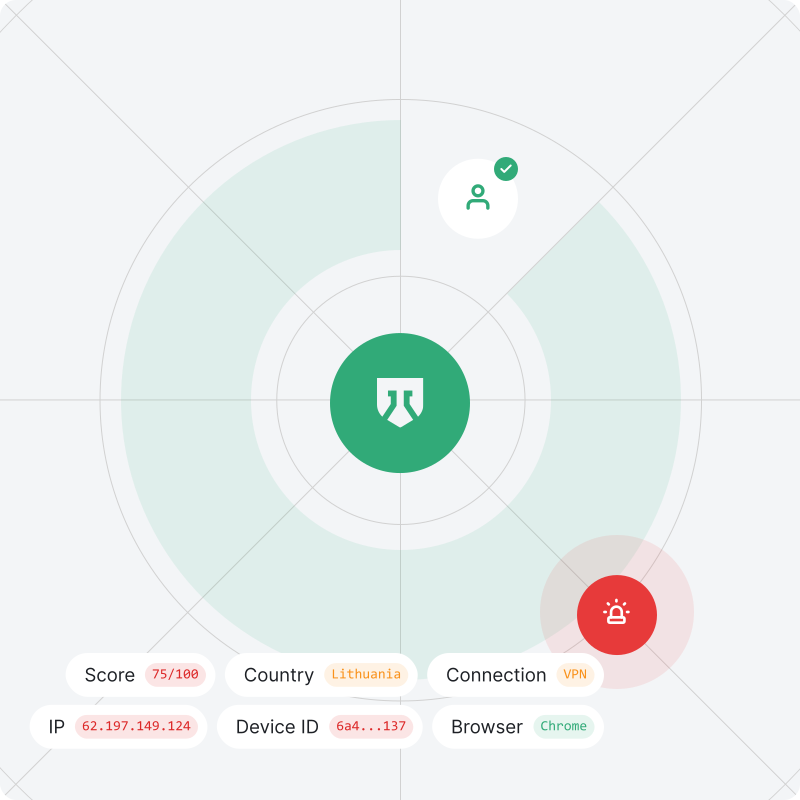
Detect automated login attempts exploiting stolen credentials
Identify logins from unfamiliar connections before access is granted
Prevent financial losses, protect brand reputation, and build trust with customers and partners
Trigger step-up authentication only for high-risk logins, leaving legitimate users unaffected
ShieldLabs recognizes the real visitor behind every anonymous session, so your team can flag unauthorized access in real time
Identify returning visitors and users across sessions, cleared cookies, rotated IP and incognito mode
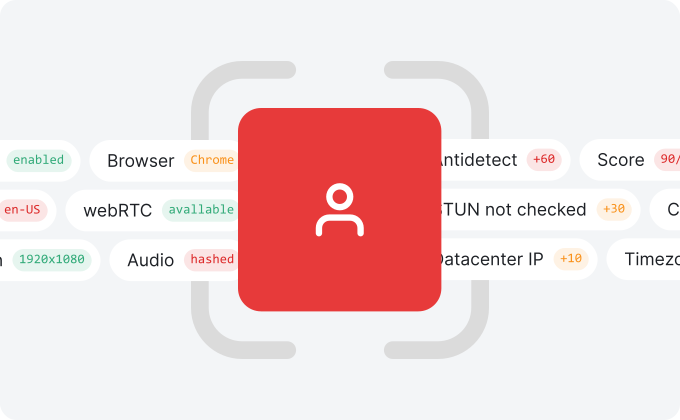
Detection of VPN, proxy, Tor, anti-detect browser, geolocation spoofing, IP reputation and other risk signals on every visit, with 99.9% risk signal detection accuracy
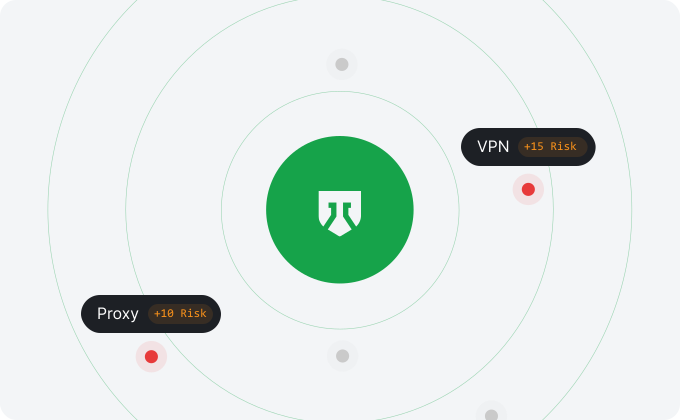
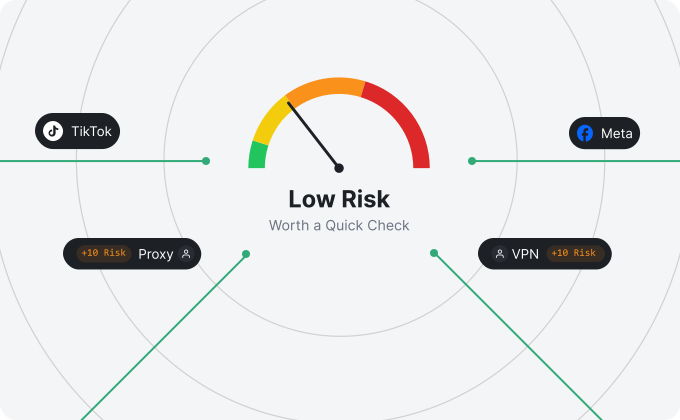
A ready-to-use score reflecting the risk of each visit, with the weight of every signal behind it
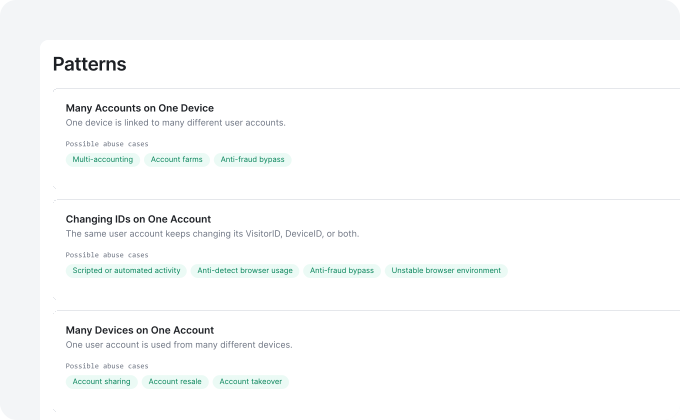
High-Risk Events detected out of the box: multi-accounting, account sharing, impossible travel and account takeover, each with Medium or High confidence
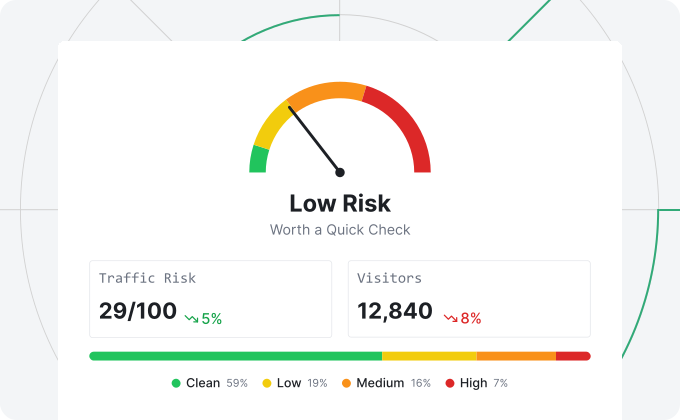
See how much of your traffic is masked, with an overall quality score and a breakdown of the sources sending your visits
Stop account takeover fraud before it triggers chargebacks, exposes user data, or damages platform trust
Accurate Identification helps prevent unauthorized account access before fraudulent activity begins
Account takeover is detected out of the box as a High-Risk Event, with Medium or High confidence
Per-session signal breakdowns and High-Risk Events give you the data to triage high-risk logins
Ready risk score helps apply step-up authentication only to suspicious logins
Easily integrate into any login or authentication flow
Get 5,000 free identifications
It identifies every visitor and returns their risk signals and a risk score
See how much of your traffic is masked, with an overall traffic score
Get the risk score, risk signals and High-Risk Events in your backend to stop fraud and abuse
{
  "request_id": "0c284695-cf0b-4755-8beb-0a2e9536595e",
  "visitor_id": "aa8c616a-8a25-4a5e-bee2-a9a08e5128a4",
  "device_id": "6a45967d-1371-9652-ba99-b01ea3992208",
  "user_hid": "u_9f2a41c7",
  "public_ip": { "ip": "62.197.149.124", "country": "United States" },
  "local_ip": { "ip": "45.83.91.7", "country": "United States" },
  "connection_type": "vpn",
  "os": "Windows",
  "browser": "Chrome",
  "device_type": "desktop",
  "risk_score": 85,
  "signals": [
    { "name": "antidetect_browser", "weight": 60 },
    { "name": "vpn", "weight": 15 },
    { "name": "timezone_mismatch", "weight": 10 }
  ]
}Free 5,000 one-time identifications, with transparent pricing that scales with your needs
Account takeover (ATO) is unauthorized access to and use of an existing user account, where someone logs in as the real account owner using stolen credentials. Unlike account creation fraud, no new account is involved, the existing user relationship is exploited.
ShieldLabs detects account takeover directly as a High-Risk Event when a login comes from an unrecognized device or connection, even when valid credentials are used.
Account takeover fraud is account takeover carried out for financial gain, turning unauthorized account access into money or resaleable data. It is one of the most common forms of online fraud and costs platforms on two fronts.
ShieldLabs scores every visitor and user with risk signals and a 0–100 Risk Score, and flags suspicious access before the session is established.
The clearest red flags for account takeover are a login from an unfamiliar device or connection paired with anomalies the real owner wouldn't produce. Most ATO attempts show one or more of the following.
ShieldLabs surfaces all of these through 300+ signals analyzed on every login attempt, and detects account takeover and impossible travel directly as High-Risk Events.
ShieldLabs detects account takeover by assigning a persistent identifier to every visitor and user, then flagging logins that come from a device or connection never previously tied to that account. The identifier survives cookie clearing and IP changes, so a returning fraudster can't look like a fresh user.
ShieldLabs delivers the resulting Risk Score and signal breakdown via the analytics dashboard, API, and Webhooks, so you can act on the result in your backend.
Credential stuffing is an automated method where stolen username and password pairs from data breaches are tested against a target platform at scale. It works because people reuse the same passwords across multiple services, so a fraction of stolen pairs unlock accounts on the target.
ShieldLabs flags credential stuffing through risk signals on the bulk login attempts and anonymized connections behind it, and detects any resulting account takeover as a High-Risk Event.
ShieldLabs flags risky logins and helps block fraudulent and abusive traffic. On every login it returns a Risk Score, risk signals and High-Risk Events, and you choose the action for each case.
ShieldLabs includes 5,000 free identifications, so you can see the results on your own traffic first.
MFA and ShieldLabs solve different parts of the login problem: MFA verifies the person holds a second factor, while ShieldLabs assesses whether the login attempt itself looks suspicious. They are complementary, not alternatives.
ShieldLabs decides when to trigger MFA, rather than replacing it, keeping low-risk logins frictionless and reserving the extra step for sessions that need it.
Common account takeover examples are credential stuffing, phishing, session hijacking, and SIM swapping, each ending with a login from a device or connection the real owner never used. The mechanics differ but the outcome is the same: someone other than the owner gains access.
ShieldLabs detects these the same way regardless of method, as an account takeover High-Risk Event, by recognizing the unrecognized device or connection behind the login, often paired with fraudulent purchases or fund transfers right after access.
Account compromise detection is the practice of identifying when a legitimate account is being used by someone other than its owner. Unlike fraudulent-transaction detection, it operates at the login level rather than waiting for a payment to go wrong.
ShieldLabs detects account compromise on every login by analyzing 300+ device, OS, browser, IP, and network signals and flagging sessions that deviate from the account's established identity.
Account takeover losses reached 15.6 billion USD in the US in 2024, with 2025 projections near 17 billion USD, making ATO one of the fastest-growing categories of online fraud. The trend lines all point in the same direction.
ShieldLabs works at the device and signal level, surfacing the login anomalies that credential-only defenses miss.
ATO prevention is the set of technical measures that keep unauthorized users out of existing accounts, and it sits within broader account fraud prevention. The defining trait is that it works at the login level, not after a transaction.
ShieldLabs implements ATO prevention by assigning persistent identification to every visitor and scoring 300+ signals on every login, flagging suspicious access on the first visit.
Account takeover protection is the ongoing capability to detect unauthorized account access across all login attempts, so suspicious logins can be challenged or denied. It differs from one-time verification by monitoring every login continuously, not just at account creation.
ShieldLabs provides account takeover protection by scoring every login from 0 to 100 and detecting account takeover as a High-Risk Event when an attempt deviates from the user's established identity.