

How to detect betting bots on sportsbooks, casinos, and poker sites

Last updated on September 25, 2026 · 10 min read
To detect betting bots, operators read the signals a script cannot fake cheaply: automation traces in the browser at sign-up and login, many accounts tied to one device or one datacenter network, bet timing no person produces, and request patterns on odds pages that look like scraping. Scored together, those signals separate a bot from a fast, skilled human.
Bots are no longer the exception. Automated traffic made up 51% of all web traffic in 2024, and bad bots alone accounted for 37%, according to Imperva's 2025 Bad Bot Report, which lists what those bots do to casinos and sports betting sites: account takeover, odds scraping, and account creation for promotion abuse. For teams trying to stop fraudsters on sportsbooks and poker rooms, the question is no longer whether betting bots are present. It is which kinds, where they enter, and what each one costs.
Key takeaways
- A betting bot is software that watches odds, places wagers, or plays hands without a person deciding each action. Some betting exchanges allow automation through their APIs; most sportsbooks, casinos, and poker rooms prohibit it in their terms.
- Operators face five kinds: odds scrapers, arbitrage and value-betting bots, poker bots and real-time assistance, account-creation bots that farm bonuses, and credential-stuffing bots that take over real accounts.
- The strongest tells are the ones a bot cannot reset per account: automation traces in the browser, the same device behind many accounts, datacenter and proxy networks, and timing that is too fast or too regular.
- Detection works best at four checkpoints: sign-up, login, bet placement, and withdrawal. Catching a bot at sign-up costs far less than unwinding its winnings later.
- The response should be graduated: rate-limit, step up, cap stakes, hold withdrawals, and close linked accounts, with refunds to players who played against a bot.
What is a betting bot?
A betting bot is software that performs betting actions on its own. It monitors prices, decides when one is worth taking, and places the bet or plays the hand without a person clicking each time. The term covers everything from a script that refreshes an odds page every second to a system that runs hundreds of accounts across several operators at once.
Whether a bot is allowed depends on where it runs. Betfair's Exchange API lets customers build tools that read markets and place bets programmatically, so automation is part of how a betting exchange works. A sportsbook sits on the other side of the line: FanDuel's terms forbid using "any robot, spider, scraper, sniping software or other automated means to access the Service" without written permission, and poker rooms ban both bots and real-time assistance tools outright. The same code that is a legitimate trading tool on an exchange is a terms violation on a sportsbook.
What makes a bot a problem is not automation as such. It is automation used to take a price before the book can move it, to claim an offer many times over, to sit at a table that real players believe is human, or to test stolen passwords at scale. Wikipedia's entry on gambling bots describes the core mechanic well: software that uses a site's interface to speed up placing bets based on a strategy, faster than any person could.
The five kinds of betting bots operators face
Not every bot wants the same thing, so they show up in different places and leave different traces. Sorting them by goal is the fastest way to decide where to look.
| Bot type | What it does | Where it shows up | What it costs the operator |
|---|---|---|---|
| Odds scraper | Pulls prices from pages or the API at high frequency | Odds and event pages, public endpoints | Server load, exposure on stale lines, resold data |
| Arbitrage and value-betting bot | Places a bet the moment a price is out of line with the market | Bet placement, often within seconds of a price change | Sharp action on mispriced lines at scale |
| Poker bot or real-time assistance | Plays hands, or feeds a human solver advice during play | Cash tables and tournaments, often many tables at once | Winnings taken from real players, lost player trust |
| Account-creation bot | Opens accounts in bulk to claim welcome offers and referral rewards | Registration and bonus claims | Bonus budget paid to one operator many times |
| Credential-stuffing bot | Tests leaked email and password pairs against the login form | Login endpoint | Taken-over accounts, drained balances, chargebacks |
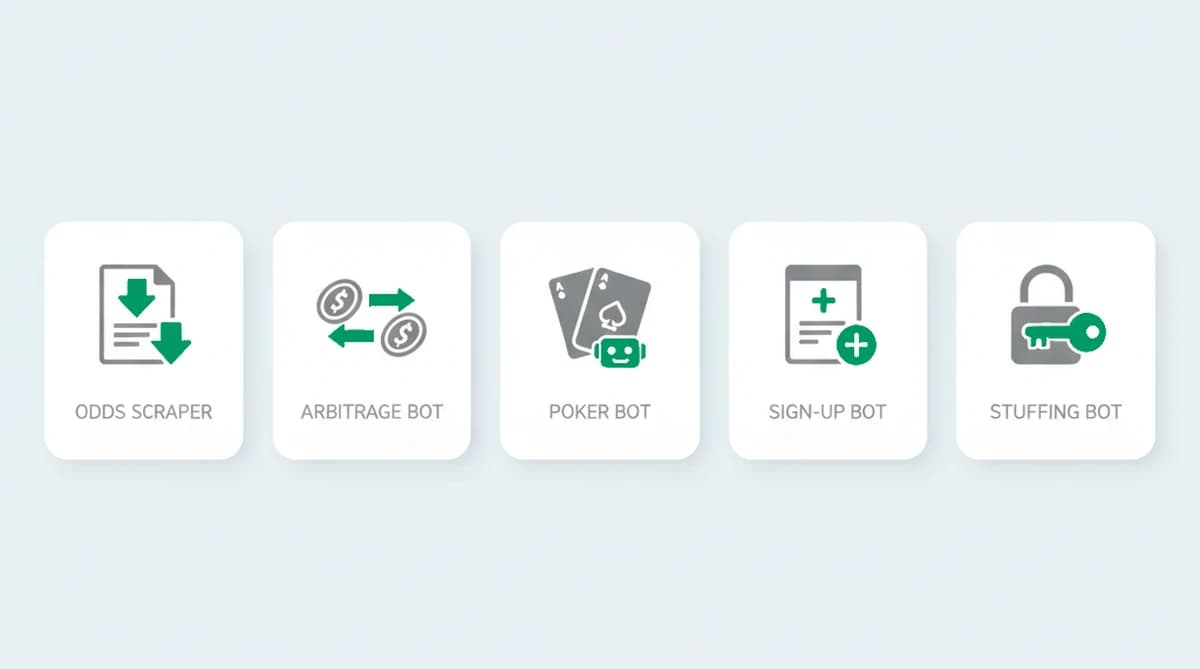
The first two are about price. A sportsbook publishes thousands of lines, and a scraper paired with an arbitrage engine only needs one of them to lag the market for a few seconds. The third is about fairness at the table, where a bot does not need a pricing error at all; it just needs to play tighter and longer than the people it sits with.
The last two are about identity. An account-creation bot is the automation layer behind bonus abuse in iGaming: the same person claiming the same offer through dozens of accounts that each look new. A credential-stuffing bot does not create accounts at all; it takes over existing ones with passwords leaked elsewhere and then places bets or withdraws the balance.
How betting bots avoid detection
Bot operators know the first checks every operator runs, so they build around them. The common techniques:
- Residential and datacenter proxies. Rotating the IP address on every request defeats rate limits and IP blocklists. A pool of residential proxies makes the traffic look like it comes from home broadband.
- Anti-detect browsers. Each account runs in its own browser profile with rewritten device details, so a farm of fifty accounts presents fifty different-looking devices. Anti-detect browser detection has to see through the rewrite, not just read the values.
- Patched headless browsers. Automation frameworks leave traces, and bot builders patch the obvious ones. The headless browser detection that catches them looks for what the patch missed rather than one flag.
- Human-like timing. Random delays between clicks, varied bet sizes, and scripted breaks are cheap to add, and newer bots use AI models to vary their play.
- Real accounts with borrowed identities. A bot that runs on accounts opened in other people's names passes identity checks, because each person is real. What they share is the device and network doing the work.
Each technique defeats one layer. None of them defeats every layer at once, which is why the signals below work in combination.
The signals that expose betting bots
Bots give themselves away through what they cannot reissue for every account and every request: the way automation touches a browser, the device doing the work, the network it rides, and timing that stays too consistent for too long.
| Signal | What it suggests | Strength |
|---|---|---|
| Browser automation traces or a headless browser at sign-up or login | A script is driving the session | High |
| An anti-detect browser or a device reporting conflicting details | A rewritten profile hiding a shared device | High |
| The same device behind many accounts | One operator running an account farm | High |
| Datacenter, proxy, or VPN connection on a betting session | Network cover for automation or a masked location | Medium-High |
| Bets placed within seconds of a price change, again and again | An arbitrage or value-betting engine | Medium-High |
| Reaction times and stake sizes that barely vary | Automated decisions rather than a person | Medium-High |
| Sessions running around the clock, or more tables than a person can follow | Poker or casino automation | Medium |
| Many failed logins across different accounts from one source | Credential stuffing | High |
| Requests for odds far faster than a person reads them | Odds scraping | Medium |
A skilled bettor can trip one of these. A professional who is quick on in-play markets will bet fast; a grinder might play many tables. What a person rarely does is trip several at once: a headless browser, on a datacenter IP, behind the same device as forty other accounts, betting within two seconds of every line move.
How to detect betting bots: a playbook for operators
Detection is most effective, and cheapest, at four checkpoints in the player lifecycle. Each one catches a different kind of bot before it costs money.
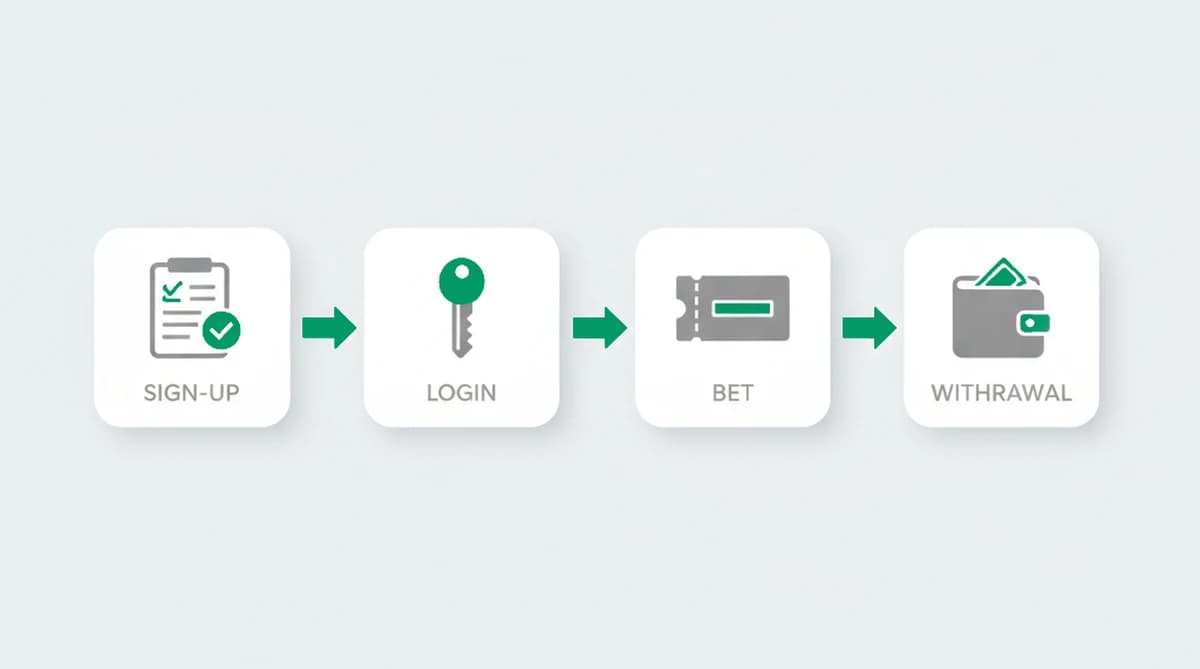
- At sign-up, read the device and the network. Check for browser automation, headless browsers, and anti-detect profiles, and compare the device against existing accounts. Account-creation bots are caught here, before a bonus is credited and before a farm grows.
- At login, watch for stuffing and takeover. Many failed attempts across different usernames from one device or network is credential stuffing. A successful login from a new device, in a new country, right after a password reset is a takeover pattern worth a step-up check. Account takeover detection belongs at this checkpoint.
- At bet placement, look at timing and linkage. Compare how fast bets land after a price change, how uniform the stakes are, and whether the account is linked to others on the same device. Pair this with rate limits on odds endpoints so scrapers pay for every request.
- At withdrawal, hold what is linked. An account that bet a bonus through once and withdrew, or that shares a device with a farm already flagged, should wait for review before money leaves.
For poker, add table-level checks: two accounts on the same device should never sit at the same table, and a player's decision times, table count, and session length can be compared against human norms.
The response is graduated rather than binary. A first flag might slow the account down with rate limits or a verification step. A strong, multi-signal case justifies capping stakes, holding a withdrawal, and closing every linked account. The reason to keep the ladder is the skilled human who trips one signal: you want them betting, not banned.
Poker bots and real-time assistance
Poker is where bots are most visible to players, because every pot a bot wins comes out of someone's stack. Rooms have started publishing what they find, and the numbers are steady rather than shrinking. CoinPoker banned 98 bot-linked accounts in January 2026 and refunded 156,446 USD to 1,360 players, with most of the bots found in cash games with buy-ins from 50 to 200 USD. A year earlier, partypoker reported closing 291 fraudulent accounts in 2024, its highest number since 2021.
Two things set poker apart. First, a bot there does not need a pricing error, only discipline: it plays a solid strategy for hours without tilt or fatigue. Second, real-time assistance blurs the line between bot and person, because a human clicks the buttons while software decides the play. Both show up as decision times that are too consistent and a style that matches known solver output, and both are usually paired with the account-farm pattern: several accounts, one device, rotating through the same tables.
Rooms that publish enforcement tend to do two things after a ban: confiscate the balance and return it to the players who sat with the bot. That refund step is also the best argument for catching bots early. Every hand a bot plays is a hand the room may later have to unwind.
Are betting bots legal?
In most regulated markets, using a betting bot is a breach of the operator's terms rather than a crime. The consequence is the account: suspension, confiscation of winnings, and a ban. Exchanges that publish an API are the exception, since they permit automation within their rules. Where bots are used to defraud other players, launder money, or take over accounts that belong to someone else, criminal law can apply, and the details vary by jurisdiction.
For an operator, the legal question matters less than the contractual one. The terms define what is allowed, and detection is what makes the terms enforceable.
How ShieldLabs detects betting bots
ShieldLabs runs on your sign-up, login, and betting pages through one JavaScript snippet, with client and server SDKs, an API, and webhooks on every plan. It brings enterprise-level functionality without enterprise pricing to sportsbooks, casinos, and poker rooms that need to separate bots from players on the first visit.
Bot and AI traffic detection separates verified bots, unverified bots, and AI agents, and flags browser automation and headless browsers as named risk signals, alongside anti-detect browsers, VPNs, proxies, Tor, and datacenter connections. ShieldLabs collects 300+ device and network signals on every visit and cross-checks them, with 99.9% risk signal detection accuracy.
Behind every session is persistent identification with 99.9% identification accuracy that survives cleared cookies, incognito windows, new browser profiles, and IP rotation. That is what ties an account farm back to the device running it. ShieldLabs detects multi-accounting and account takeover directly as High-Risk Events, each with Medium or High confidence, so a bot farm and a credential-stuffing run are flagged as what they are, not left as raw signals to assemble.
Each visit returns a risk score from 0 to 100 with the named signals behind it, delivered through the API or a webhook. ShieldLabs stops bot-driven abuse and helps block fraudulent and abusive traffic, and you choose the action for each case: rate-limit a scraper, step up a login, cap a sharp bot's stakes, or close a farm and refund the players it sat with. The same detection covers iGaming and gaming platforms. The free tier covers 5,000 identifications, one time, and paid plans start from 79 USD a month, with chat and email support on every plan.
Sources
- Imperva: 2025 Bad Bot Report (2025)
- Betfair Developer Program: Exchange API
- FanDuel: Terms of Use
- Wikipedia: Gambling bot
- CoinPoker: CoinPoker Bans 98 Poker Bots and Refunds 156K USD to Players (January 2026)
- Poker Industry PRO: PartyPoker Caught More Bots in 2024 Than Previous Two Years (April 2025)
Frequently asked questions
- Do betting bots actually work?
- A betting bot does exactly what it is programmed to do, only faster. It does not create an edge on its own: a bot running a losing strategy loses money faster. Where bots make money is where speed and scale are the edge, such as catching a stale price before a sportsbook moves its line, placing the same arbitrage across many books at once, farming a welcome bonus across dozens of accounts, or playing thousands of poker hands without fatigue. That is also why operators treat them as a fraud problem rather than a strategy question.
- How to tell if a player is a bot?
- Look for behavior no person sustains and for traces automation leaves behind. At the table or the betting screen, that means reaction times that barely vary, identical bet sizing, sessions that run around the clock, and play across more tables or markets than a person can follow. In the browser, it means automation frameworks, headless browsers, and devices that report conflicting details. On the network, it means datacenter or proxy connections and many accounts sharing one device. No single tell proves it; several together do.
- Is it illegal to use AI to play online poker?
- It depends on the jurisdiction, but in most places using a bot or real-time assistance software is a breach of the poker room's terms rather than a crime. Rooms treat it as cheating: the usual outcome is a permanent ban, confiscation of the balance, and a refund of the winnings to the players who faced the bot. Where bots are used to defraud other players or launder money, criminal law can apply, so the answer for any specific case is a question for a lawyer in that market.
- What is odds scraping?
- Odds scraping is the automated collection of prices from a sportsbook's pages or API, usually at high frequency. Scrapers feed arbitrage and value-betting tools that compare prices across many books and alert the moment one is out of line, and some resell the data. The cost to the operator is server load, exposure on stale lines, and a stream of sharp bets that arrive seconds after a price is published.
- Does ShieldLabs block betting bots automatically?
- ShieldLabs detects bots and helps block fraudulent and abusive traffic, and you choose the action for each case. Every sign-up, login, and bet returns a risk score from 0 to 100 with named risk signals, including browser automation, headless browsers, anti-detect browsers, and datacenter or proxy connections, and multi-accounting and account takeover are detected directly. A flagged session can be rate-limited, stepped up, limited, or closed.
Related articles

How to stop multi-accounting in online gambling: sportsbooks, poker, and casinos
How to stop multi-accounting in online gambling: why players open multiple betting accounts, the signals that link them to one person, and an operator playbook.


First Request Detection With HTTP/2 Header Fingerprints for Defenders
HTTP/2 aware header fingerprinting for defenders. Use SETTINGS, WINDOW_UPDATE and pseudo header order to spot impersonation quickly.


5-Stage Referral Fraud Detection for Product & Engineering Teams
Practical 5-stage playbook for product & engineering teams: combine explainable signals, graph-based scoring, and event holds to stop referral fraud.