

How to prevent bonus abuse in iGaming without an ID gate

Last updated on October 21, 2026 · 11 min read
To prevent bonus abuse, operators watch for the signals that reveal one person behind many accounts: several sign-ups tied to the same persistent device or network, near-identical contact or payment details, a claim-then-minimum-bet-then-withdraw cycle, and the use of an anti-detect browser or a VPN to disguise the connection. The strongest of these signals is device and network identity, because it links accounts even after the cookie is cleared, the email is changed, or the IP is rotated. Read those signals at the moment a bonus is claimed, score how new the player really is, and choose the action for each claim, and bonus abuse stops being cheap to run.
Key takeaways
- Bonus abuse is one user claiming the same promotion many times under accounts built to look like separate new players. It quietly turns a player-acquisition budget into a payout to a farm.
- The signals that expose it are the consistency an abuser cannot hide: the same device, the same network, reused payment details, and the claim-and-cash-out cycle, even when the email and IP change every time.
- Email, IP, and cookie checks miss it because all three are trivial to swap. The device and network behind each claim are what stay recognizable.
- You can detect multiple accounts at the device and network layer without forcing every new player through an identity-document check, which keeps friction off real players.
- No single check is enough. Device deduplication, network intelligence, velocity limits, and a risk score work together, and you choose the action for each risky claim.
What is bonus abuse?
Bonus abuse is the practice of claiming a promotional offer more times than the rules allow, by creating accounts that each look like a separate first-time player. The offer is usually a welcome bonus, a deposit match, free spins, or free bets, and the move is always the same: one user, many fabricated identities, each collecting the offer once so that together they collect it many times.
It travels under a few names. In ecommerce and SaaS the same mechanic is called promo abuse, where the prize is a coupon or a referral payout instead of a casino bonus. A person who does it is a bonus abuser.
And it sits next to bonus hunting, the legitimate-but-aggressive cousin covered further down, where the line is identity count rather than enthusiasm. The shared root, one person presenting as many, is why the detection approach carries across all of them.
Left unchecked it is expensive twice over. The welcome-offer budget meant to win real players turns into a recurring payout to one user, and the pile of fake accounts left behind distorts the acquisition metrics a growth team steers by, so cost per acquisition reads cheaper than it is and the next campaign chases the wrong players.
The signals that reveal bonus abuse
A bonus abuser gives themselves away through what they cannot reissue for every account. The email is disposable, the IP is rentable, the cookie clears in a click, but the device making the claim and the network it rides stay the same from one "new player" to the next. So the useful read is never one signal in isolation, it is how many independent signals land on the same claimant. The ones that carry the most weight at a bonus claim, and the risk each points to:
| Signal at the bonus claim | What it suggests | Risk direction |
|---|---|---|
| The same persistent device behind several player accounts | one person running many accounts | High |
| The same network or connection behind many "new" players | a farm or syndicate working from one place | High |
| An anti-detect browser or a spoofed device profile | a profile rebuilt to look like a fresh player | High |
| A VPN, anonymous proxy, or datacenter connection | network cover over the real origin | High |
| A registration, payment, and play location that do not line up | a masked origin, or one user working accounts across borrowed locations | Medium-High |
| A claim, a minimum bet, then an immediate withdrawal | the bonus cycle, not real play | Medium-High |
| Unusual frequency of bonus claims from one footprint | automation or a hunter working at scale | Medium-High |
| A reused payment instrument or withdrawal destination across accounts | the same hand funding and cashing out many accounts | Medium |
| Near-identical contact or address details across accounts | accounts minted from one template | Medium |
One detail is worth drawing out, because it is where abusers get lazy: they rarely invent genuinely fresh details for every account, so contact data tends to arrive as near-clones. Incremented email aliases, the same inbox reused with plus-address or dot variations, and sequential phone numbers are a template showing through, and a template is a pattern an operator can read.
No single row is proof. A real player can use a VPN, and two people in one household can share a network. The read is correlation: a claim that lights up several rows at once, especially a device already seen behind other accounts, is the one to hold. Correlating many weak signals this way is one practical answer to a problem academics have long studied, including the work on detecting fake accounts in large-scale online services presented at USENIX NSDI, which ranked accounts by how likely they were to be fake.
A new email or a rotated IP rewrites the surface of an account but none of the hardware underneath it, which is why a stable device read outlasts every address-based check.
How bonus abuse works in iGaming
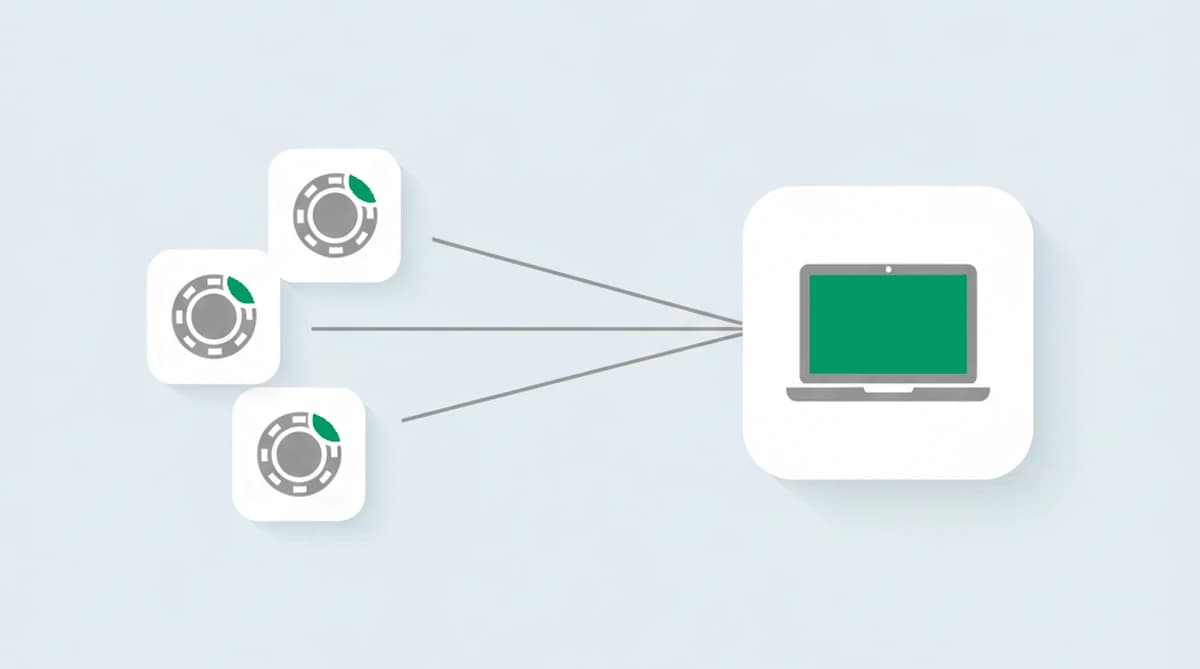
In iGaming and online casinos the offer is rich and the abuse is industrialized, so the vocabulary is its own. The core move is multi-accounting: one person, or a coordinated syndicate, runs many accounts to claim a welcome bonus or reload offer repeatedly. Stripe's 2025 analysis of first-party fraud tied 7.4 percent of signups at AI companies to suspected multi-account abuse, and a casino welcome bonus is one of the richest versions of that target.
On top of that sit a few recognizable patterns. There is the claim-and-cash-out cycle, where an account takes a bonus, places the minimum bet the terms require, withdraws, and then goes quiet, since a real player keeps going while an abused account usually falls dormant the moment the bonus value is out. There is bonus arbitrage, working the math of an offer across accounts so the house edge is covered. And there are farms and click-farms that mint accounts in bulk, often scripted, to harvest no-deposit and sign-up offers at scale.
The bonus types abusers target
Different offers attract different abuse, but the most-targeted are predictable:
- Sign-up and no-deposit bonuses, because they pay out before any deposit risk.
- Deposit-match bonuses, worked with the minimum deposit and a fast withdrawal.
- Free spins and free bets, harvested across many accounts.
- Refer-a-friend payouts, self-referred between a user's own fake accounts.
- Loyalty and reload offers, farmed by accounts aged just enough to qualify.
The offer changes, the underlying tell does not: many "new" players that resolve back to one device, one network, or one payment trail.
How do casinos know if you have multiple accounts?
Casinos know because they stop trusting the name and email on an account and start reading the device and network behind it. A new inbox, a cleared browser, and a fresh IP change everything on the surface, but the machine making the deposit, the connection it arrives on, and reused payment details stay recognizable, so accounts that look unrelated still line up.
The layer that does the work is persistent device and network identification. It derives a stable identifier from the way a device and its connection present themselves, and that identifier survives the exact moves an abuser relies on: a new email, cleared cookies, an incognito window, even a VPN. When several accounts resolve to the same identifier, that link is the detection.
We tested how far that identifier holds by throwing the abuser's own moves at it, a fresh inbox, wiped cookies, a private window, then a VPN layered on top, and it survived each one, because it is derived from how the device and connection present themselves rather than from anything a player can reset. The scale is real: Stripe's analysis of first-party fraud put suspected multi-account abuse at 7.4 percent of signups, and a casino welcome bonus is one of the richest versions of that target. Reading it got more reliable, not less, in 2022, when Firefox turned on Total Cookie Protection by default and address-level tracking lost even more ground to the device underneath.
The important part for player experience is that this happens in the background, from signals the device and browser already expose, so it can flag a multi-accounting pattern without asking an honest new player to upload an identity document. The deeper mechanics of linking accounts to one device are the same ones behind multi-accounting prevention in any industry.
The online-gambling multi-accounting guide separates sportsbook, poker and casino scenarios. The bonus abuse detection workflow focuses on the evidence needed around an offer claim.
Where bonus hunting ends and bonus abuse begins
A detection setup that treats every aggressive player as a fraudster will punish some of your best customers, so the line matters. A bonus hunter is one real person who works promotions hard but honestly: they read the terms, clear the wagering requirement, take a welcome offer once, and move to the next book. At the sharp end this becomes matched betting and arbitrage, a single account squeezing the math of an offer inside its rules. You may not love it, and you can write your terms to limit it, but it is one identity acting once, which makes it a policy call rather than a fraud signal.
What detection is actually built to catch is the jump from one identity to many. When a single person stands up a row of accounts to take the same welcome bonus again and again, or runs a scripted farm against a no-deposit offer, the issue is no longer a keen player, it is manufactured identity at volume.
The question stops being how hard someone plays an offer and becomes how many accounts trace back to one person. Drawing that line cleanly is what lets you act on the farm while leaving the sharp, honest player alone, and it is why the right tool detects multi-accounting directly and lets you choose the action for each case.
How to prevent bonus abuse: the detection playbook
You prevent bonus abuse by stacking a few inexpensive checks around the claim rather than trusting any single one, so that beating all of them at once stops being worth an abuser's time. None of the controls below is enough alone; together they move abuse from cheap-and-automatic to slow-and-not-worth-it.
- Deduplicate on the device and network, not the credential. Tie each claim to the device and connection making it, so a new inbox does not read as a new player. This is the layer that stays put while the email, the cookie, and the IP are all being swapped underneath it.
- Read the risk signals. An anti-detect browser, a VPN, an anonymous proxy, or a datacenter connection on a bonus claim is the cover an abuser uses to look like many people. Surface it as a signal you act on.
- Cap claim velocity. Rate-limit bonus claims per device, network, and footprint, so one machine cannot work through dozens of accounts in an afternoon even when each email checks out.
- Gate the cashable value. Hold a bonus behind the wagering or activity bar your terms already define, so a claim-and-cash-out cycle never reaches the withdrawable part on day one.
- Score the claim, then act on it. Combine the signals into a single risk score at the moment of the claim and act on the high ones, instead of finding the pattern later in a payout report.
Score, then choose the action
The thread through all of it: detection flags the risky claims, and you choose the action for each case. A good detection layer returns a risk score, the named signals behind it, and the multi-account events it detects. You read that result and choose whether a given bonus claim is credited normally, held for a closer look, or stepped up to a verification check.
That is what keeps a real player who happens to use a VPN from being treated like an abuser, while the bonus farm gets held.
Detect at the device layer, before you ask for an ID
The default reflex is to bolt identity verification onto the front door, but a document check taxes every honest new player to catch a few abusers, and it is exactly the friction that hurts conversion. Reading the device and network first inverts that. You catch multi-accounting silently, on signals the device and browser already expose, and reserve a heavier identity step for the small set of claims that actually look risky. Detection at the device layer is how you cut abuse without turning sign-up into an obstacle course.
Connect bonus eligibility to the deposit and withdrawal records
Bonus abuse monitoring needs a traceable claim: the offer version, eligible account, acceptance time, qualifying deposit and eventual withdrawal. When a promotion includes wagering conditions, record how qualifying activity is calculated and how corrections are handled. A payment approval answers a different question from whether the offer can be claimed.
Use device and account relationships to prioritize the claims that deserve review. Repeated benefit use across linked accounts matters more than a shared network alone. Keep gambling multi-accounting investigations connected to the bonus record rather than maintaining a separate, unexplained blocklist.
Preventing bonus abuse with ShieldLabs
ShieldLabs runs on your sign-up or bonus-claim page through one JavaScript snippet, and it risk-scores every visitor on the first visit, so you have a read on the player behind a claim before you credit the bonus. At the center is persistent identification that ties a "fresh" account back to a device already seen, even after the user switches email, clears cookies, and rotates IP. It does its work in the background, with no friction for a real player and no identity document required.
Each visit returns a risk score from 0 to 100 with the risk signals behind it, named rather than hidden in a black box:
{
  "event_type": "identification.scored",
  "schema_version": "2026-06-01",
  "created_at": "2026-06-11T09:42:00Z",
  "data": {
    "request_id": "30f524eb-3111-499f-a3a3-21c985db4d3f",
    "visitor_id": "3e1f05ff-ddd6-4ca1-b0c8-968105040a4b",
    "device_id": "c3aa0908-f618-4321-b365-55f23394e44a",
    "connection_type": "vpn",
    "risk_score": 85,
    "detection_flags": { "anti_detect_browser": true, "vpn": true },
    "observed_at": "2026-06-11T09:42:00Z"
  }
}
You read that response, or the same payload delivered to a webhook, and choose the action for each risky claim: credit a clean player normally, hold a high-scoring bonus for review, or step a borderline one up to a check. The same device_id reappearing behind a "new" account is the link a fresh email was supposed to break.
Across claims, ShieldLabs detects four High-Risk Events, Multi-accounting, Account sharing, Impossible travel, and Account takeover, each with Medium or High confidence, and shows which accounts trace back to one device, so your team can watch a bonus farm as a trend in the analytics dashboard rather than chasing claims one at a time.
ShieldLabs scores every visitor, names the signals behind that score, and helps block fraudulent and abusive bonus claims. Because every score comes with named signals rather than a sealed verdict, you can always say why a given claim was held. The same identity layer carries over to bonus, promo, and coupon abuse across other offer types and to bonus abuse prevention as a managed solution.
Sources
- Wikipedia: Matched betting
- Cao, Sirivianos, Yang, Pregueiro: Aiding the Detection of Fake Accounts in Large Scale Social Online Services (USENIX NSDI, 2012)
- Stripe: Analyzing first-party fraud trends: account, free-trial and refund abuse (2025)
Recommended
Frequently asked questions
- What is a bonus abuser?
- A bonus abuser is someone who claims a promotion more times than the rules permit by registering as several different players. Instead of one account taking a welcome offer once, the same person runs a cluster of accounts, often built with throwaway emails and masked connections, so each one collects the offer and the combined payout lands with a single user. What marks them out is not how they play but that many of their accounts trace back to one device, network, or payment trail.
- How do bonus abusers hide their identity?
- They lean on tools that reset the parts of an account a check usually trusts. A fresh email and a cleared browser make each sign-up look new, an anti-detect browser rewrites the values a site reads, and a VPN, proxy, or datacenter connection hides the real origin. What none of those reset cleanly is the device and the network path underneath, so a stable device read still links the accounts back together, and the effort to look new becomes a signal in its own right.
- What is the difference between device fingerprinting and IP or cookie checks?
- An IP and a cookie are both easy to change, so a check built on them treats every cleared browser or rotated address as a brand-new player. Device fingerprinting derives a stable identifier from the way a device and its connection present themselves, which holds steady when the email, the cookie, and the IP all change. That persistence is why it catches the multi-accounting those lighter checks miss.
- What is the claim-and-cash-out cycle in bonus abuse?
- It is the pattern of an account that exists only to extract a bonus: claim the offer, place the minimum bet the terms require, withdraw, and then go dormant. A real player keeps playing, so an account that goes quiet the moment the bonus value is out is behaving like a harvested one, and a run of accounts that all follow that arc, especially from one device or network, is one of the clearer tells to read.
- Is bonus abuse illegal?
- In most cases bonus abuse is a breach of a casino's terms, not a crime. A welcome bonus comes with rules you accept when you claim it, and opening extra accounts to take it again breaks that agreement rather than a law, so the usual consequences are account-level: the operator voids the bonus, confiscates the related winnings, closes the accounts, and bars future sign-ups. It becomes criminal fraud when stolen identities, stolen cards, or stolen payment details fund the accounts, or when an organized syndicate runs it at scale. So a single player bending the bonus rules is something an operator polices through its terms, while identity theft or card fraud layered on top is what brings in the law.
- How does ShieldLabs help prevent bonus abuse?
- ShieldLabs adds one JavaScript snippet to your claim or sign-up page and, on the first visit, returns a risk score from 0 to 100 with the named risk signals and persistent identification behind it. That identifier ties a fresh claim back to a device already seen even after a new email and a rotated IP, and the score weighs the signals so you can act on the risky claims. The free tier covers your first 5,000 identifications, enough to watch real risk scores on your own claims before you act on a single claim.
- How do iGaming payment controls and bonus abuse detection work together?
- Payment controls assess deposits and withdrawals, while bonus eligibility checks whether an account qualifies for the offer. Connect the promotion, account, device, deposit and withdrawal records so reviewers can reconstruct a claim. Successful payment authorization does not establish bonus eligibility, and linked accounts require review against the offer terms.
Related articles
The 8 best bonus and promo abuse prevention tools in 2026
The 8 best bonus and promo abuse prevention tools in 2026, how prevention works by linking many bonus claims back to one person, and how to choose.

How to prevent coupon abuse (and tell it from coupon fraud)
How to prevent coupon abuse: what separates it from coupon fraud and everyday couponing, and how merchants catch one shopper using many accounts.
How to prevent free-trial abuse in AI companies: a developer's guide
How AI companies prevent free-trial abuse: the credit-farming economics, the signals that expose a farmed signup, and how to score it at the API.