

Calculate Fraud Detection Pricing With ShieldLabs' 5,000 Free Tier


Last updated on September 30, 2026 · 13 min read
Most fraud detection tools bill by per-identification volume, tiered subscription, or usage-based compute, and a rough rule of thumb is that low-volume sites pay under $100 a month while high-volume operations move into usage-based compute pricing that scales with traffic. ShieldLabs, for reference, publishes a free tier for up to 5,000 identifications, then flat monthly plans at $79, $319, and $799. Knowing which model fits your traffic profile determines whether your bill stays predictable or creeps upward with growth.
TL;DR:
- Small sites with predictable volume should choose tiered subscription plans, as they cover typical traffic without unexpected per-query charges.
- Usage-based pricing for high-volume operations tracks actual compute, which can benefit platforms with fluctuating traffic spikes and avoids upgrading fixed tiers.
- Overage charges often result from traffic spikes, real-time scoring requirements, or additional signals like data enrichment, increasing overall costs unexpectedly.
- Vendors that publish transparent, real-world projected bills based on your actual traffic enable more accurate budgeting before signing a contract.
- Cloud-based solutions generally offer more predictable costs tied to usage, whereas on-premises models involve fixed infrastructure expenses, often making them less flexible for growth.
Table of Contents
- Common pricing models buyers will see
- Primary cost drivers and where hidden fees come from
- How to calculate your monthly cost with worked examples
- How to evaluate plans and choose the best pricing model
- ShieldLabs: published pricing and product facts to test with real traffic
- Comparison of pricing transparency and contract terms among providers
- Pricing implications of on-premises vs cloud-based fraud detection solutions
- Impact of compliance and data privacy regulations on pricing
- Short perspective: when paying more upfront makes financial sense
- Get started: try ShieldLabs' free tier and validate cost on your traffic
- Sources
- FAQ
Common pricing models buyers will see
Fraud detection vendors typically price around one of three billing shapes, and the choice affects both predictability and unit cost as volume grows.
- Per-identification or per-query pricing charges for each visitor lookup or scoring event, which suits low-volume teams but can become expensive without volume discounts as traffic scales.
- Tiered subscription pricing bundles a fixed number of identifications into a monthly rate with overage charges beyond the cap, which tends to favor teams with steady, forecastable traffic.
- Usage or compute-based pricing bills by the hour for model training and hosting, a structure common among vendors offering custom machine learning models rather than a shared detection engine.
- Hybrid pricing layers add-ons such as data storage, premium signal enrichment, or dedicated infrastructure fees on top of a base rate.
Startups and small e-commerce sites generally do best with tiered subscriptions because the included cap covers typical traffic without per-query billing surprises. Scale-ups with unpredictable spikes often prefer usage-based compute pricing, since it flexes with demand rather than forcing an upgrade to the next fixed tier. Enterprises running custom models or requiring dedicated infrastructure tend to negotiate hybrid contracts that combine a base subscription with specific add-ons for support and data retention.
Primary cost drivers and where hidden fees come from
The headline per-unit rate rarely tells the whole story. Several variables push the final invoice higher than the advertised price suggests.
- Volume and traffic spikes: average monthly volume might fit comfortably in a tier, but burst traffic around promotions or seasonal peaks can trigger overage charges.
- Latency and real-time scoring: real-time decisioning requires more compute than batch processing, and vendors often price the two differently.
- Data retention and storage: keeping months of historical identification data for investigations or trend analysis adds ongoing storage fees.
- Premium signals and enrichment: deeper lookups such as anti-detect browser detection or device history enrichment are sometimes billed separately from the base identification fee.
- Support tiering and minimum commitments: onboarding assistance, SLAs, and annual minimums can add a meaningful fixed cost on top of usage.
Pro Tip: Ask any vendor for a 90-day projected bill built from your actual traffic pattern, not just their published rate card, so burst and overage behavior show up before you sign.
How to calculate your monthly cost with worked examples
Estimating a realistic monthly bill starts with three inputs: monthly identification volume, the share of traffic that needs real-time scoring, and how long you need to retain historical data.
- Define your inputs. Pull last month's unique visitor count, note what percentage of decisions happen in real time versus batch, and decide on a retention window based on your investigation or reporting needs.
- Run the small-site example. A site with 100,000 identifications a month sits comfortably within many mid-tier subscription plans, since most tiered vendors set caps well above that volume before overage kicks in.
- Run the high-volume example. A platform processing several million identifications a month typically moves past fixed tiers into usage-based compute pricing, where cost tracks the hours of model inference and hosting consumed rather than a flat per-tier rate.
- Apply the ShieldLabs example. A team starting from zero gets 5,000 free identifications with no card required, then moves to $79 a month once volume exceeds that, stepping up to $319 or $799 as identification volume grows, with cost per identification falling at higher tiers.
- Run a sensitivity check. A 20% increase in monthly identifications can be the difference between staying inside a tier's cap and triggering the next plan level, so it is worth modeling both your average and your peak month before committing.
Fraud costs companies an average of 7.7% of annual revenue globally, which gives buyers a benchmark for weighing detection spend against the revenue currently at risk.
How to evaluate plans and choose the best pricing model
A structured evaluation prevents surprises after signup. Before committing to any plan, work through a short checklist with both your finance and engineering teams.
- Confirm how an "identification" is counted, since definitions vary between a unique visitor, a session, or every API call.
- Request a sample invoice or projected bill based on your actual traffic profile rather than relying on the published rate card alone.
- Ask about overage behavior, minimum commitments, and data egress fees, which rarely appear in the headline price.
- Confirm signal-level transparency and audit logs so your engineering team can see the reasoning behind a score and keep the final decision in your own code.
- Decide between a short pilot and an annual contract based on how much budget predictability your organization needs versus how much flexibility you want while validating results.
Teams evaluating multiple vendors side by side often benefit from a structured comparison of fraud detection software options before narrowing down to a pricing model.
ShieldLabs: published pricing and product facts to test with real traffic
ShieldLabs publishes its pricing rather than gating it behind a sales call: a free tier covers up to 5,000 identifications with no card required, then paid plans run $79, $319, and $799 per month, with cost per identification falling as volume increases and annual billing saving 20 percent.
- Signal depth: detection draws on more than 100 signals covering VPNs, proxies, Tor, Apple Private Relay, datacenter IP ranges, anti-detect browser detection, and automation traffic.
- Persistence: returning visitors are recognized with up to 99% accuracy despite cleared cookies, incognito mode, or months between visits.
- Transparency: every risk score arrives with the signals that produced it, so the result is auditable rather than opaque.
- Setup speed: a JavaScript snippet gets a first signal flowing in about five minutes, with SDKs for Node.js, Python, Go, and PHP alongside an OpenAPI specification.
ShieldLabs provides the score and the signals behind it. What your team does with that score, including any decision to block a session or flag an account, happens in your own code.
Comparison of pricing transparency and contract terms among providers
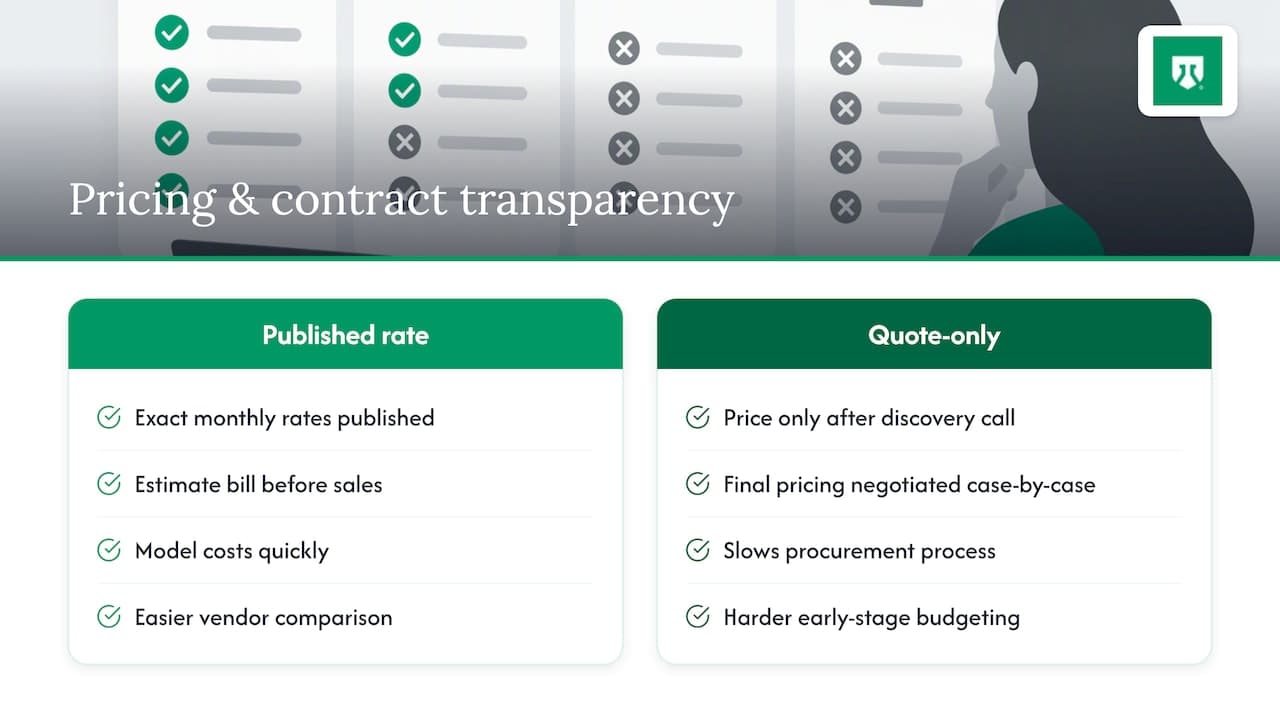
Fraud detection vendors vary widely in how openly they price their products. Some publish exact monthly rates and let a prospective buyer calculate an estimated bill before ever speaking to sales. Others require a discovery call to get any number at all, with final pricing negotiated case by case based on volume, contract length, and feature bundling.
That difference in transparency changes how buyers shop. A published rate card lets a technical team model costs against real traffic and compare vendors on equal footing within an afternoon. A quote-only model, by contrast, means the real comparison only happens after sales conversations with each finalist, which slows procurement and makes early-stage budgeting harder.
Contract terms follow a similar pattern. Some vendors offer month-to-month billing with no minimum commitment, which suits teams still validating whether detection spend is justified by the fraud losses it addresses. Others require annual contracts with minimum volume commitments, often in exchange for a lower effective per-unit rate. Annual commitments tend to make sense once a team has already validated results on a shorter engagement and wants predictable budgeting going forward.
Buyers comparing options should ask each vendor directly whether the published price is final or a starting point for negotiation, and whether overage, support, and onboarding are included or billed separately. The answer often matters more than the headline number itself.
Pricing implications of on-premises vs cloud-based fraud detection solutions
Cloud-based fraud detection is typically billed as a subscription or usage-based service, with the vendor absorbing infrastructure costs and passing them through in the per-identification or per-tier rate. This model has a low upfront cost, since there is no hardware to provision, and it scales up or down with traffic without a separate capacity planning exercise.
On-premises or self-hosted detection shifts costs in the opposite direction. The organization pays for the infrastructure to run the models, the engineering time to maintain them, and the ongoing tuning that a managed vendor would otherwise handle. That structure can make sense for organizations with strict data residency requirements or highly specific model needs, but it usually means a larger fixed cost that does not shrink during low-traffic periods the way a usage-based cloud plan does.
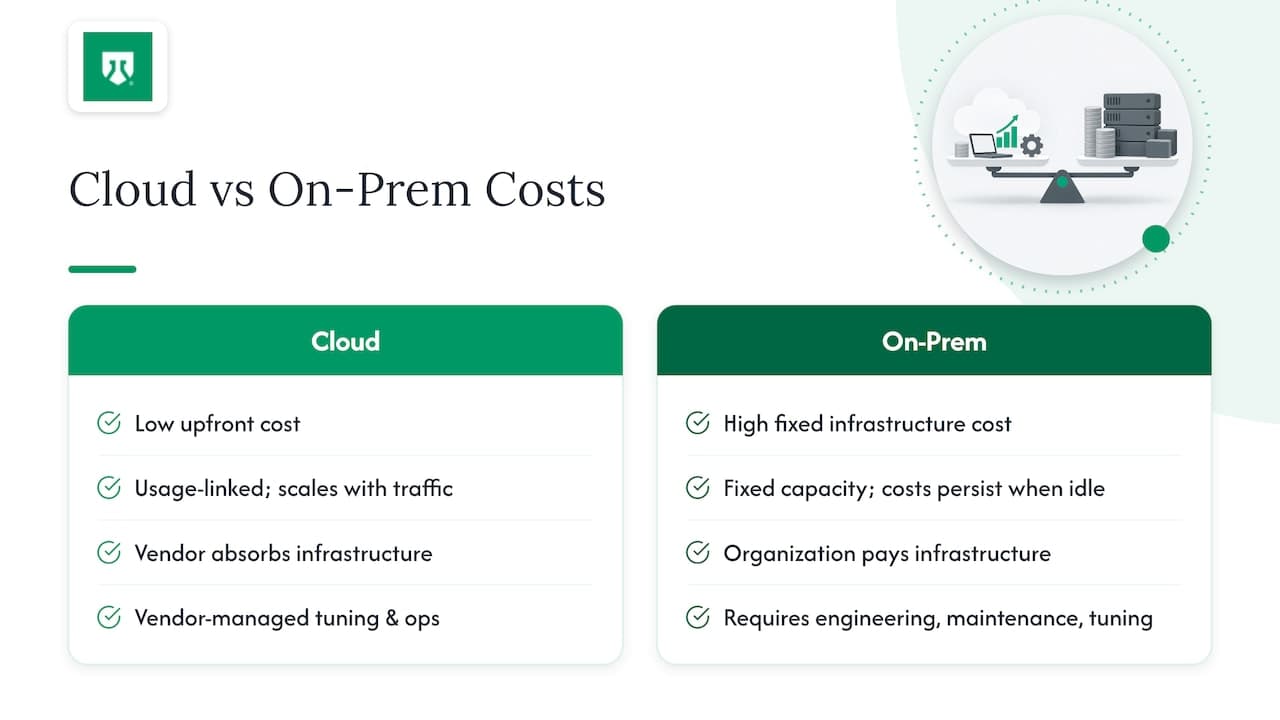
For most growth-stage and enterprise teams outside of specialized industries with hard residency mandates, cloud-based pricing offers a more predictable cost curve tied directly to actual usage. The tradeoff is less control over exactly how models are hosted and tuned, which matters more for organizations with in-house data science teams already building custom detection logic.
Impact of compliance and data privacy regulations on pricing
Data privacy and compliance requirements affect fraud detection pricing indirectly, through what a vendor has to build and maintain to operate across regions, rather than through a separate compliance line item. Vendors serving customers across multiple jurisdictions often need to support data residency options, retention limits, and deletion workflows, and building that infrastructure has a cost that eventually shows up somewhere in the pricing structure.
Buyers in regulated industries such as fintech or gaming should ask vendors directly how their pricing and data handling map to the regulations relevant to their own jurisdiction, since claims of "compliance" mean very different things depending on which framework and region are in scope. A vendor's certifications, or lack of them, should be confirmed directly through documentation rather than assumed from marketing language. Fintech teams in particular should look closely at how a vendor's approach to account takeover and fraud signals lines up with their own regulatory obligations before assuming price parity with a general-purpose fraud tool.
Short perspective: when paying more upfront makes financial sense
The instinct to choose the cheapest plan often overlooks the actual math. With companies losing an average of 7.7% of annual revenue to fraud, a higher-tier plan that catches more fraud can pay for itself many times over. Predictable subscription pricing also makes more sense once a team needs to budget staffing and SLAs around detection rather than treating it as a variable cost. The best way to confirm which side of that tradeoff you are on is a short pilot measured against actual fraud losses before committing to a longer contract.
— Jeff
Get started: try ShieldLabs' free tier and validate cost on your traffic
Most fraud detection pricing pages ask you to estimate your cost from a rate card. ShieldLabs lets you generate a real one, using your own traffic, before spending anything.
- Sign up self-serve and get 5,000 free identifications with no card required, so the first invoice you see reflects real usage rather than a sales estimate.
- Integrate in minutes with a JavaScript snippet or SDKs for Node.js, Python, Go, and PHP, backed by an OpenAPI specification for anything custom.
- Run the worked-example math from this article against your own numbers, then compare the resulting projected bill on the pricing page against whatever quote-based vendor you are evaluating.
Once you have that real invoice projection, deciding between tiers at different price points becomes a straightforward volume calculation rather than a guess.
Sources
The revenue-loss figure cited above comes from TransUnion's H2 2025 fraud report. For a monetary-outcome metric to weigh against detection cost, see the Value Detection Rate paper. Plan figures reference the ShieldLabs pricing page.
- Fraud Costs Businesses Nearly 8% of Their Equivalent Revenues Globally, TransUnion Reports
FAQ
How do you calculate a fraud detection rate?
Fraud detection rate is typically the share of actual fraudulent events correctly flagged out of all fraud attempts, but for cost decisions many practitioners prefer a monetary-outcome metric instead. The Value Detection Rate measures the dollar value of fraud captured relative to total fraudulent value, which aligns detection performance more directly to financial benefit than raw accuracy.
How much does fraud cost businesses each year?
Fraud costs vary by company and industry, but globally, businesses lost an average of 7.7% of their annual revenue to fraud in the period covered by TransUnion's H2 2025 report. That figure gives buyers a benchmark for weighing detection spend against potential losses.
What is the best fraud detection tool for my budget?
The best fit depends on your traffic volume, billing preference, and whether you need real-time scoring or batch processing. ShieldLabs publishes flat monthly pricing at $79, $319, and $799 with a free tier for up to 5,000 identifications, which lets you test detection accuracy and cost against your own traffic before committing.
Is there a free option to test fraud detection pricing before buying?
Yes, several vendors offer free tiers or trials so buyers can validate real costs against real traffic before paying. ShieldLabs offers 5,000 free identifications with no card required, letting you generate a projected bill based on your own volume before choosing a paid plan.
How do overage charges typically work in tiered pricing plans?
Overage charges apply once your monthly identification or query volume exceeds the cap included in your plan, and the per-unit rate for those extra events is usually higher than the effective rate inside the tier. Asking a vendor for their specific overage rate and billing cycle before signing helps avoid surprise charges during traffic spikes.
Recommended
Related articles
Map JA3/JA4 to Endpoints: CAPTCHA vs Device Fingerprinting for Teams
Practical, implementation-first guidance for fraud and security teams. Map JA3/JA4, client hints, WebGL and behavioral signals to endpoints, and trigger...

Stop Sybil Attacks Without KYC: Evidence-First Prevention for Marketplaces
Build an evidence-first defense for marketplace Sybil attacks: payment-weighted reputation, graph-based detection, device and anonymity signals, plus...
98%+ Ecommerce Bot Detection: Research Backed, OWASP Aligned
A practical ecommerce bot detection playbook: research-backed behavioral models, OWASP-aligned layered defenses, shadow-mode rollout, and explainable risk...