

Adaptive authentication: the device signal that decides when to step up

Last updated on September 23, 2026 · 9 min read
Every login is a small bet. Challenge everyone on every sign-in and you protect the account but train your best customers to resent you. Challenge no one and a stolen password walks straight in. The average cost of a data breach reached $4.88 million in 2024, so the stakes on the wrong bet are real. Those stolen passwords are the common case rather than the exception, too: the 2025 Verizon Data Breach Investigations Report found stolen credentials behind 22 percent of confirmed breaches, the single most common way in. Adaptive authentication is the way out of that trade-off: instead of a fixed rule for everyone, it reads the context of each login and asks for more proof only when the sign-in looks risky. The single factor that carries the most weight in that decision is whether the device behind the login is one the account has used before. We build device-recognition signals for a living, and across the login traffic we have tested, the recognized device is the input most tightly tied to a genuine return.
Key takeaways
- Adaptive authentication (also called risk-based authentication) adjusts how much proof a login requires based on the risk of that specific attempt, rather than challenging every user the same way.
- It works by scoring context signals at sign-in: the device, the network and location, the time, and the behavior, then stepping up only when the score is high.
- The device signal does the heavy lifting. A login from a device the account has used for months is low risk; the same credentials on a brand-new device behind a masked connection is not.
- The point is to move friction to where the risk is: a recognized returning user glides through, and the second factor is saved for the sessions that actually look wrong.
- Recognizing the device is a signal your auth stack consumes. The engine, the MFA challenge, and the policy stay in your identity platform.
What is adaptive authentication?
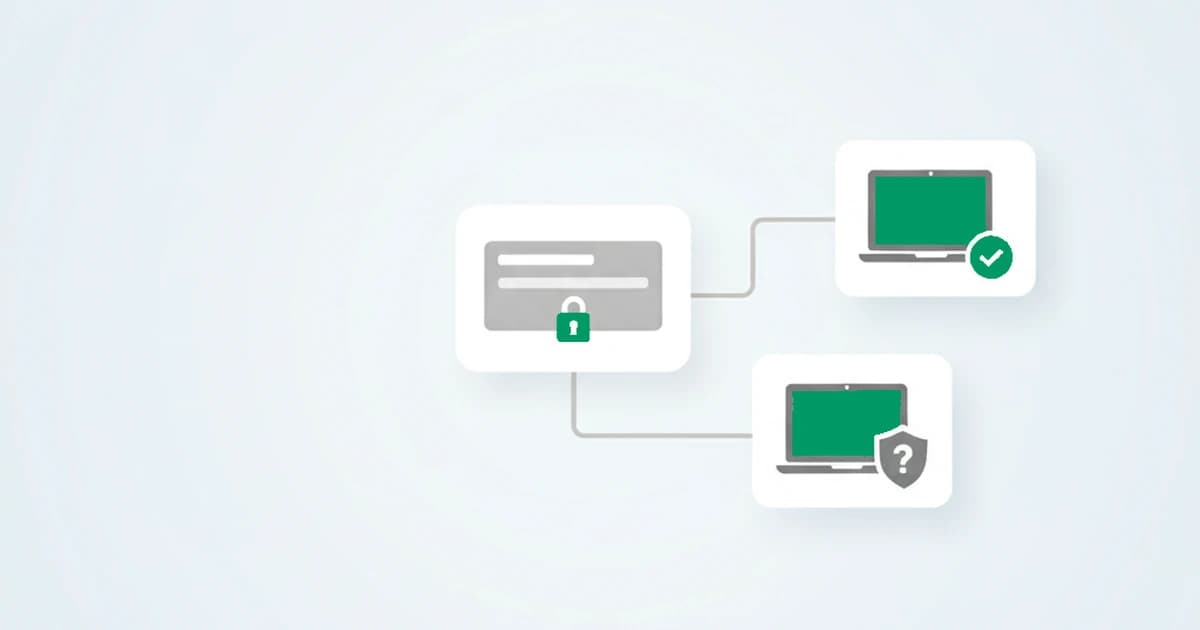
Adaptive authentication is an approach to login security that varies the amount of verification a user must provide based on the risk of the individual sign-in. A low-risk login, a returning customer on their usual laptop and network, is allowed through on the password alone. A high-risk login, the same credentials arriving from an unfamiliar device in a new country, is asked for a second factor, held for review, or denied. The system adapts the requirement to the context instead of applying one blanket rule.
The reason it exists is that a fixed policy is wrong in both directions. Requiring a second factor from everyone on every login is secure but heavy, and the friction pushes teams to weaken or disable it. Requiring nothing beyond a password is frictionless but defenseless against a credential that has leaked. Adaptive authentication resolves the tension by spending friction only where the risk is. A 2019 study that measured risk-based authentication on real traffic, published in the proceedings of IFIP SEC, found it blocks the large majority of account-takeover attempts while challenging only a small fraction of legitimate logins, which is the balance a blanket rule cannot strike.
Adaptive vs risk-based authentication: are they the same?
In practice the two terms are used interchangeably, and this guide treats them as one idea. If a distinction is drawn, it is one of emphasis:
- Risk-based authentication (RBA) names the mechanism: score the risk of a login, then require more proof when the score is high.
- Adaptive authentication names the behavior: the system adapts, over the same signals, and often across the whole session rather than just the login moment.
Both describe the same loop, read the context, compute a risk level, and adjust the challenge. The vocabulary varies by vendor and by document; the underlying model does not. Throughout this guide, "adaptive" and "risk-based" point at the same thing.
How adaptive authentication works: the signals it weighs
An adaptive system builds a risk picture from context signals gathered at the moment of sign-in, then compares that picture against how the account normally behaves. No single signal is a verdict; the risk score is how far the login drifts from the account's baseline. The signals that carry the most weight:
| Signal at login | What it tells the risk engine | Weight in the decision |
|---|---|---|
| Is this a device the account has used before? | a recognized device is the strongest sign the login is genuine | High |
| Network and connection: is it masked by a VPN, proxy, or datacenter? | a masked origin is common in credential resale and stuffing | Medium-High |
| Location and impossible travel | a jump the account could not physically make points to a shared credential | High |
| Time and pattern of the attempt | an odd hour or a burst of failures across accounts looks automated | Medium |
| Behavior during the session | actions that do not match the account's history raise the risk mid-session | Medium |
The engine combines these into a single risk level and maps it to an action: allow, step up to a second factor, or deny. The whole point is that most logins are ordinary and score low, so the extra proof is reserved for the minority that look wrong. That reserve is what keeps a recognized customer from meeting a challenge they do not need.
The device is the signal that decides when to step up
Read down that table and one signal is doing more than the others. The network can be masked, the location can be moved with a VPN, the time can be chosen, but the machine behind the login is the thing an attacker who bought a password did not inherit along with it. That is why device recognition is the anchor of an adaptive decision: it is the factor most correlated with "this is really the account owner" and the hardest for an impostor to fake.
The logic is simple in both directions. When an account has signed in from the same handful of devices for months and a new login arrives on one of them, the risk is low and the user should glide through. When the same credentials appear on a device the account has never touched, especially behind a masked connection, the risk is high and a step-up is warranted. Recognizing the returning device is what lets the system be confident enough to skip the challenge, and unfamiliar-device is what triggers it. The recognized device is consistently the cleanest predictor of a genuine return, which is why it deserves the most weight in the score.
We measured that ranking rather than assumed it. Grading each signal on its own across real login traffic, we ran the comparison and saw the recognized device separate genuine returns from impostor sessions more cleanly than the network, the location, or the time, each of which an attacker can shift at will. The machine behind the login is the one input a stolen password never arrives with, which is why our score leans on it hardest.
This is also where adaptive authentication meets device-based authentication: the recognized device is the input, and the adaptive engine is what acts on it. A durable device identifier that survives a cleared cookie and a rotated IP is what makes "have we seen this machine before" answerable at all.
Adaptive authentication vs MFA
Adaptive authentication and multi-factor authentication are often set against each other, but they do different jobs and work best together. MFA is the control: the second factor, a one-time code, a push, a passkey, that proves the user beyond a password, the mechanism NIST's digital identity guidelines define through authenticator assurance levels. Adaptive authentication is the decision: whether, and when, to demand that factor.
A blanket MFA policy prompts every user on every login, which is secure but adds friction to your most loyal customers and, in practice, gets weakened because of it. Adaptive authentication keeps MFA in place but aims it: a recognized device on a normal connection is trusted through, while an unfamiliar or masked session is the one asked to complete the second factor. The device signal decides when MFA is worth asking for, working alongside the MFA you already run. The same targeting is what makes passwordless authentication smoother too, since a recognized device can raise the confidence of a passkey login.
Where the device signal fits with your auth stack
The risk engine that computes the score, the MFA challenge, the passkey ceremony, the session policy, and the final allow-or-deny all live in your identity and authentication stack. A device-recognition layer works alongside them, supplying one input those systems weigh: an independent read of whether this session comes from a device the account has used before, and whether the connection behind it is masked.
In practice the two halves chain together. The device layer scores the session, names the signals, and flags the risky ones; your auth stack chooses the action for each case, a second factor, a hold, a re-verification, or a clean pass. That keeps your step-up challenges aimed at the logins that deserve them. It is the same shape as the detection side of account takeover, read from the friction-reduction angle rather than the attack-catching one.
Adding the device signal to adaptive authentication with ShieldLabs
ShieldLabs gives your adaptive authentication the device signal it turns on. You add one JavaScript snippet to your login page, and on each attempt it returns persistent identification plus a risk score from 0 to 100 with the named signals behind it: whether the device is one this account has used before, and whether the connection carries risk signals such as a VPN, an anonymous proxy, a datacenter, or an anti-detect browser. The identifier is derived and survives a cleared cookie and a rotated IP, so a returning customer is recognized as the same machine and a genuinely new device stands out.
ShieldLabs scores the session, names the evidence, and flags the risky logins. You read the risk score and named signals through the API and webhooks and choose the action for each case, letting a recognized device glide through and stepping up an unfamiliar one. Recognition runs at 99.9% identification accuracy and holds through cleared cookies and incognito sessions. The same identity layer carries into account takeover prevention on the security side. The free tier covers your first 5,000 identifications.
Sources
- Wiefling, Lo Iacono, Dürmuth: Is This Really You? An Empirical Study on Risk-Based Authentication Applied in the Wild (IFIP SEC, 2019)
- Gavazzi et al.: A Study of Multi-Factor and Risk-Based Authentication Availability (USENIX Security, 2023)
- NIST: SP 800-63B Digital Identity Guidelines (authentication and authenticator assurance)
- IBM: Cost of a Data Breach Report 2024
- Verizon: 2025 Data Breach Investigations Report (2025)
- Wikipedia: Multi-factor authentication
Recommended
Frequently asked questions
- What is adaptive authentication?
- Adaptive authentication is a login-security approach that changes how much verification a user must provide based on the risk of the individual sign-in. A low-risk login, a returning user on a familiar device and network, passes on the password alone, while a high-risk login is asked for a second factor or held. It adapts the requirement to the context instead of applying one fixed rule to everyone, which puts friction where the risk is rather than on every customer.
- Is adaptive authentication the same as risk-based authentication?
- In everyday use, yes. Both describe the same loop: read the context of a login, compute a risk level, and adjust how much proof is required. If a distinction is drawn, risk-based authentication emphasizes the scoring mechanism while adaptive authentication emphasizes the behavior of adapting across the session. The underlying model is the same, and this guide treats the terms as interchangeable.
- What is the difference between adaptive authentication and MFA?
- MFA is the control, the second factor that proves a user beyond a password. Adaptive authentication is the decision about when to demand it. A blanket MFA policy challenges everyone on every login; adaptive authentication keeps MFA but aims it, so a recognized device on a normal connection is trusted through and an unfamiliar or masked session is the one stepped up. They work together, one is the challenge and the other decides when the challenge is worth it.
- Which signals does adaptive authentication use?
- It weighs context signals gathered at sign-in: whether the device is one the account has used before, whether the connection is masked by a VPN, proxy, or datacenter, the location and any impossible travel, the time of the attempt, and the behavior during the session. These combine into a single risk score, and the strongest of them is the device, because it is the factor an attacker who only bought a password cannot easily reproduce.
- How does ShieldLabs help with adaptive authentication?
- ShieldLabs supplies the device-recognition signal an adaptive engine weighs. One JavaScript snippet on your login returns persistent identification and a risk score with the named risk signals behind it, so you can tell a recognized returning device from an unfamiliar one. ShieldLabs flags the risky sessions, and your auth stack acts on the result to step up or allow. The free tier covers your first 5,000 identifications.
Related articles
4 Step Node.js Device Fingerprinting with W3C Privacy and ShieldLabs
Implement Node.js device fingerprinting that follows W3C privacy guidance. Follow a 4 step integration with provenance, confidence scores, drift checks,...


Device Spoofing Detection for Web Fraud Teams
How browser, device and TLS signals reveal spoofing on the web, plus where mobile attestation belongs in a separate defense layer.
Device Fingerprinting for Fraud: GDPR and UK PECR Considerations
A practical guide to purpose, consent exceptions, retention and rights when using device fingerprinting for fraud prevention in the UK and EU.