

4 Step Node.js Device Fingerprinting with W3C Privacy and ShieldLabs

Last updated on October 6, 2026 · 10 min read
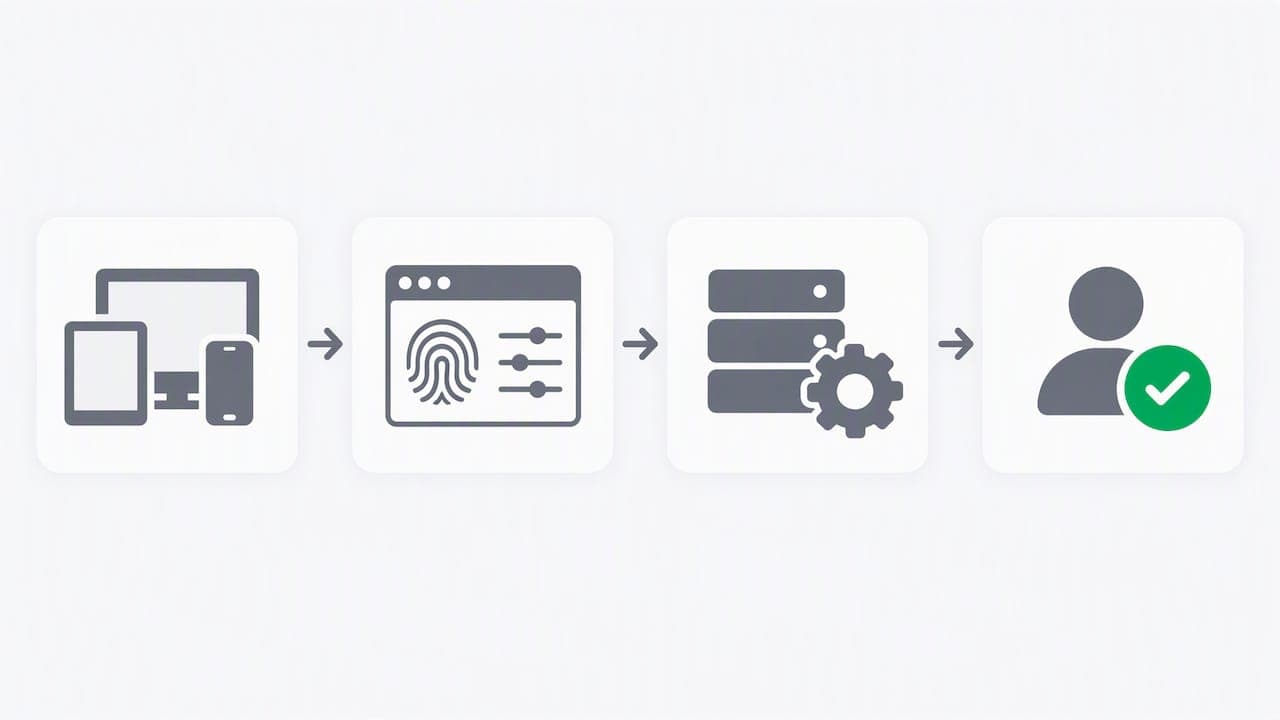
The practical approach for Node.js is to collect a small, versioned set of client and server signals, hash and persist them with provenance, and treat the resulting fingerprint as a risk signal rather than definitive identity. Start by logging normalized request headers server-side and adding one lightweight client probe. Keep entropy collection minimal, in line with W3C fingerprinting guidance, and store confidence alongside the fingerprint id.
TL;DR:
- Collecting minimal signals, versioning algorithms, and storing confidence levels are essential to maintain accurate, privacy-aware device fingerprints.
- Combining server-side headers and TLS data with active client probes improves detection but requires careful handling of privacy and drift risks.
- Regularly testing fingerprint stability after browser updates and applying short retention periods helps prevent false positives and drift over time.
- Using a hybrid approach, as recommended, offers better accuracy than relying solely on server or client signals alone.
- Privacy guidance suggests limiting data collection to what is necessary, bucketing numeric signals, and providing transparency to mitigate risks.
Table of Contents
- Why device fingerprinting helps and what it actually gives you in practice
- Server-side vs client-side fingerprinting: what to collect where
- Concrete signals to collect in a Node.js fingerprint and their practical value
- Node.js integration checklist: step-by-step flow and storage best practices
- Privacy and W3C guidance: minimize entropy and make fingerprinting detectable
- Operational best practices: retention, testing for drift, evaluation and cost considerations
- Author perspective: practical expectations for engineers
- ShieldLabs: a detection layer engineers can integrate for auditable visitor identification
- FAQ
- Sources
Why device fingerprinting helps and what it actually gives you in practice
Fingerprinting earns its place in a fraud stack by supporting returning-visitor recognition, multi-accounting detection, and session hardening. It tells your scoring logic that two sessions probably share a device or probably do not. It should feed decisions, not make them on its own. The W3C's fingerprinting guidance frames fingerprints as a correlation and risk signal, not proof of identity, and recommends that implementers expose the confidence and provenance behind each one.
Several conditions erode linkability in practice:
- Browser and OS updates change canvas, WebGL, and font rendering output between sessions.
- Shared NATs and carrier-grade address translation put many unrelated users behind one IP.
- Privacy features like tracking protection and fingerprinting randomization strip or alter signals.
- Anti-detect browser detection becomes necessary because these tools exist specifically to spoof the signals fingerprinting relies on.
Treat a fingerprint match as evidence, weight it, and combine it with other context before acting on it.
Server-side vs client-side fingerprinting: what to collect where
Passive, server-side collection and active, client-side probing solve different problems, and a production system usually needs both.
- Passive signals come from the request itself: headers, IP metadata, and TLS-level fingerprinting such as JA3-style hashes computed from the Client Hello packet. They require no client code, carry low detectability, and give a coarse but immediate correlation signal.
- Active client probes run JavaScript in the browser to collect canvas and WebGL rendering output, font availability, and audio or timing characteristics. These carry far more entropy than headers alone, but they also carry more privacy exposure and are easier for a privacy-conscious browser to block or randomize.
- The hybrid pattern collects both, signs and timestamps the client probe payload before it leaves the browser, validates it server-side on arrival, and stores the provenance of every signal that contributed to the final fingerprint id.
A Stack Overflow thread on reading the TLS Client Hello packet from a Node.js app walks through the practical limits of generating a JA3-like fingerprint purely server-side, which is worth reading before you commit to that approach alone.
Concrete signals to collect in a Node.js fingerprint and their practical value
A useful fingerprint schema stays small and documents exactly what each signal is good for.
- User-Agent, Accept, Accept-Language, and IP: cheap to log, useful for coarse request correlation, unreliable as standalone identifiers since many devices share identical header sets.
- TLS and JA3-like fingerprints: computed from handshake data on the server, harder to spoof casually than headers, still imperfect across client libraries and versions.
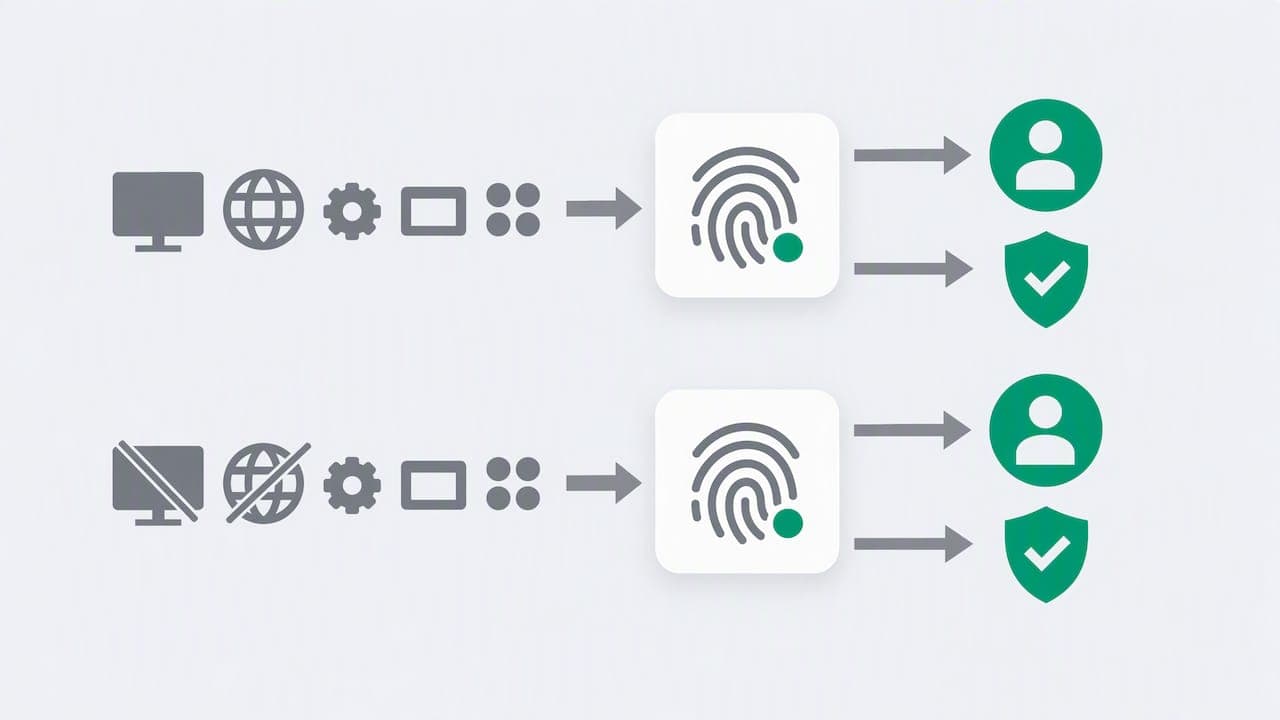
- Canvas and WebGL hashes: higher entropy from the browser, read more about the technique in our WebGL fingerprinting explainer, but output shifts with GPU driver and browser updates.
- Font list or targeted font checks: a single-value check ("is this font installed") carries less privacy exposure than enumerating the full list.
- deviceMemory, hardwareConcurrency, and feature flags: coarse but stable hardware hints that round naturally into buckets.
- Navigation timing and resource load characteristics: behavioral signals that add context but drift with network conditions, so weight them lightly.
Pro Tip: Version your fingerprint algorithm explicitly (v1, v2) so you can tell whether a match failure came from signal drift or from a change you made yourself.
Node.js integration checklist: step-by-step flow and storage best practices
A working integration follows four steps, in order, and each one has a failure mode worth planning for.
- Serve a minimal client script. Inline or load a small probe that collects only the signals you have decided to use, then POSTs them as JSON to a
/fingerprintendpoint. Keep the payload small and documented. - Normalize and hash server-side. In your Node handler, canonicalize signal keys into a consistent order, apply a versioned, salted hash function, and compute a fingerprint id from the result. Canonicalization matters because inconsistent key ordering or casing will quietly produce different hashes for the same device.
- Persist with provenance. Store the fingerprint id, the hashed or minimized signals that produced it, a confidence value, timestamps, and any related account IDs. Avoid storing raw high-entropy values longer than you need them.
- Combine with other signals in scoring. A fingerprint id alone is brittle. W3C guidance frames fingerprinting as an ensemble problem, recommending that practitioners combine fingerprint evidence with account history, transaction patterns, and velocity checks rather than treating it as a standalone verdict.
A single request-only hash built from User-Agent, IP, Accept-Language, and Accept headers is easy to implement in an afternoon, but it is a coarse correlation signal, not a reliable identifier on its own. Monitor drift and false positive rates once this is live, and adjust confidence weighting as real traffic data comes in.
Privacy and W3C guidance: minimize entropy and make fingerprinting detectable
W3C's guidance document gives engineers a short list of design rules that reduce privacy risk without gutting the fingerprint's usefulness.
- Return only the values your scoring logic actually needs. A boolean "font installed" check beats enumerating every font on the system.
- Round or bucket numeric signals like device memory or screen resolution instead of returning raw, highly specific values.
- Prefer single-value queries over full enumerations wherever the API allows it, since enumeration maximizes entropy and maximizes exposure at the same time.
- Advertise what you collect, through a privacy policy or through response headers like Accept-CH, and build graceful degradation into your client probe for visitors who block or restrict it.
These rules do not eliminate fingerprinting's privacy footprint, but they narrow it to what your fraud logic genuinely uses.
Operational best practices: retention, testing for drift, evaluation and cost considerations
Running fingerprinting in production is less about the initial probe and more about keeping it accurate over time.
- Log every change to your fingerprint composition, including which signals were added, removed, or reweighted, and when.
- Run periodic experiments measuring re-identification rate and false positive rate after major browser release cycles, since rendering engine updates are the most common cause of silent drift.
- Keep provenance and a confidence score attached to every stored fingerprint, not just the hashed id.
- Apply short retention windows to raw high-entropy values and prefer storing hashed attributes wherever your scoring logic allows it.
Pro Tip: Schedule a recurring check after every major Chrome and Safari release, since canvas and WebGL output are the signals most likely to shift and quietly inflate your false positive rate.
If you bring in a detection provider instead of building every probe yourself, setup time and published pricing become part of the evaluation, not an afterthought.
Author perspective: practical expectations for engineers
Start small. Deploy passive header logging and exactly one client probe, measure whether it actually improves your fraud decisions, then iterate from there. Most teams over-invest in exotic client signals before they have proven that basic request correlation and provenance tracking earn their keep. Jeff writes on fraud detection implementation for engineering teams, with a focus on keeping fingerprinting auditable rather than opaque.
— Jeff
ShieldLabs: a detection layer engineers can integrate for auditable visitor identification
When a team wants fingerprinting and anonymity detection without building every probe from scratch, ShieldLabs device intelligence gives visitor identification, anonymity signal detection, and a risk score that arrives with the underlying signals attached, so the verdict stays auditable instead of sitting in a black box. Detection covers VPNs, proxies, Tor, Private Relay, datacenter ranges, anti-detect browser detection, and automation traffic, drawn from more than 100 signals per visit. Identification persists across cleared cookies and IP changes with up to 99% accuracy. Setup is one JavaScript snippet, with server-side SDKs available for popular backend languages. The free tier covers 5,000 identifications with no card required, and published plans start at $79 per month on the Starter tier, scaling to Growth and Scale as volume grows.
FAQ
What is device fingerprinting in Node.js?
Device fingerprinting in Node.js combines server-side signals like headers and TLS handshake data with optional client-side probes such as canvas or font checks, then hashes them into a fingerprint id. The result works as a correlation and risk signal rather than a definitive identity, consistent with W3C guidance on fingerprinting.
Is server-side or client-side fingerprinting more accurate?
Neither is accurate alone. Server-side signals like headers and TLS fingerprints are quick to implement and harder to detect, while client-side probes like canvas and WebGL carry more entropy but drift with browser updates, so a hybrid approach that combines both tends to perform better.
Does device fingerprinting violate privacy regulations like GDPR or CCPA?
Fingerprinting itself is not inherently prohibited under GDPR or CCPA, but using personal data for tracking typically requires a lawful basis, notice, or consent depending on the jurisdiction and use case. W3C's guidance recommends minimizing entropy and making collection detectable, and teams should confirm specific obligations with their own legal counsel rather than relying on general guidance.
How do I handle fingerprint changes after a browser update?
Keep each fingerprint algorithm versioned and log confidence scores so you can tell drift apart from a deliberate schema change. Running periodic re-identification tests after major browser releases, as outlined in operational best practices, helps catch silent accuracy drops before they affect fraud decisions.
Can device fingerprinting be spoofed?
Yes. Anti-detect browser detection exists specifically because tools designed to randomize or fake canvas, WebGL, and other client signals are widely available, which is why fingerprints should feed a broader risk score built on account, transaction, and velocity signals rather than stand alone.
Sources
- Mitigating Browser Fingerprinting in Web Specifications (W3C)
- Server-side fingerprint: How to read Hello packet from a NodeJs app to generate a JA3?
Recommended
Related articles

Device Spoofing Detection for Web Fraud Teams
How browser, device and TLS signals reveal spoofing on the web, plus where mobile attestation belongs in a separate defense layer.


Device Fingerprinting for Fraud: GDPR and UK PECR Considerations
A practical guide to purpose, consent exceptions, retention and rights when using device fingerprinting for fraud prevention in the UK and EU.
CAPTCHA vs Device Fingerprinting: When to Use Each
Compare challenges with device identification and risk signals, then choose where friction belongs in a web fraud prevention flow.