

Device Spoofing Detection: Map Techniques to Play Integrity, JA3, JA4


Last updated on October 4, 2026 · 15 min read
Device spoofing is the practice of making one device, browser, or connection look like another to defeat identity checks, ad measurement, or access controls. Effective detection does not rely on a single flag. It combines platform attestation, network fingerprints such as JA3 and JA4, and request-context analysis like RQ4 into a risk score that is auditable rather than a black box, with providers supplying the underlying signals.
TL;DR:
- Combining platform attestation, TLS fingerprinting, and request-context analysis is essential to accurately detect sophisticated device spoofing.
- Spoofed devices often use multiple layers such as rotated User-Agents, residential proxies, and emulators, making single-field checks unreliable.
- Attestation reuse and inconsistent network or header signals are strong indicators of brokered or volume-based spoofing attacks.
- Detection signals must be layered into a risk score, guiding graduated enforcement actions like challenges or re-authentication rather than immediate blocking.
- Prioritize verification methods like attestation on high-risk flows such as payments and account creation, and leverage behavioral scoring for general traffic.
Table of Contents
- How spoofing campaigns compose identity signals to impersonate devices
- Common device spoofing techniques and the signals that expose them
- Why undetected spoofing distorts marketing and platform metrics
- Building a detection pipeline from attestation to behavioral scoring
- Turning detection signals into layered enforcement
- How ShieldLabs fits into a device spoofing detection pipeline
- Real-world patterns behind device spoofing detection
- Where device spoofing detection is heading next
- Privacy and ethical considerations in spoofing detection
- Where to focus first if you are building this out
- Try the signals yourself before you build the pipeline
- FAQ
- Sources
How spoofing campaigns compose identity signals to impersonate devices
A convincing spoofed device rarely relies on one trick. Operators stack several layers: a rotated or tampered User-Agent string, an IP address pulled from a residential proxy pool, a browser configured for anti-detect purposes to mask automation fingerprints, and sometimes a full emulator standing in for real hardware. Each layer defeats a different check, so the combination is what makes the device look legitimate end to end.
A newer and harder problem is the brokered attestation. Instead of forging a platform attestation, which is cryptographically difficult, some operators capture a genuine attestation from a real device and reuse it across many sessions. The attestation itself checks out because it came from real hardware once. Volume and timing are what expose the pattern, not the credential.
This is why static checks fail. A regex match against a User-Agent string or a denylist of known data center IP ranges catches the laziest attempts and nothing else.
- Anti-detect browsers rotate fingerprints to blend in with ordinary consumer traffic.
- Residential proxy networks hide data center origins behind real home IP addresses.
- Emulators replicate device metadata without replicating the hardware underneath.
Detection has to look past any single field and ask whether the whole request is internally consistent.
Common device spoofing techniques and the signals that expose them
Most spoofing attempts fall into a short list of patterns, each with its own tell.
- User-Agent and Client Hints tampering: a User-Agent claiming one browser alongside Sec-CH-UA headers describing another is a direct contradiction; the MDN Web Docs guidance on browser detection notes that UA strings alone are unreliable and recommends client hints and feature detection instead.
- TLS fingerprint mimicry: tools can spoof a User-Agent but struggle to perfectly replicate a browser's TLS handshake, which is why JA3 and JA4 fingerprinting catches mismatches that header inspection misses.
- Proxy and residential proxy patterns: a single IP serving an implausible number of distinct sessions, or an IP range known for proxy resale, points to infrastructure built for volume rather than one person browsing.
- Anti-detect browser and emulator signs: missing device sensors, virtualized GPU strings, or hardware metadata that does not match the claimed device model all suggest a simulated environment.
- Rooting, hooking, and runtime modification: on mobile, signs of root access or inline hooking indicate the app's own runtime has been altered, a technique MASTG guidance treats as useful but evadable on its own.
No single row on this list is conclusive. Together, they narrow the field considerably.
Why undetected spoofing distorts marketing and platform metrics
Spoofed devices do not just slip past security checks, they corrupt the numbers marketing and product teams rely on. A campaign that looks efficient because of a flood of cheap installs may actually be paying for traffic that never converts, which skews attribution models and makes channels with real users look worse by comparison.
- Install fraud inflates acquisition metrics and wastes ad spend on devices that never retain.
- Promo and referral abuse lets the same person claim bonuses repeatedly under different spoofed identities.
- Attribution models trained on this polluted data learn the wrong patterns and keep recommending the wrong channels.
Install fraud and ad spend waste are measurable problems for advertisers relying on device-level attribution, and the distortion compounds every time a flawed model informs the next budget decision.
Building a detection pipeline from attestation to behavioral scoring
A workable detection pipeline treats no single signal as final. It layers attestation, network fingerprinting, and behavioral context, then lets a scoring system weigh all of them together.
Platform attestation is the strongest starting point for app traffic. Google's Play Integrity API verifies that a request comes from a genuine, unmodified app running on a certified Android device, and it includes a recent device activity metric worth checking alongside the verdict itself. Apple's equivalent, App Attest, generates a hardware-bound attestation and a fraud metric describing roughly how many keys have been attested per device over a 30-day window, a useful signal for spotting brokered attestations reused at volume. Both verdicts should be validated server-side on every request rather than cached, since caching reopens the door to replay.
For web traffic, network-layer signals carry more weight. JA3 and JA4 TLS fingerprints reveal handshake details that are hard to spoof convincingly, and pairing them with header consistency checks closes gaps that User-Agent inspection alone leaves open, a point Fastly's own guidance on UA spoofing makes directly. Request-context analysis, described in the RQ4 specification, goes a step further by checking whether a request's headers are logically consistent with each other across a session. Its session-level extension, RQ4-S, is built specifically to catch cookie handoffs, where a real browser clears a challenge and an automated client then reuses those cookies.
Runtime integrity checks, such as scanning for inline hooks or inspecting process memory maps, add a further layer on mobile but are evadable by a determined operator and should never stand alone.
- Attestation verdicts answer whether the device itself is genuine.
- JA3/JA4 and RQ4 answer whether the request's network and header behavior is consistent.
- Behavioral signals, like unusual volumes of attestations from one identity or rapid session transitions, answer whether the pattern over time looks human.
Pro Tip: Weight attestation heavily on high-value flows like payments or account creation, and lean on network and behavioral signals for everything else, since attestation checks add latency you don't want on every page view.
Turning detection signals into layered enforcement
Detection only matters if it changes an outcome, and the safest pattern is graduated rather than binary. A risk score should move a session through stages: monitor quietly, issue a soft challenge, require step-up verification, or hold the action, with each threshold tuned by the sensitivity of what the user is trying to do. The decision to block always sits in the customer's own code, informed by the score rather than replaced by it.
- Fold attestation verdicts and fraud metrics directly into the same scoring model as network and behavioral signals.
- Keep every signal that contributed to a score visible to the developers and analysts who need to explain a decision.
- Set different thresholds for different flows, since a browsing session and a withdrawal request carry different risk.
- Revisit thresholds on a schedule, since spoofing tooling evolves and a static rule set ages quickly.
| Stage | Trigger | Typical action |
|---|---|---|
| Monitor | Low risk score, minor signal mismatch | Log and continue |
| Challenge | Moderate score, one inconsistent signal | CAPTCHA or soft friction |
| Step-up | High score, multiple inconsistent signals | Re-authentication or manual review |
| Prevent | Confirmed pattern, customer-defined threshold | Customer code blocks or limits the action |
How ShieldLabs fits into a device spoofing detection pipeline
A provider can collect numerous signals per visit and use them to identify anonymity methods, including VPNs, proxies, Tor, Apple Private Relay, data center IP ranges, and anti-detect browser detection, then score the risk of that visit. The risk score includes the signals behind it, so a developer or analyst can see why a visit was flagged rather than relying on an opaque number.
- Identification can persist over time, recognizing a returning visitor with up to 99% accuracy despite cleared cookies, incognito mode, or IP rotation.
- Traffic-quality analytics can break down risk by acquisition channel, helping teams see which campaigns bring in anonymized or high-risk traffic.
- The setup can run through a single JavaScript snippet, with various framework guides and server-side SDKs available for integration.
- A free tier may cover a limited number of identifications without requiring payment information, enough to test signal coverage against a real traffic sample before committing to a paid plan.
The resulting score is one more input into the kind of layered pipeline described above, not a substitute for it.
Real-world patterns behind device spoofing detection
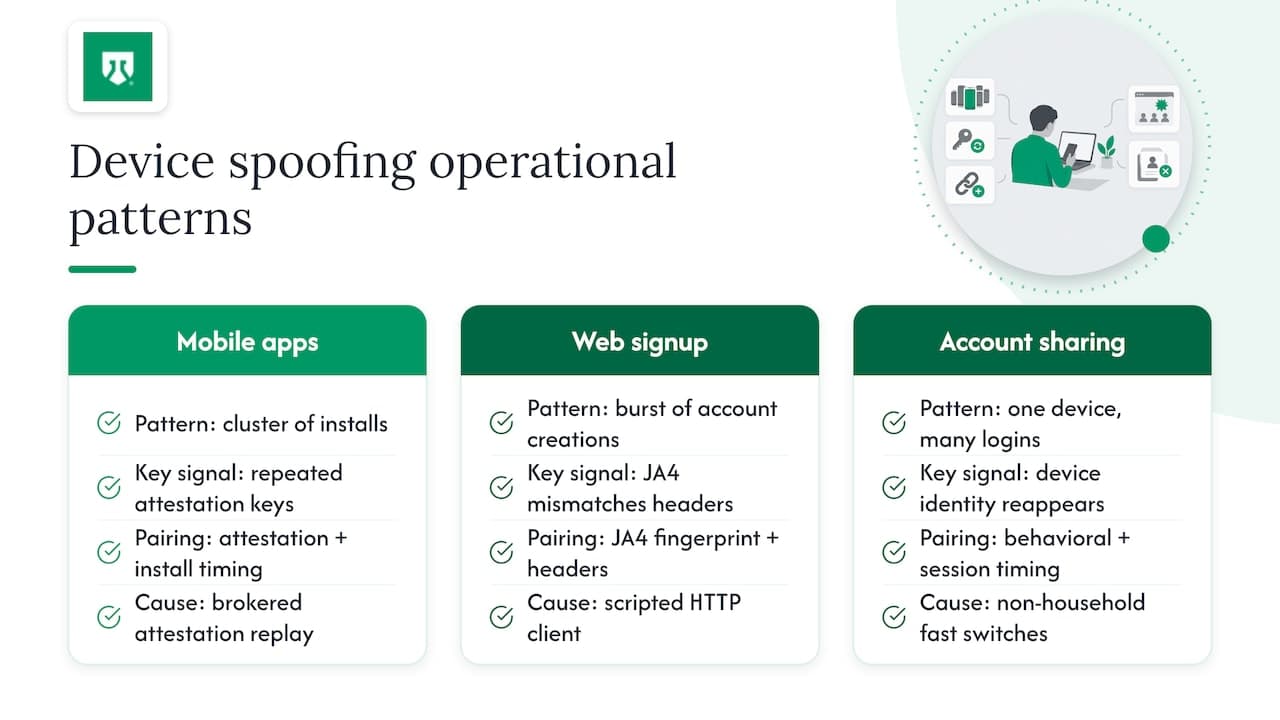
Device spoofing detection tends to surface in three recurring operational contexts rather than one dramatic incident. In mobile app ecosystems, teams tracking install campaigns often notice a cluster of installs from devices whose attestation metrics look unusual: a handful of hardware-bound keys attested an implausible number of times in a short window, consistent with a brokered attestation being replayed across sessions that claim to be separate devices. Pairing the attestation fraud metric with install timing is usually what surfaces the cluster, since the attestation alone still looks valid.
In web-facing signup flows, the common pattern is a burst of account creations from sessions whose TLS fingerprint does not match the browser their headers claim to be. A JA4 fingerprint consistent with a scripted HTTP client, arriving with headers formatted like a mainstream browser, is a mismatch that header inspection alone would miss entirely.
In account-sharing and loyalty programs, the giveaway is usually behavioral rather than a single bad signal: one device identity returning under several account logins in patterns that do not match ordinary multi-user households, often paired with session transitions that happen faster than a person switching accounts would plausibly move. None of these patterns rely on one piece of evidence. They hold up because attestation, network, and behavioral signals point the same direction at once, which is the operational argument for combining them rather than picking one and trusting it.
Where device spoofing detection is heading next
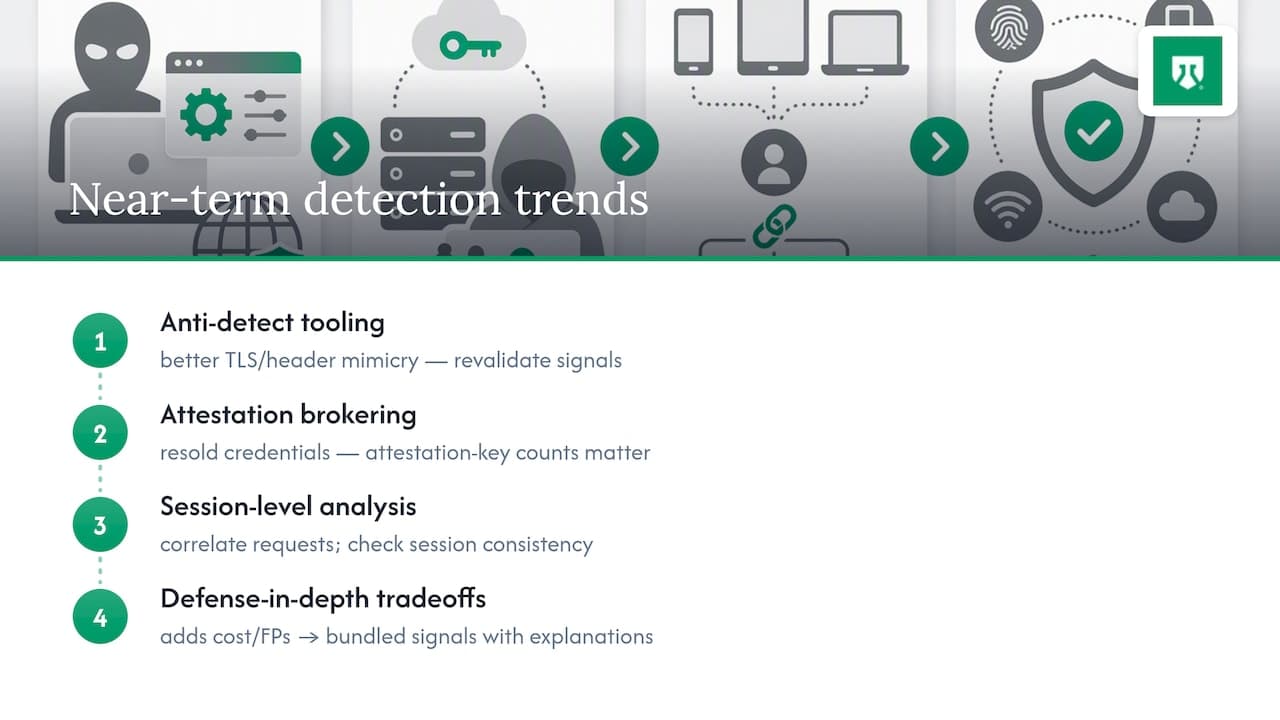
Spoofing tooling and detection methods are moving in step, and a few shifts are worth watching. Anti-detect browser tooling continues to get better at mimicking legitimate TLS and header behavior, which means network-layer signals that worked well last year need regular revalidation rather than a one-time setup. Attestation brokering, where a genuine device credential is captured and resold or reused, is likely to keep growing as platform attestation becomes more widely required, putting more weight on fraud metrics like attestation-key counts rather than the attestation verdict alone.
Request-context analysis is also maturing past single-request checks toward session-level correlation, the direction RQ4-S already points in by looking for cookie handoffs between a human-solved challenge and a later automated request. Expect more detection methods to follow that pattern: checking not just whether one request looks clean, but whether a session's behavior over time is internally consistent with being one person.
The harder challenge is that defense-in-depth raises the bar for attackers but also raises the operational cost for defenders. Every additional signal adds integration work, latency, and a new category of false positive to tune. Teams that try to adopt every available signal at once often end up with a pipeline nobody fully understands, which defeats the purpose of auditability. The practical trend is toward platforms that bundle multiple signal types with the reasoning behind each score exposed, rather than toward any single new detection trick replacing the rest.
Privacy and ethical considerations in spoofing detection
Device spoofing detection sits close to a privacy line, since the same signals that catch abuse can also build a detailed profile of an ordinary visitor. Collecting over 100 signals per visit, as a persistent identification system does, is defensible when it serves a stated fraud or security purpose and indefensible when it is repurposed into tracking people without a clear reason tied to that purpose.
A few principles hold up in practice. Signals should be collected and scored for a specific, stated purpose, such as spotting multi-accounting or account takeover, rather than accumulated speculatively. Risk scores should remain auditable, with the contributing signals visible to the team acting on them, so a flagged user or an internal reviewer can ask why a decision was made and get a real answer instead of a shrug. Retention periods for device and network signals deserve the same scrutiny as any other personal data, since a fingerprint that persists for months is, functionally, a long-lived identifier.
None of this requires avoiding detection, since fraud at scale carries its own real costs to other users and to the business. It does mean treating the signals as evidence that feeds a human or automated decision, not as a surveillance byproduct collected because the data happens to be available. Teams building these pipelines should also be clear internally about what jurisdiction's privacy rules apply to their traffic, since obligations vary by region and by the type of data collected.
Where to focus first if you are building this out
If you are prioritizing, put platform attestation on the flows where a bad decision is expensive: payments, account creation, withdrawal requests. Reserve RQ4 and TLS fingerprinting for your general web API traffic, where attestation isn't available or practical, and let behavioral scoring do the work of catching patterns that only show up at scale. The mistake I see most often is a team picking one signal, usually the one easiest to integrate, and treating its verdict as final. Build toward an auditable score with clear escalation steps instead, so a human can always trace why a session was flagged.
— Jeff
Try the signals yourself before you build the pipeline
Most teams reading this already know which spoofing patterns are hurting their metrics. What's usually missing is not a plan but the raw signals to feed one, the kind of attestation data, network fingerprints, and anomaly patterns described above, available without a months-long integration project.
- Such a platform can collect anonymity and device signals, including anti-detect browser detection, VPN and proxy identification, and persistent visitor recognition, and provide the risk score with the reasoning behind it.
- Your own code decides what happens next: monitor, challenge, or restrict, exactly the layered pattern this article has walked through.
- The free tier covers 5,000 identifications with no card required, enough to test signal coverage on a staging property before committing.
- Full plan details, including Starter at $79 per month, Growth at $319 per month, and Scale at $799 per month, are on the pricing page.
Start with the free tier, compare the traffic-quality report against what your current stack is telling you, and decide from there.
FAQ
What does "device spoofing" mean?
Device spoofing is the practice of making a device, browser, or connection present false or misleading identity information, such as a fabricated User-Agent, a masked IP address, or a reused hardware attestation, to appear as a different or more trustworthy device than it actually is. It is used to defeat fraud checks, inflate ad metrics, or bypass access restrictions.
How does a scammer spoof a phone number?
Phone number spoofing typically involves manipulating caller ID data sent through voice-over-IP services, which let the displayed number be set independently of the actual originating line. This is a telephony-specific technique distinct from device spoofing, though both rely on presenting false identity information to a system that trusts it by default.
What are the four types of spoofing?
Definitions vary across sources, but common categories include IP spoofing, email spoofing, caller ID spoofing, and device or browser spoofing, each manipulating a different layer of identifying information. Device and browser spoofing is the category most relevant to app security and ad fraud, combining User-Agent tampering, proxy use, and emulated hardware.
What is an IP spoofing attack in cybersecurity?
An IP spoofing attack involves sending network packets with a forged source IP address, making traffic appear to originate from a different, often trusted, location or device. It is commonly paired with proxy or residential IP networks in device spoofing campaigns to mask the real origin of fraudulent traffic.
Sources
- Overview of the Play Integrity API | Android Developers
- Secure your apps with App Attest - WWDC26 - Videos - Apple Developer
- RQ4 SPEC.md
- UA spoofing 101: Detection and Defense with Fastly’s Next‑Gen WAF
- Browser detection using the user agent - MDN Web Docs
Recommended
Related articles
Developers: Detect Incognito Mode After Chrome 76 With Server Signals
For developers: why client probes break after Chrome 76, what detectIncognito.js detects, and when server side signals prove reliable.


Laravel Bot Detection: RateLimiter Recipes, Redis Scaling, and API Use
Code ready Laravel bot detection: per-endpoint RateLimiter examples, Redis throttling notes, fingerprint signals, honeypots, and guidance on when to use a...

Calculate Fraud Detection Pricing With ShieldLabs' 5,000 Free Tier
Estimate fraud detection costs with a buyer-focused pricing workbook and worked examples. Validate your projection using ShieldLabs' 5,000 free...