

Deploy Tor Detection in Five Minutes for Security Engineers

Last updated on September 18, 2026 · 16 min read
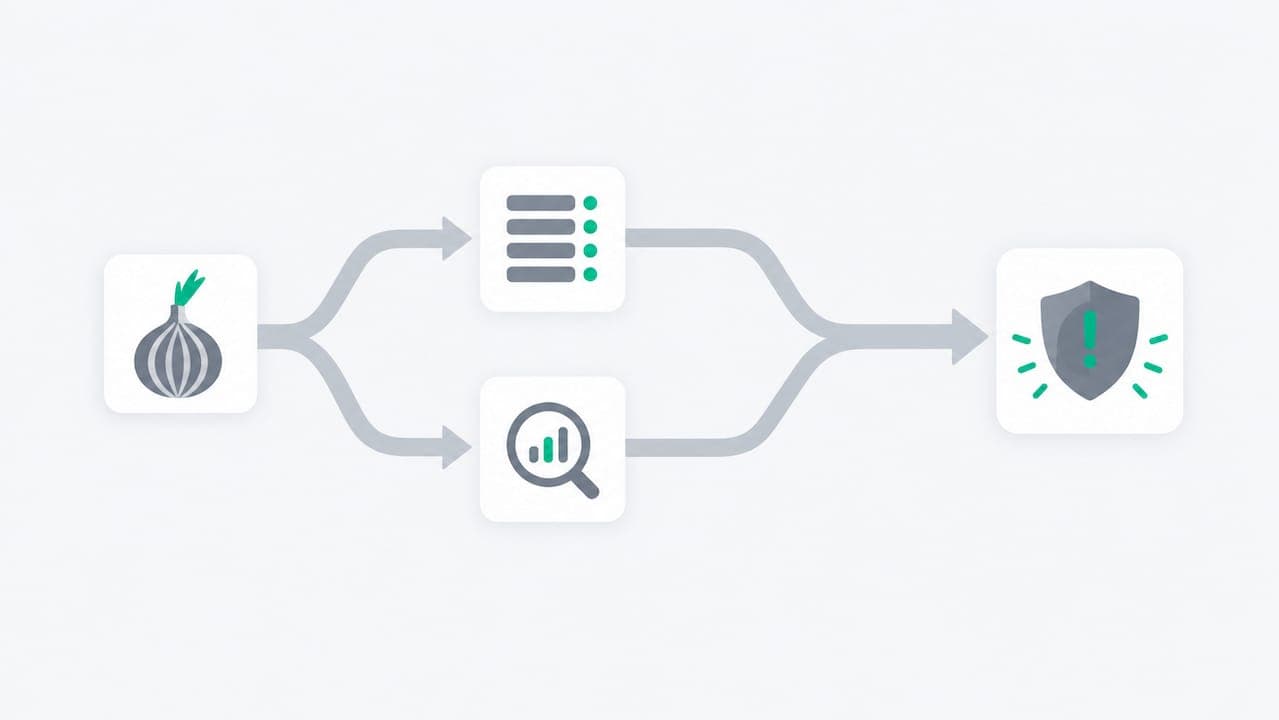
Yes, Tor traffic is detectable. The Tor Project publishes a real-time list of every active exit node, so a straightforward IP lookup catches most Tor-originated requests as they hit your infrastructure. Start there: build or buy an exit-node check as your first detection layer, then feed the result into policy, not into an automatic block, unless your compliance posture demands otherwise.
TL;DR:
- Exit-list matching provides near real-time detection of most Tor activity, with hourly updates from the Tor Project's public consensus, offering high certainty in identifying exit-node traffic.
- Combining exit-list checks with traffic analysis, behavioral models, and TLS fingerprinting significantly improves detection, especially against bridges and pluggable transports designed to evade IP-based methods.
- Enrichment of logs at request time and placing Tor checks early in policy workflows help prevent false negatives and reduce unnecessary processing while maintaining updated detection accuracy.
- Blocking Tor should be limited to high-risk endpoints, while other instances benefit from monitoring, logging, and feature-level gating to avoid punishing legitimate privacy use.
- Integrating Tor signals with threat intelligence feeds enhances risk assessment, distinguishing malicious actors from legitimate privacy users by correlating IPs with known threats.
Table of Contents
- Why Detect Tor Traffic: Use Cases That Justify the Work
- Which Tor Detection Method Fits Your Stack?
- How to Implement Tor Detection Across Firewalls, Apps, and Logs
- Tools and Examples You Can Test Right Now
- When to Block, Monitor, or Challenge Tor Traffic
- How ShieldLabs Signals Fit Into Detection Pipelines
- Catching Tor Bridges When Exit-Node Lists Miss Them
- Can Behavioral Analytics Catch Tor Traffic That IP Lists Miss?
- Should You Correlate Tor Traffic With Threat Intelligence Feeds?
- Beyond IP: TLS Fingerprinting and Packet Timing Analysis
- An Ops-First Take on Tor Detection
- Add Auditable Tor Signals to Your Stack Without a Sales Call
- Sources
- FAQ
Why Detect Tor Traffic: Use Cases That Justify the Work
Tor detection earns its place in a stack when it feeds a decision, not just a dashboard. Security and product teams typically wire it into four workflows:
- Fraud signals: correlating Tor sessions with account creation, credential stuffing attempts, payment retries, and multi-accounting patterns.
- Authentication decisions: triggering step-up MFA, a risk hold, or manual review instead of an outright login block.
- Network protection: feeding firewall and PEP (policy enforcement point) rules, enriching SIEM events, and logging sessions for incident response.
- Accessibility trade-offs: journalists, researchers, and privacy-conscious customers use Tor legitimately, so many teams gate sensitive features instead of banning the whole session.
The right use case depends on what the endpoint protects. A password reset form and a wire transfer API do not warrant the same response to a Tor-flagged visitor.
Which Tor Detection Method Fits Your Stack?
No single method covers every case, and the ones worth deploying rarely conflict with each other. They stack.
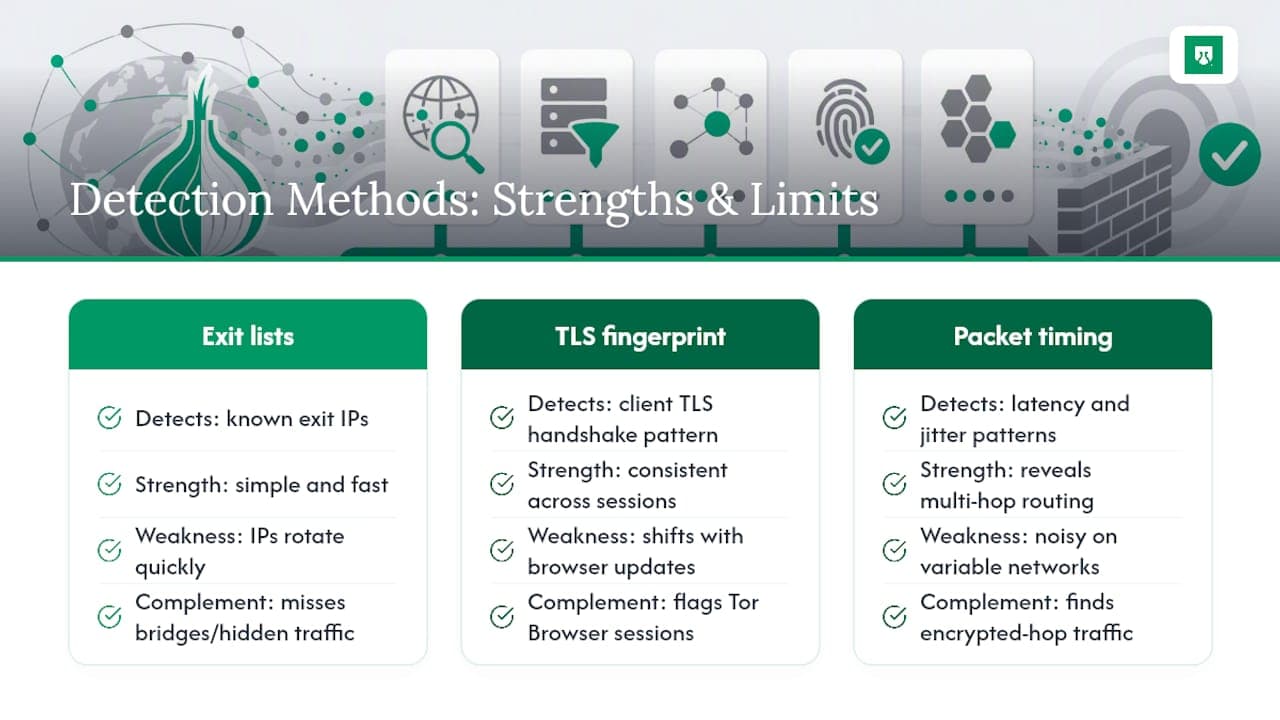
- Exit-list matching: The Tor Project's torbulkexitlist is the authoritative source for current exit-node IPs, drawn directly from the network consensus. It is precise for exit-node traffic specifically and typically refreshes hourly, which matters because nodes rotate constantly.
- DNS-based lookup: Query-based checks avoid the overhead of downloading and storing a full list, and they self-update since you're always querying live data. The trade-off is latency: a DNS round-trip on every request adds up fast on high-throughput services.
- API enrichment: Lightweight JSON endpoints return a yes/no on whether an IP is a current exit node, often alongside a live exit-node count refreshed from the Tor consensus. These fit naturally into log-enrichment pipelines and per-request checks without maintaining infrastructure yourself.
- Traffic analysis / App-ID: Flow and cipher-level heuristics catch what exit lists miss, including bridges and obfuscated pluggable transports that never touch a public exit IP. Palo Alto's Unit 42 research notes that pairing exit-IP blocking with traffic classification covers meaningfully more Tor activity than either method alone.
- Host and endpoint signals: Correlating Tor flags with VPN, proxy, and anti-detect browser detection signals sharpens the risk score. A visitor who trips Tor detection and shows browser automation markers is a different risk tier than one who just shows a Tor exit IP.
Exit lists are uniquely reliable compared to VPN or proxy detection precisely because Tor exit nodes are published in a public consensus. VPN providers rotate IP ranges quietly and proxies rarely disclose anything; Tor's transparency is the exception, not the rule, in the anonymization space.
Pick exit-list matching if you need certainty on exit-node traffic with minimal engineering lift. Pick traffic analysis if bridges and pluggable transports are a real threat model for your service. Most mature setups run both.
How to Implement Tor Detection Across Firewalls, Apps, and Logs
Integration patterns differ by layer, but the sequence is consistent:
- Firewalls: Load exit-node data as an External Dynamic List (EDL) that fetches automatically on a schedule. Palo Alto's own knowledge base on blocking Tor walks through EDL setup alongside App-ID rules for traffic that evades the IP list entirely.
- Web apps and mail servers: DNS-based or API checks at the application layer keep detection logic close to the request without pushing load onto network appliances built for packet inspection, not lookup queries.
- Log pipelines: Enrich events at ingestion time, not in a nightly batch job. Persist the detection timestamp alongside the session, then let downstream logic decide on MFA prompts, holds, or flags for analyst review.
- Policy ordering: Place Tor checks before other risk logic so a confirmed exit-node hit can short-circuit unnecessary processing.
Pro Tip: Enrich as close to event time as possible. Exit nodes rotate by the hour, so an IP flagged as Tor at 2:00 PM may be a clean residential address by 6:00 PM. A detection pipeline with a stale list creates false negatives and, just as often, false positives against IPs that have since been reassigned.
Tools and Examples You Can Test Right Now
Reproducing Tor detection doesn't require building anything from scratch. A handful of tools cover most use cases.
- Falco plus a custom script: The Sysdig tutorial on detecting Tor connections with Falco shows how to install Falco, apply rules matching known Tor ports and destinations, and pipe alerts into a script for inbound and outbound connection monitoring.
- API lookups: A basic
curlorfetchcall against a Tor-detection JSON endpoint returns exit-node status per IP. Cache results for the duration of a session, since repeated per-request lookups against the same IP burn through rate limits fast. - ExoneraTor for historical checks: When investigating a past incident, ExoneraTor confirms whether a specific IP was operating as a Tor relay on a specific date, which is invaluable for retroactive log analysis and incident write-ups.
- Staging validation: Run synthetic requests from known exit nodes in a staging environment before trusting a detection pipeline in production, and confirm your logs capture the match, not just the raw IP.
When to Block, Monitor, or Challenge Tor Traffic
Detection without a policy framework just generates noise. The decision hinges on endpoint sensitivity, your user population, and any regulatory constraints on access.
ASD's guidance on defending against Tor abuse recommends blocking where practical, but favors monitoring and logging when blocking would cut off legitimate access.
- High-risk endpoints (admin panels, payment flows, credential resets): deny outright.
- Everything else: monitor first, escalate to a step-up challenge if other risk signals stack up, then allow if the session clears.
- Avoid overblocking by parsing exit-node policies carefully and maintaining allowlists for known-good Tor-using partners or researchers. The Tor Project's own abuse guidance suggests feature-level gating over a full ban, precisely to avoid punishing legitimate anonymity use.
- Centralize logs: keep Tor-flagged sessions in a searchable store with enough retention for analysts to reconstruct incidents weeks later.
How ShieldLabs Signals Fit Into Detection Pipelines
Detection tools should hand your team a signal, not make the call for you. A Tor flag from an exit-list match, a DNS lookup, or an API enrichment source is one input among several, alongside VPN, proxy, and anti-detect browser signals, that your code uses to decide whether to block, challenge, or log a session. Auditable systems attach the underlying signals and timestamps to every risk score, so a reviewer can see exactly why a session was flagged rather than trusting a black-box verdict. Integration speed matters here: a JavaScript snippet or backend SDK gets signals flowing in minutes, which beats maintaining exit-list infrastructure in-house for teams without spare engineering cycles.
Catching Tor Bridges When Exit-Node Lists Miss Them
Exit-list matching has a blind spot: bridges. Bridges are unlisted Tor relays designed specifically to evade the public consensus, and pluggable transports like obfs4 or meek disguise Tor's traffic signature further by wrapping it in what looks like ordinary HTTPS or even innocuous-looking cloud traffic.
Because bridges never appear in the torbulkexitlist, IP matching alone will not catch them. Detecting this traffic requires stepping up to traffic-level analysis: unusual TLS handshake patterns, connection behavior that doesn't match the domain being requested, or repeated short-lived connections to endpoints associated with bridge infrastructure. Unit 42's research on Tor in enterprise environments points to combining IP-based methods with traffic classification specifically to close this gap, since bridge traffic behaves differently from ordinary web traffic even when it hides its destination.
Pluggable transports add another wrinkle. Obfuscation protocols are built to defeat deep packet inspection, so signature-based detection often fails outright. What tends to work instead is looking at what surrounds the connection: does an endpoint that should see occasional traffic suddenly show a steady drip of small, regularly timed packets that don't match any known application behavior? That kind of anomaly, more than any single packet inspection rule, is what flags bridge use in practice. Teams serious about closing this gap treat exit-list matching as a floor, not a ceiling, and budget separately for traffic-pattern analysis.
Can Behavioral Analytics Catch Tor Traffic That IP Lists Miss?
Behavioral analytics fills gaps that static lists cannot, particularly for bridge and pluggable-transport traffic that never touches a published exit IP. Instead of asking "is this IP on a list," behavioral models ask "does this session act like Tor traffic acts."
Machine learning approaches applied to this problem generally look at a cluster of signals together rather than any single one: packet timing variance, cell sizes consistent with Tor's fixed 512-byte cell structure, connection duration patterns, and the ratio of upstream to downstream bytes. Tor's onion routing protocol produces traffic shapes that differ subtly but measurably from ordinary browsing, streaming, or file transfer, and models trained on labeled traffic samples can learn to separate the two.
The practical catch is false positives. A model tuned aggressively enough to catch obfuscated Tor traffic will also flag some legitimate encrypted VPN or corporate tunnel traffic, since both share characteristics like consistent packet sizing and steady keep-alive behavior. That is why behavioral scoring works best as a contributing signal in a broader risk score rather than a standalone gate. Feed the output into the same decision layer that handles exit-list matches and traffic-analysis flags, weight it appropriately, and let accumulated evidence, not one model's verdict, decide the response. Teams that skip this and let a behavioral model auto-block risk cutting off legitimate encrypted business traffic that simply resembles Tor at the packet level.
Should You Correlate Tor Traffic With Threat Intelligence Feeds?
A Tor exit-node hit by itself tells you a visitor is anonymized. It does not tell you whether that visitor is a researcher, a customer protecting their location, or someone running a credential-stuffing campaign. Threat intelligence correlation is how you tell the difference.
Cross-referencing a Tor-flagged IP or session against known indicators, such as IPs previously associated with credential-stuffing campaigns, botnet command infrastructure, or fraud rings reported by industry-sharing groups, turns a neutral anonymity signal into a weighted risk score. An exit node that has hosted malicious traffic before, or one whose session shows up alongside other indicators in a threat feed, warrants a different response than a first-time Tor visitor with no history attached to that node.
The operational pattern is straightforward: enrich the Tor detection event with a threat-feed lookup at the same point you enrich it with the exit-list check, ideally in the same pipeline pass to avoid adding a second round-trip. Persist both results together in your SIEM so an analyst reviewing an incident sees the full picture, anonymity plus reputation, rather than two disconnected data points they have to manually correlate later. This matters most for incident response: a Tor session tied to a known-bad indicator justifies immediate escalation, while an isolated Tor flag with no corroborating signal may only warrant logging and monitoring under the policy framework covered earlier. Skipping this correlation step is one of the more common gaps in otherwise solid Tor-detection setups, since teams often build the IP check and stop there.

Beyond IP: TLS Fingerprinting and Packet Timing Analysis
IP-based detection has a shelf life measured in the time it takes an exit node to rotate. Network-level indicators that don't depend on the IP address at all tend to hold up longer, and they matter most for the bridge and pluggable-transport traffic that exit lists can't see.
TLS fingerprinting examines how a client negotiates its TLS handshake: cipher suite order, supported extensions, and elliptic curve preferences. Tor Browser is built on a specific Firefox base and negotiates TLS in a recognizable, consistent way across sessions, which differs from the broader spread of fingerprints you'd see from ordinary browser traffic. A fingerprinting layer that flags this pattern catches Tor Browser sessions even when the underlying IP shows no exit-node history.
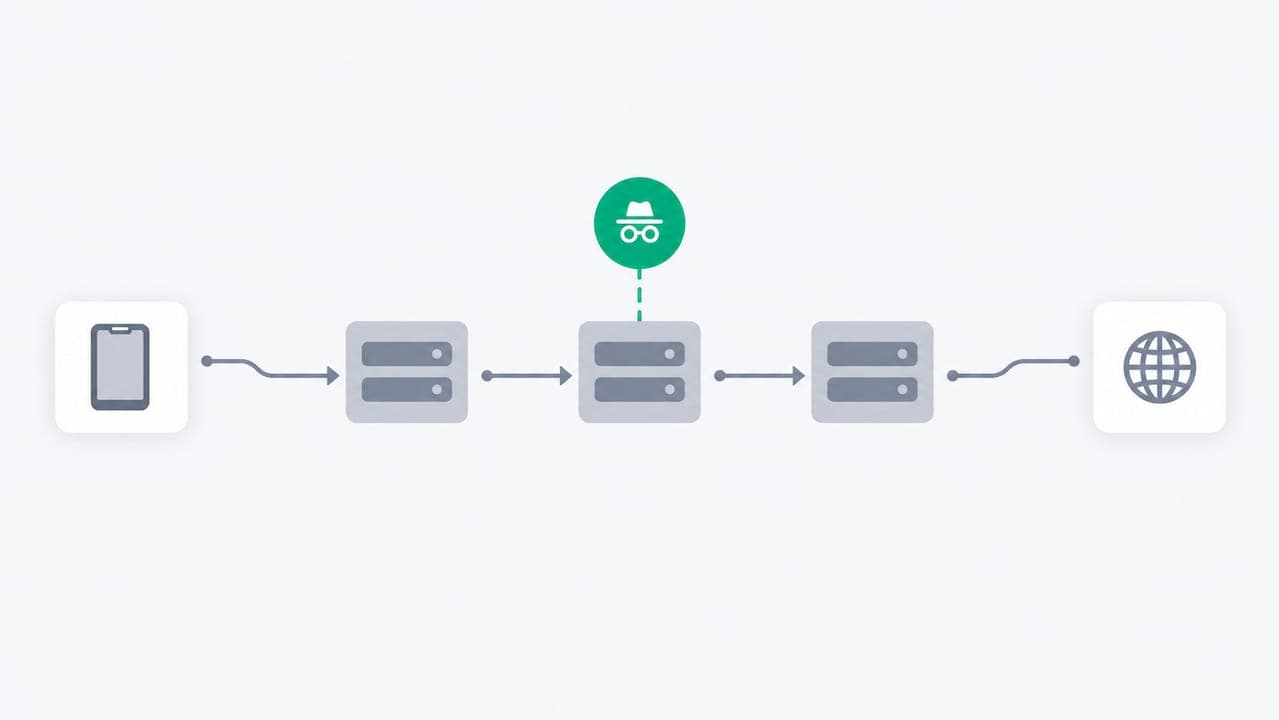
Packet timing analysis looks at the rhythm of a connection rather than its content. Tor's onion routing adds latency at each hop, and that latency shows up as measurable jitter and delay patterns that differ from a direct connection. Combined with the fixed cell-size structure Tor uses internally, timing analysis can flag sessions that route through multiple encrypted hops even when every individual packet looks unremarkable on its own.
Neither method works well in isolation. TLS fingerprints shift as browser versions update, and timing analysis produces noise on any network with variable latency for unrelated reasons. Used together with exit-list matching and behavioral scoring, they close most of the remaining gap between "traffic we can identify with certainty" and "traffic that behaves like it's hiding something."
An Ops-First Take on Tor Detection
Most of the guidance floating around treats Tor detection as a binary: block it or don't. That framing wastes the actual value of detection, which is information, not an on/off switch. The teams that get this right treat a Tor flag the way they'd treat any other risk signal: weighted, logged, and combined with everything else known about the session.
The conventional advice also over-indexes on exit lists and stops there. Exit-list matching is necessary, cheap, and precise, but treating it as complete detection ignores bridges, pluggable transports, and the entire class of obfuscated traffic built specifically to defeat IP-based checks. If your threat model includes anyone motivated enough to use a bridge, an IP list alone gives you false confidence.
What the reader should prioritize first is unglamorous: get exit-list matching wired into logging before anything else, because it is nearly free and catches the majority of Tor traffic you'll ever see. Then build the policy layer, sensitivity by endpoint, before adding behavioral models or TLS fingerprinting. A sophisticated detection stack feeding a policy nobody defined is worse than a simple one feeding a sharp decision framework.
— Jeff
Add Auditable Tor Signals to Your Stack Without a Sales Call
Building exit-list matching, DNS lookups, and traffic-analysis heuristics in-house takes real engineering time, and maintaining refresh cadence and false-positive tuning after launch takes more. Shieldlabs treats Tor detection as one signal among more than 100 collected on every visit, alongside VPN, proxy, Apple Private Relay, datacenter IP ranges, and anti-detect browser detection, scored together and shown with the exact signals behind each verdict so your team can audit the decision rather than trust a black box. Setup runs through a JavaScript snippet or backend SDKs for Node.js, Python, Go, and PHP, typically live within about five minutes.
Pricing is published, not gated behind a demo call: start with 5,000 free identifications, no card required, then scale into the Starter, Growth, or Scale plans as volume grows. Check the anonymity signal detection product page for what ships on every tier, then create a free account to see Tor and anonymity signals against your own traffic today.
Sources
FAQ
Is Tor Legal to Use in the United States?
Yes. Using Tor is legal in the United States, and courts have not treated Tor use alone as evidence of wrongdoing. What a business does with detection is a policy choice, not a legal requirement, since Tor itself is a legitimate privacy tool used by journalists, researchers, and ordinary consumers.
Is Tor Traffic Actually Untraceable?
No, not entirely. Tor obscures a visitor's origin IP by routing traffic through multiple encrypted relays, but exit-node IPs are publicly listed, and traffic-analysis techniques like TLS fingerprinting and packet timing can still flag a session as Tor-routed even without unmasking the user behind it.
Can My Internet Provider See That I'm Using Tor?
An internet service provider can typically see that a connection is going to a Tor entry node, since that first hop isn't hidden, but it cannot see the destination or content of the traffic once it enters the Tor network. This is a separate question from what a website or application can detect on its end using exit-list or traffic-analysis methods.
Does Using Tor Automatically Flag a Visitor as Fraudulent?
No. A Tor connection is one risk signal, not proof of fraud, since plenty of legitimate users route through Tor for privacy reasons. Most operational guidance, including ASD's recommendations, treats it as an input to a broader risk score rather than an automatic block, which is how platforms like Shieldlabs weight Tor alongside more than 100 other signals before producing a risk verdict.
Recommended
Related articles
Stop False Positives: Apple Private Relay Detection for IT & Fraud Ops
Ops guide to detecting Apple Private Relay. Learn three detection techniques, when to return NXDOMAIN, and fraud safe rules for teams.


5 Low Latency Checks to Detect Anti Detect Browsers for Fraud Teams
Research backed playbook for fraud teams: five low latency checks to spot anti detect browsers, signal to score mapping, and a ShieldLabs setup path.

Detect Free Trial Abuse with 100+ Signals for SaaS Teams
Detect free trial abuse without blocking real users. Use auditable signals, progressive friction, and metrics to protect conversion.