

VPN vs proxy vs Tor: how each hides traffic and how detection tells them apart

Last updated on July 23, 2026 · 9 min read
In a nationally representative 2025 survey of U.S. adults, 32 percent said they currently use a VPN, and proxies and Tor add millions more masked sessions on top. A VPN, a proxy, and Tor all do the same surface thing: they put another address between a visitor and your server. Underneath, they work in three different ways, and each one leaves a different trace. For anyone reading traffic to tell a genuine visitor from a masked one, the useful question is not "which is most private" but "which one is this, and what does it still reveal." This guide explains how each hides traffic, what each one cannot hide, and how a detection layer tells them apart.
Key takeaways
- A proxy swaps your IP for one relay, usually without encryption. A VPN wraps all of a device's traffic in an encrypted tunnel to a server. Tor routes traffic through three volunteer relays with layered encryption so no single hop sees both ends.
- They trade off on the same axes: how much traffic they cover, whether they encrypt it, how many hops it takes, and how easy the exit point is to recognize.
- None of them hides the fact that the connection is anonymized. A VPN or datacenter proxy exits from a known hosting range, Tor exits from a public relay list, and the device behind all three can still be recognized.
- For a detection layer, the connection type is one named signal among several. Reading it alongside the device and the rest of the session is what separates a privacy-conscious real user from a masked abuser, without treating "uses a VPN" as guilt on its own.
What is the difference between a VPN, a proxy, and Tor?
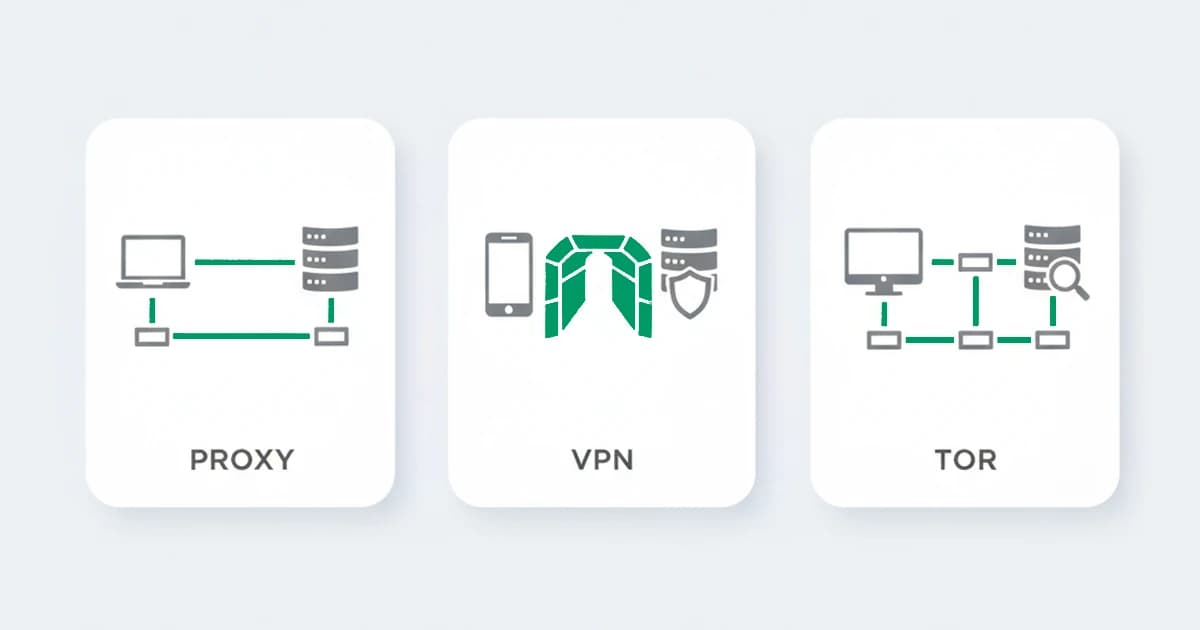
A proxy is a single intermediary server that forwards your requests, so the destination sees the proxy's IP address instead of yours. Most proxies do not encrypt traffic; they simply relay it, often for one app or browser rather than the whole device. A VPN (virtual private network) builds an encrypted tunnel from the whole device to a VPN server, so a local network or ISP sees only encrypted traffic to that server, and the destination sees the server's IP. Tor (The Onion Router) routes traffic through a volunteer network of at least three relays with a separate layer of encryption for each hop, so the entry relay knows who you are but not where you are going, and the exit relay knows the destination but not who you are.
The short version: a proxy changes your address, a VPN encrypts and changes your address for the whole device, and Tor spreads trust across several relays so no single point sees the full picture. Each buys more anonymity than the last and pays for it in speed and complexity.
How a VPN hides traffic, and what it reveals
A VPN encrypts everything leaving the device and sends it to a VPN server, which decrypts it and forwards it on. To your ISP or a local network, the traffic is an opaque tunnel to one address. To the destination, the request arrives from the VPN server's IP, in the VPN provider's chosen country.
What it does not hide is the nature of that server. Commercial VPN servers run in datacenters, on IP ranges that belong to hosting providers rather than home or mobile networks, and the busiest ones appear across many unrelated sessions. A residential-consumer request that suddenly arrives from a datacenter ASN in another country is not proof of fraud, but it is a legible risk signal. The encryption protects the contents; it does not disguise where the exit sits.
How a proxy hides traffic, and what it reveals
A proxy is the lightest of the three: it forwards requests so the destination sees the proxy's IP, usually with no encryption and often for a single browser or client. Proxies come in two flavors that matter for detection. A datacenter proxy exits from hosting infrastructure, easy to classify the same way a VPN server is. A residential proxy routes through a real consumer device, so the exit IP looks like an ordinary home or mobile connection, which is exactly what makes it harder to catch on the address alone.
What a proxy reveals is inconsistency. Because it typically covers one app and does not encrypt, the rest of the session often disagrees with the proxied address: a timezone, language, or connection characteristic that does not line up with the claimed location, or the same device reappearing behind many rotating proxy IPs. The address is disposable; the device and the environment behind it are not.
How Tor hides traffic, and what it reveals
Tor sends traffic through a circuit of three relays: an entry guard, a middle relay, and an exit relay. Each hop peels one layer of encryption, so the entry relay sees your real address but not your destination, and the exit relay sees the destination but not you. Circuits rotate every few minutes, so the exit IP a site sees keeps changing.
What Tor cannot hide from the destination is that it is Tor. Every relay, including the exit, is published in a directory the Tor Project maintains openly, so a site can check an incoming IP against the public exit-node list in a single lookup. The detection of Tor traffic is genuinely easy for that reason; the hard part is judgment, because most of the roughly two million people who, as of 2026, connect to Tor each day are not committing fraud. And circuit rotation does not defeat device recognition: the exit IP changes every few minutes while the device behind the circuits stays the same.
VPN vs proxy vs Tor: the comparison
| Proxy | VPN | Tor | |
|---|---|---|---|
| What it changes | Your IP, usually for one app | Your IP, for the whole device | Your IP, rotating every few minutes |
| Encryption | Usually none | Full tunnel, device to server | Layered, one per relay |
| Hops | One relay | One server | Three or more relays |
| Coverage | Single browser or client | All device traffic | Per-application (the Tor Browser) |
| Speed | Fast | Fast | Slow |
| What the destination sees | The proxy IP | The VPN server IP | A public Tor exit-node IP |
| What it still reveals | Datacenter or residential exit; session inconsistency | Datacenter ASN, known VPN ranges | Membership of the public exit list |
| How detection reads it | Classify the IP, weigh device and session consistency | Match datacenter and known-VPN ranges | Match the published exit-node list |
The last two rows are the point: each tool hides the address well and hides the fact of anonymization poorly. That is the seam detection works in.
How detection tells them apart
We ran test sessions through a commercial VPN, a datacenter proxy, and a Tor circuit, and each came back as its own named connection type, while a rotated proxy IP still tied back to the same device identifier. To a detection layer, "VPN," "proxy," and "Tor" are three distinct named signals, and the way each is read reflects how each one exits:
- Tor is the most clear-cut. The exit relays are a public list, so the read is a lookup: does the incoming IP appear on the current Tor exit-node list. A match names the connection as Tor with high confidence.
- VPN and datacenter proxy exits share a tell: they leave from hosting infrastructure rather than a consumer network. Matching the IP against datacenter ranges and known commercial-VPN ranges names the connection type, and the ASN classification separates a hosting exit from a genuine home or mobile connection.
- Residential proxies are the hard case, because the exit IP is a real consumer address that no list flags. Here the address alone is not enough, and the read shifts to consistency: whether the rest of the session lines up with the claimed connection, and whether the same device keeps reappearing behind IPs that rotate away.
Across all three, the connection type is a starting point, not a verdict. A VPN carries a privacy-conscious shopper as often as an abuser, so a detection layer weighs the named risk signal alongside the device behind it and the rest of the session, rather than acting on the address in isolation.
Detecting VPN, proxy, and Tor traffic with ShieldLabs
ShieldLabs runs from one JavaScript snippet and reads the connection behind every visit, naming which of these it is. Each visit returns a risk score from 0 to 100 with the risk signals behind it, including a VPN, an anonymous proxy, or Tor, a datacenter connection, and a privacy relay, so a masked session is labeled by type rather than lumped into one bucket. Alongside the connection read sits persistent identification that stays stable even as a proxy rotates its IP or a Tor circuit changes its exit every few minutes, which is what keeps a rotating address tied back to one device.
You read the score and the named signals through the API and webhooks and choose the action for each masked connection, whether that means letting a privacy-conscious customer through, holding a high-risk session for review, or stepping it up. ShieldLabs names the connection type and helps block fraudulent and abusive traffic. The free tier covers your first 5,000 identifications.
Sources
- Wikipedia: Tor (network)
- Wikipedia: Proxy server
- Wikipedia: Virtual private network
- Tor Project: Tor Metrics, daily users
- Security.org: 2025 VPN Trends, Statistics, and Consumer Opinions (nationally representative survey of 1,009 U.S. adults, 2025)
Recommended
Frequently asked questions
- Is Tor a VPN or a proxy?
- Neither, though it overlaps with both. Like a proxy, Tor changes the IP the destination sees; like a VPN, it encrypts traffic. What makes it distinct is that it routes through at least three volunteer relays with a separate layer of encryption per hop, so no single relay sees both who you are and where you are going. A VPN uses one server you have to trust; Tor spreads that trust across several relays run by different operators.
- What is the main difference between a VPN, a proxy, and Tor?
- Coverage and encryption. A proxy changes your IP for one app and usually does not encrypt anything. A VPN encrypts all of a device's traffic and routes it through one server. Tor encrypts in layers and routes through multiple relays for stronger anonymity at the cost of speed. In short: a proxy is the lightest, a VPN is the balanced middle, and Tor is the most anonymous and the slowest.
- Which is hardest to detect: a VPN, a proxy, or Tor?
- A residential proxy is usually the hardest, because its exit IP is a real consumer address that no public list flags, so detection has to rely on device and session consistency rather than the IP alone. Tor is the easiest, because its exit relays are published openly and can be matched in a single lookup. Commercial VPNs and datacenter proxies sit in between, recognizable by their hosting IP ranges.
- Does a VPN, proxy, or Tor hide that you are anonymizing traffic?
- Not from the destination. Each hides your real address well, but each reveals that the connection is masked: a VPN and datacenter proxy exit from hosting ranges, and Tor exits from a public relay list. A residential proxy hides the anonymization on the address itself, which is why detection there leans on the device and the session rather than the IP.
- Is it illegal to use a VPN, proxy, or Tor?
- In most countries, no. VPNs, proxies, and Tor are legal, widely used privacy tools, and journalists, researchers, and ordinary users rely on them every day. A few countries restrict or block them, and using any of them to commit fraud or another crime is still illegal regardless of the tool. For a business reading traffic, the takeaway is that an anonymized connection is a signal to weigh, not evidence of wrongdoing on its own.
- How does ShieldLabs tell a VPN, proxy, and Tor apart?
- It reads the connection behind each visit and names the type: a Tor exit matched against the public relay list, a VPN or datacenter proxy matched against hosting and known-VPN ranges, and a residential proxy caught through session and device consistency when the IP looks clean. Each is returned as a distinct named risk signal with a risk score, and persistent identification ties a rotating IP back to one device. You choose the action for each connection type.
Related articles
15 best VPN and proxy detection tools for fraud prevention in 2026
Compare the best VPN and proxy detection tools for fraud prevention in 2026: what each detects, residential-proxy coverage, pricing, and how to choose.

6 Step Datacenter Proxy Detection Workflow for Fraud Teams
Practical production guide for fraud teams: detect datacenter proxies by pairing ASN, rDNS, device/TLS telemetry and IP population signals.

Engineers & Fraud Ops: Reduce False Positives with 0–100 Proxy Scores
Implementation focused proxy detection for engineers and fraud teams: APIs, caching, TLS fingerprints, and a 0–100 confidence model to cut false positives.