

Engineers & Fraud Ops: Reduce False Positives with 0–100 Proxy Scores


Last updated on September 23, 2026 · 15 min read
Proxy detection identifies when a visitor's traffic is routed through an intermediary, whether that's a datacenter proxy, a residential IP pool, or Tor, and it should feed a confidence score into your fraud decisioning rather than function as an automatic verdict. Treat every result as one input among several: pair it with signals like ASN reputation, TLS fingerprint, and behavioral patterns before deciding whether to allow, challenge, or block a session.
TL;DR:
- Proxy detection relies on combining weak signals such as IP reputation, protocol fingerprinting, and behavioral analysis to produce a confidence score rather than an automatic verdict.
- Residential proxies are difficult to detect because they use real ISP addresses with no abuse history, requiring session-layer behavioral and fingerprinting checks instead of IP lists.
- Integrating multiple detection techniques and applying a weighted score improves accuracy, especially against evasive tactics like IP rotation and fingerprint spoofing.
- Privacy considerations require treating proxy detection as a risk indicator, not an absolute, to avoid unfairly penalizing legitimate users like privacy-conscious consumers and remote workers.
- Continuous feedback and tuning, along with caching and performance-aware design, are essential for effective detection systems that adapt to evolving proxy evasion methods.
What Is Proxy Detection and How Does It Work?
Proxy detection works by cross-referencing IP-level data against known anonymizer infrastructure, then reinforcing that lookup with fingerprint and behavior checks. No single method catches everything, so the discipline is really about combining weak signals into one confident answer. Here's how the major proxy types behave once they hit a detection stack.
- Datacenter proxies: Easiest to catch. Hosting ASNs like AWS, OVH, or DigitalOcean rarely serve residential traffic, so ASN and hosting classification flags them almost immediately.
- Residential proxies: Hardest to catch. They ride on real ISP address blocks, which means standard IP databases see a legitimate home connection and wave it through.
- Tor: Detectable through published exit node lists, which update frequently enough to catch most sessions, though new relays create brief blind spots.
- SOCKS proxies: Often exposed by open-port scanning and protocol-level fingerprinting, since SOCKS handshakes behave differently than direct connections.
- HTTP proxies: Frequently leave header artifacts (
X-Forwarded-For,Via, inconsistentUser-Agentstrings) that a basic header check picks up.
Residential proxies break IP-list strategies specifically because the address itself has no abuse history. The fix isn't a better list. It's adding fingerprint and behavioral layers that don't care what the IP looks like on paper.
For a broader view of the collection layers, the proxy detection guide compares IP, connection and device-based evidence before provider evaluation.
Core Detection Methods: From IP Lookups to Behavioral Signals
Effective proxy detection stacks four techniques, each catching what the others miss.
- IP intelligence and ASN reputation: Lookups against hosting ranges, open-proxy lists, and curated anonymizer datasets catch the obvious cases fast, but they generate false positives on shared corporate NAT ranges and false negatives on freshly rotated residential pools.
- Active protocol tests: Probing for open proxy ports or SOCKS handshake behavior works well in controlled testing but doesn't scale cleanly across millions of production requests, since active probing adds latency and can tip off adaptive proxy pools.
- TLS and HTTP fingerprinting: JA3/JA4 fingerprints capture the exact sequence of a TLS handshake, and HTTP/2 header-order checks reveal when a client's claimed browser doesn't match its actual negotiation pattern. A residential exit node forwards a Python or headless-browser TLS handshake unchanged, so the mismatch surfaces even when the IP looks clean. Learn more about how TLS fingerprinting works.
- Behavioral and contextual analysis: Request timing, mouse and scroll patterns, and navigation rhythm expose automation that no static signal touches.
Pro Tip: Don't run these four checks as independent pass/fail gates. Feed each one's output into a single weighted score. A session that fails one weak signal but passes three strong ones should land in a different risk band than one that fails all four.
Detection providers increasingly recommend returning a typed result alongside a 0 to 100 confidence value, which gives engineering teams a tunable dial instead of a binary switch.
Why Residential Proxies Slip Past Most Detection Tools
Residential proxies borrow real IP addresses from consumer ISPs, often through consent-based SDKs baked into free mobile apps or browser extensions. That means the address genuinely belongs to a home broadband connection with no hosting-provider fingerprint and no history on abuse blocklists. ASN checks, which work well against datacenter traffic, simply return "clean" because technically the network is clean.
Catching residential proxy traffic requires shifting from network-layer checks to session-layer patterns:
- Repeat-client signatures: The same device fingerprint or behavioral profile appearing across dozens of "different" residential IPs within a short window.
- Navigation rhythm mismatches: Click timing or scroll behavior that reads as scripted even though the IP looks like a home user.
- Fingerprint-to-claim mismatches: A TLS handshake or HTTP/2 profile that doesn't match the browser the client claims to be running.
- Reputation correlation: Weighing IP reputation together with live connection checks, since residential-proxy datasets go stale as pools rotate.
Detection here still produces false negatives, so the practical trade-off is to step up authentication on higher-sensitivity actions (payments, account creation, bonus claims) rather than issue wholesale blocks that punish real customers on legitimate home connections. Read more on residential proxy detection trade-offs.
Integrating Detection: API Calls, SDKs, and Caching Strategy
The standard production pattern is a lightweight server-side check on sensitive actions, plus optional client-side enrichment for smoother UX on lower-risk pages. Running detection on every page load is wasteful; running it on login, checkout, and account-creation endpoints is where it earns its keep.
- Cache TTLs: Cache detection results for a few minutes rather than calling the API on every request. This balances freshness against the reality that IP reputation and ASN data don't change second to second.
- Response fields to require: A usable API should return the anonymizer type (proxy, VPN, Tor, datacenter), a confidence score, ASN details, a last-seen timestamp, and the evidence tokens behind the verdict, not just a flat yes or no.
- Integration shape: A JavaScript snippet on the client for passive fingerprint collection, paired with a server-side SDK call to fetch the verdict before the sensitive action completes.
- Logging discipline: Log every verdict alongside the outcome (chargeback, confirmed fraud, false alarm) so you can retune thresholds against real data instead of guesswork.
Pro Tip: Log evidence tokens, not just the final score. When you're debugging why a legitimate customer got flagged six months from now, the score alone won't tell you which signal fired. The underlying evidence will.
Turning a Confidence Score Into a Policy
A 0 to 100 confidence scale beats a binary flag because fraud risk is genuinely a spectrum, not a coin flip. A score of 15 and a score of 85 both mean "some proxy signal present," but they call for opposite responses.
- Trusted (0 to 29): Allow the session, but log it. Most corporate VPNs and privacy-conscious users land here.
- Suspicious (30 to 59): Step up with a secondary check, a one-time code, or a soft challenge, scaled to how sensitive the action is.
- Dangerous (60 to 100): Challenge or block outright on high-value actions like payouts or new-account bonuses, especially when the proxy type is datacenter or Tor.
Build a policy matrix that crosses proxy type against confidence level against action sensitivity, then review false positives and false negatives regularly. Thresholds may drift over time as proxy providers change their infrastructure, so treat the matrix as a living document, not a one-time configuration.
What ShieldLabs Sees That IP Lists Miss
ShieldLabs pulls from 300+ device and network signals collected on each visit, spanning the full range of risk signals: VPNs, proxies, Tor, Apple Private Relay, datacenter ranges, and anti-detect browser detection. That breadth matters because no single signal category, IP reputation included, catches every anonymization method on its own.
The identification layer persists across sessions, recognizing a returning visitor with 99.9% accuracy even after cleared cookies, incognito mode, IP rotation, or months between visits. That persistence directly addresses the residential-proxy problem: a fraudster rotating through many "different" residential IPs still shows up as the same recognized identity, which turns an IP-rotation evasion tactic into a detection advantage.
Setup can be done quickly with a single JavaScript snippet, backed by server-side SDKs for popular languages, plus an OpenAPI specification for custom integration. See network intelligence for anonymized traffic for the underlying signal categories.
- 300+ device and network signals per visit, deterministic rules plus AI interpretation
- Persistent identification independent of cookies or IP changes
- One JS snippet, five-minute setup, SDKs for major backend languages
Legal and Ethical Lines Around Proxy Detection
Detecting a proxy is not the same as being entitled to block whoever uses one. Millions of people run VPNs for entirely legitimate reasons: journalists working under hostile regimes, corporate employees on company networks, privacy-conscious consumers, and travelers avoiding public Wi-Fi risks. Treating "proxy detected" as automatic grounds for denial punishes a huge population that poses no fraud risk at all.
The ethical baseline is proportionality. A financial payout request warrants a stricter response to a high-confidence proxy signal than a simple content page view does. Blanket blocking policies that treat every VPN user as a suspect tend to generate support tickets and lost revenue that outweigh whatever fraud they prevent, particularly in regions where VPN use is common for legitimate privacy reasons rather than abuse.
There's also a data-handling dimension. Proxy and fingerprint signals often qualify as personal data under regional privacy frameworks, which means retention periods, purpose limitation, and access controls matter as much as detection accuracy. Teams building or buying detection capability should document what signals are collected, how long they're retained, and who can access the raw evidence behind a score, independent of whatever specific regulatory regime applies in their market.
The practical rule: use proxy detection to choose the action for each case, not as a rubber stamp for denying service. The signal tells you what's likely true about the connection. The policy you build around it determines whether that insight is used fairly.
How Proxies Evade Detection, and What Closes the Gap
Proxy operators actively engineer around detection, which is why static IP lists lose effectiveness within weeks of publication. The most common evasion techniques:
IP rotation cycles through large residential or mobile pools so no single address accumulates enough reputation history to get flagged. Header spoofing strips or rewrites X-Forwarded-For and Via headers to hide the proxy hop entirely. TLS fingerprint randomization attempts to vary the JA3/JA4 handshake signature to avoid matching known automation fingerprints, though this is harder to pull off convincingly than header manipulation. Anti-detect browsers go further, spoofing canvas rendering, font lists, screen resolution, and dozens of other browser-level attributes to mimic a unique, ordinary user on every session.
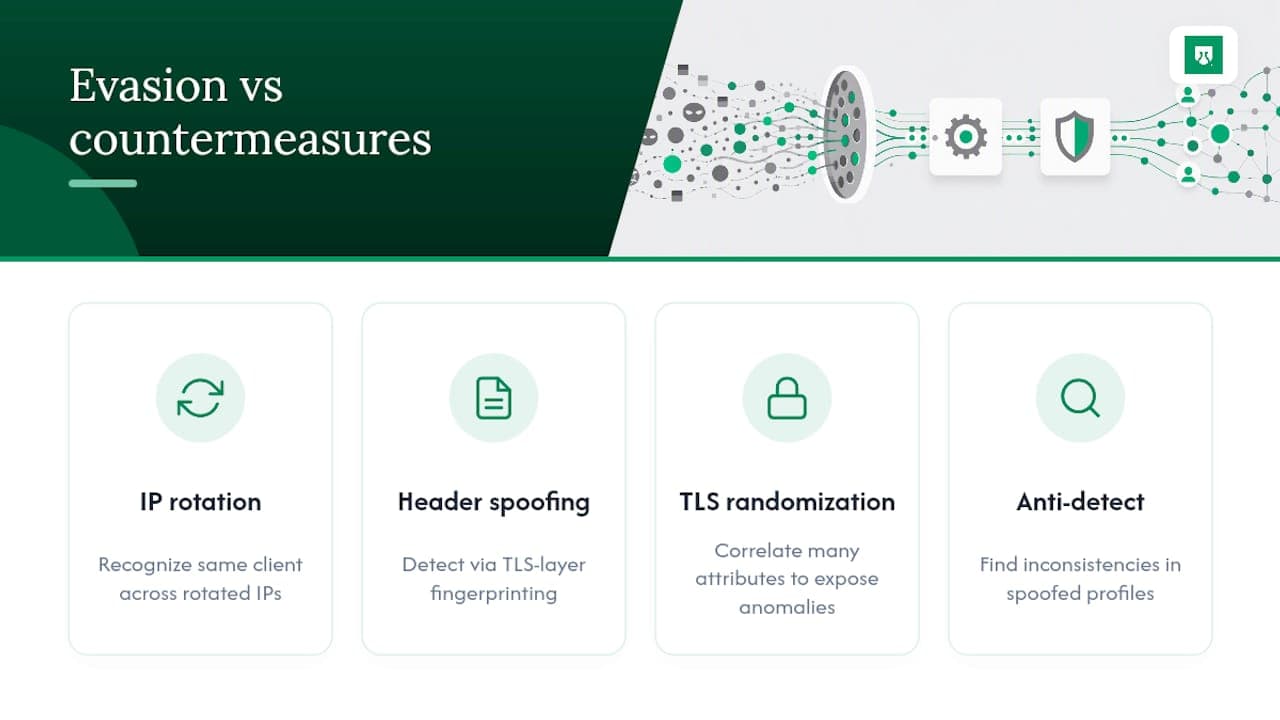
Countermeasures track each evasion tactic directly. Against IP rotation, persistent device and behavioral fingerprinting recognizes the same client across hundreds of rotated addresses, since the underlying device and behavior patterns don't change even when the IP does. Against header spoofing, TLS-layer fingerprinting catches what happens below the application layer, where spoofing is far harder to fake convincingly. Against fingerprint randomization, correlating dozens of attributes simultaneously exposes the statistical anomalies that a single randomized value can't hide. Against anti-detect browsers specifically, anti-detect browser detection looks for the inconsistencies that occur when a script tries to fake too many attributes at once, since genuine devices produce naturally correlated signals that spoofed profiles rarely replicate perfectly.
The arms race never fully resolves. Every detection improvement pushes evasion techniques to get more sophisticated, which is exactly why layered signals outperform any single method over time.
Balancing Detection Against Visitor Privacy
Proxy detection sits in tension with the same privacy motivations that drive people to use proxies in the first place. A person running a VPN specifically to avoid being tracked doesn't necessarily want their connection type, browser fingerprint, and behavioral pattern logged by every site they visit either.
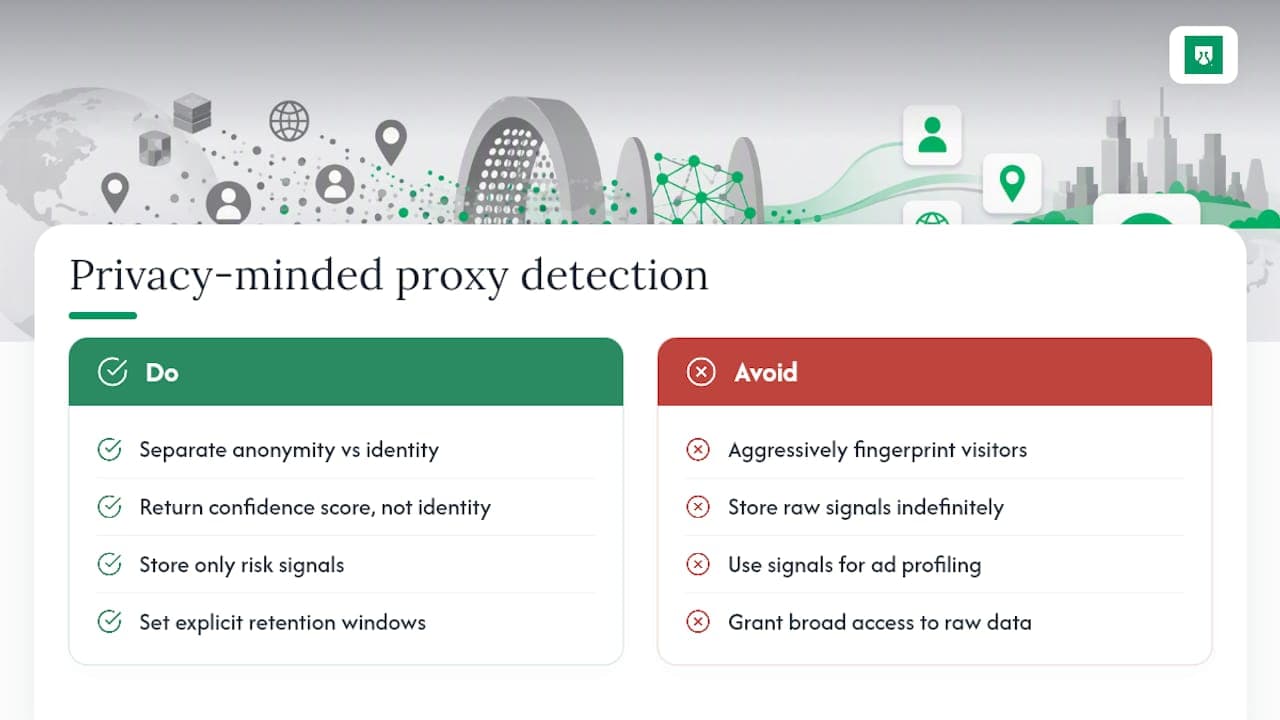
The privacy-conscious approach separates two questions that often get collapsed into one: is this connection anonymized, and who specifically is behind it? Good proxy detection answers the first question without necessarily answering the second. A confidence score and a proxy-type label don't require identifying the actual person, and systems that store only the risk signal rather than a full identity profile limit exposure if that data is ever breached or misused.
Retention policy matters as much as collection scope. Signals used to compute a real-time risk score during checkout don't need indefinite storage once the transaction resolves. Teams should define explicit retention windows tied to actual fraud-investigation needs (a chargeback dispute period, for example) rather than storing raw signal data indefinitely by default.
There's a reasonable counterargument worth taking seriously: aggressive fingerprinting for fraud prevention can shade into the same tracking techniques used for advertising profiling, and the line between the two isn't always visible to the person being tracked. The honest answer is that detection systems should be built and used narrowly, for the specific purpose of catching abuse like account takeover or multi-accounting, with access to raw evidence limited to the teams who need it for that purpose. Purpose limitation isn't just a compliance checkbox. It's the difference between a detection system that respects the people it's protecting and one that just adds another layer of surveillance to the internet.
Proxy Detection in Practice: Where It Actually Gets Used
iGaming platforms run proxy detection against bonus abuse, where the same person creates dozens of accounts from rotated residential IPs to claim sign-up bonuses repeatedly. Detection here leans on persistent fingerprinting more than IP reputation, since the individual IPs are usually clean.
Fintech and payment platforms apply stricter thresholds at withdrawal and account-opening moments than at browsing. A high-confidence datacenter proxy on a login attempt might trigger a step-up challenge; the same signal on a withdrawal request might trigger a manual review hold, because the cost of a false negative differs by an order of magnitude between those two actions.
Subscription and SaaS platforms use proxy detection to catch free-trial abuse, where a single person spins up trial accounts across dozens of "unique" sessions using rotating proxies to dodge device-based trial limits. Persistent identification that survives IP rotation directly closes that loophole, since the underlying device gets recognized regardless of which address it connects from.
E-commerce and marketplace platforms watch for proxy-masked location spoofing on promotional campaigns that are geographically restricted, where a shopper routes through a proxy in an eligible region to access a discount meant for a different market.
Across all four cases, the pattern repeats: the value isn't in blocking every proxy connection, it's in raising the cost and friction of abuse just enough that the economics stop working for the people running it at scale, while ordinary users pass through with minimal friction.
The Gap Between Textbook Detection and Production Reality
Most proxy detection writing treats the topic as a solved classification problem: check the IP, get an answer. That framing breaks down the moment residential proxies enter the picture, and residential proxies are exactly what serious fraud operators use now, because datacenter IPs get burned within days.
The advice that's usually missing: stop trying to build a perfect single-shot detector, and start building a feedback loop. Your thresholds on day one are guesses. The false positives and false negatives you log in the first month are the actual training data that makes the system useful, and teams that skip that iteration cycle end up with either a leaky system that lets abuse through or an overzealous one that blocks legitimate customers on shared corporate VPNs.
The other underrated point: caching and latency decisions aren't a footnote, they're a design constraint that shapes what detection you can even afford to run. A detection stack that adds 400 milliseconds to every checkout will get ripped out by the product team regardless of its accuracy. Detection that respects the performance budget survives long enough to actually generate the tuning data it needs to improve.
If there's one habit worth adopting over any specific technique, it's treating every verdict as provisional and every policy threshold as temporary. The proxy landscape shifts constantly. A system built to be re-tuned monthly will outlast one built to be right forever.
Yahor Papou, CMO at ShieldLabs
Evaluating a Proxy Detection Provider Before You Commit
Run any provider you're evaluating against a short checklist: signal breadth (does it cover Tor and Apple Private Relay, not just datacenter IPs?), whether evidence behind the score is exposed or hidden, added request latency, SDK coverage for your backend stack, and whether pricing is published or hidden behind a sales call.
Anti-detect browser detection, Tor and Private Relay coverage, and multi-accounting detection are available on some proxy detection plans, with pricing and identification limits varying among providers. That transparency matters when you're evaluating providers, because it lets your team test real traffic against real thresholds before committing budget, rather than negotiating blind. Explore VPN, proxy, and residential proxy detection to see how the signal categories map to your integration, and start with the free identification tier to see how your own traffic scores before deciding on anything further.
Sources
- RFC 7239: Forwarded HTTP Extension | RFC Editor
- Mi et al.: Resident Evil: Understanding Residential IP Proxy as a Dark Service (IEEE S&P 2019)
Recommended
Related articles
Stop False Positives: Apple Private Relay Detection for IT & Fraud Ops
Ops guide to detecting Apple Private Relay. Learn three detection techniques, when to return NXDOMAIN, and fraud safe rules for teams.

Deploy Tor Detection in Five Minutes for Security Engineers
Ops first Tor detection for security engineers: deploy exit lists, DNS/API lookup, TLS fingerprints, and auditable signals in five minutes.
6 Step Datacenter Proxy Detection Workflow for Fraud Teams
Practical production guide for fraud teams: detect datacenter proxies by pairing ASN, rDNS, device/TLS telemetry and IP population signals.