

Start Visitor Identification in 5 Minutes: Validate with 5,000 Live IDs


Last updated on September 23, 2026 · 9 min read
Visitor identification is the practice of using device and network signals to recognize a browser or device across sessions and score its risk, even when cookies get cleared or IP addresses rotate. It belongs in your stack whenever repeat abuse, account fraud, or traffic quality problems outrun what session data and login credentials alone can catch.
TL;DR:
- Device and network signals degrade at different rates, with network data remaining more resilient than browser attributes under privacy pressures.
- Persistent recognition combines device, network, and behavioral signals into one cross-checked identity to reduce errors caused by privacy updates or shared networks.
- Layering diverse signals, continuous validation, and fallback paths are essential to keep visitor identification reliable in production environments.
- Detection rules should target abusive patterns like multi-accounting, trial abuse, and account takeover, with conservative thresholds to balance review volume and accuracy.
- Validating visitor identification tools requires checking signal transparency, cross-session persistence, integration options, and testing on real traffic with published pricing.
What Signals Make Up Visitor Identification?
Visitor identification pulls from four signal groups, and each one degrades differently under pressure. Browser and hardware attributes (screen resolution, installed fonts, canvas rendering, GPU details) are easy to collect but increasingly unstable, since privacy updates in major browsers change fingerprint output with little warning. Network signals (IP address, autonomous system number, datacenter range detection) tend to be more resilient because rerouting traffic through a VPN or anti-detect browser still leaves detectable fingerprints in connection behavior. Behavioral metadata (typing cadence, navigation timing, session duration) adds a layer that's harder to fake convincingly. Derived patterns, such as how many accounts share one device fingerprint, turn raw signals into fraud indicators.
The anonymity vectors your detection needs to cover include:
- VPNs and commercial proxies masking origin IP
- Tor exit nodes and their rotating relay structure
- Apple Private Relay, which obscures both IP and location
- Datacenter IP ranges used to simulate residential traffic
- Anti-detect browser configurations built to spoof or randomize fingerprints
- Automation frameworks and bot traffic mimicking human sessions
- Cookie clearing and incognito sessions meant to reset identity
Network anchors tend to outlast browser attributes because changing your IP or ASN takes more deliberate effort than clearing a cache. A device fingerprinting approach that leans only on browser-level signals will drift faster than one that weights network and behavioral data alongside it.
Why Persistent Recognition Beats Single-Session Fingerprinting
Single-session fingerprinting answers one question: is this visit unique right now? Persistent identification asks a harder question: is this the same visitor as three months ago, despite a new IP, a cleared cache, and a different browser version? The distinction shows up in two failure modes. A collision happens when two different users get collapsed into one identity, usually because they share generic device specs or sit behind the same network. A division happens when one real user gets split into several IDs because a browser update, a new network, or a privacy setting changed their signal fingerprint.
Both failure modes have gotten worse as browsers ship more aggressive privacy defaults. Research on browser privacy changes breaking visitor identification accuracy shows that platform updates can quietly raise false positive rates when a system treats fingerprinting as its sole identity signal. Shared networks compound the problem, since a coffee shop's IP or a company's NAT gateway can make dozens of unrelated devices look identical to a network-only detector. Mobile carriers add another wrinkle: carrier-grade NAT means thousands of phones on the same network can share an IP simultaneously.
The fix isn't chasing a perfect binary match. It's assigning a confidence score to each identification and setting thresholds, so a high-confidence match triggers different downstream logic than a lower-confidence one. Persistent device intelligence works by combining device, network, and behavioral signals into a durable ID that survives cleared cookies, incognito, and IP rotation.
Building an Operational Program That Doesn't Break in Production
A visitor identification program only holds up if it's layered, tested, and monitored the way any production system should be. Here's the sequence that keeps it reliable:
- Layer signals, don't stack one on top of another blindly. Combine device fingerprints with IP reputation, behavioral timing, and account history so no single evasion technique defeats the whole system.
- Run continuous validation against browser beta channels. Test upcoming releases before they ship broadly, and correlate any KPI shift with the release date to catch drift early.
- Set drift thresholds that trigger action. If match rate drops or false positives spike past a defined percentage, that's a signal to investigate, not a number to explain away later.
- Build fallback paths for degraded confidence. Step-up verification, short-lived tokens, and rate limits give you a way to handle a visitor who can't be matched with high confidence, instead of defaulting to a hard block or a blind pass.
Pro Tip: Track match rate, false positive rate, and manual review volume as a set, not individually. A rising match rate paired with rising manual review volume usually means your confidence thresholds are too loose, not that detection is improving.
Segment traffic-quality metrics by acquisition channel too. A campaign that drives cheap clicks but a disproportionate share of anonymized or high-risk sessions is a signal worth escalating to your marketing team, not just your fraud queue.
How to Integrate Visitor Identification Without Losing Signal
Where you place identification code changes what you can measure. A client-side JavaScript snippet is faster to deploy and works for most web traffic, but placing it after a consent banner can quietly suppress early-session signal collection. A server-side SDK gives more control over timing and works better when you need identification before a page fully renders, such as at checkout or login.
Initial configuration should cover a short list of decisions before you look at a single dashboard:
- Enable bot filtering immediately, since unfiltered bot traffic inflates your denominator and makes match rate look worse than it is
- Split mobile and desktop reporting from day one, since carrier NAT affects mobile match rates differently than fixed broadband
- Refresh IP-to-ASN mappings on a regular cadence rather than treating them as static
- Run a sampling period on staging traffic before trusting production numbers
The first metrics worth instrumenting are raw identification counts, match rate split by device type, false positive rate from manual review outcomes, and per-source traffic risk bands. Teams that skip the mobile/desktop split often misdiagnose a carrier-NAT problem as a fingerprinting failure. Fixes like moving collection server-side and filtering bots before they hit your match-rate calculation have been shown to lift match rates by double-digit percentage points in teams that had been measuring against an inflated denominator.
Detection Rules for Common Fraud Patterns
Most abuse patterns show up as a mismatch between visitor continuity and account velocity. Here's how that translates into rules:
- Multi-accounting: flag when fingerprint confidence stays above a set threshold while accounts-per-fingerprint over a rolling window exceeds your baseline.
- Free-trial abuse: combine device recognition with payment method reuse and email pattern checks; a returning device signing up under a new email within days of a prior trial expiration is a strong signal.
- Account takeover: watch for a login from a device or network the account has never used, paired with immediate changes to payment details or contact information.
- Coordinated rings: look for one fingerprint or a narrow fingerprint cluster appearing across dozens of accounts, especially alongside rapid account creation spikes from the same network or ASN.
Tune these rules conservatively at first. A threshold set too tight generates review volume your team can't absorb, and a threshold set too loose lets rings operate undetected for weeks. Escalate to manual review whenever confidence sits in the middle band rather than auto-approving or auto-denying borderline cases. Device fingerprinting paired with additional verification signals consistently outperforms fingerprinting used alone, since anti-fingerprinting tools and spoofed fingerprints can undermine a single-signal rule set.
What a Detection Layer Looks Like in Production
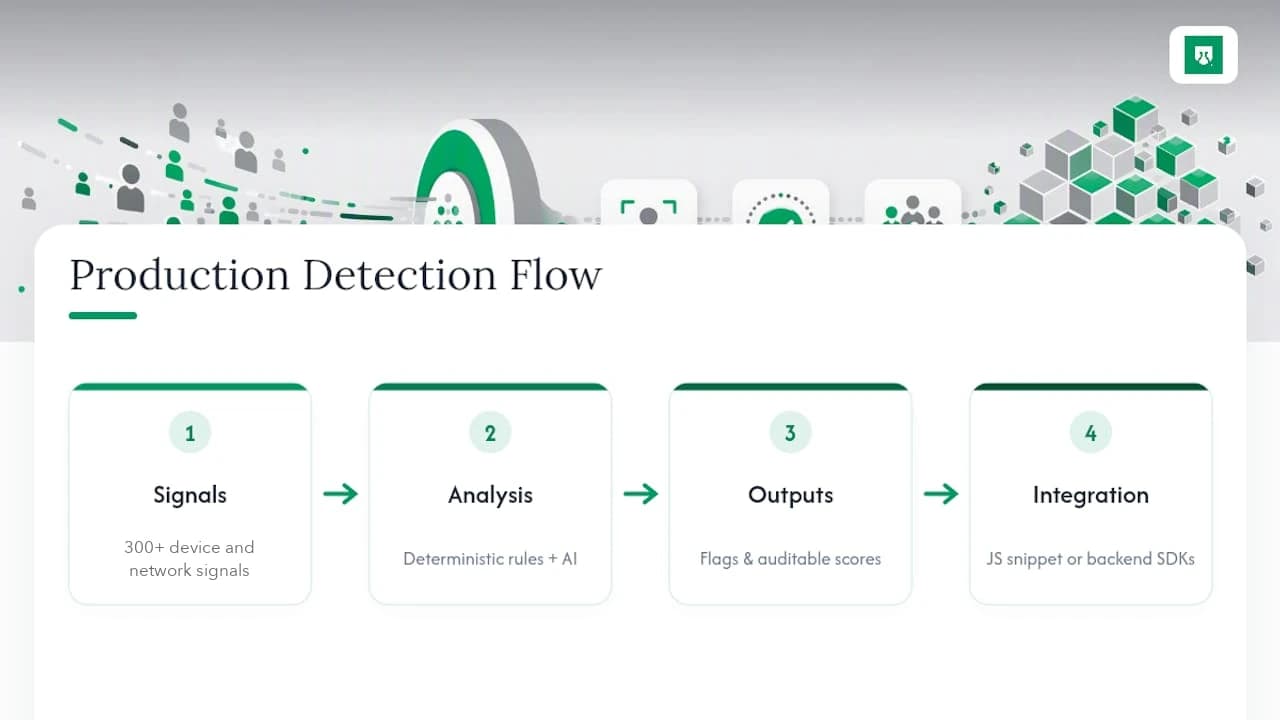
ShieldLabs identifies visitors using more than 300 device and network signals, interpreted through deterministic rules and AI to flag VPNs, proxies, Tor, Apple Private Relay, datacenter ranges, anti-detect browser detection, and automation or bot traffic.
Every score comes with the specific signals that produced it, so your engineering and risk teams can audit the reasoning and choose the action for each case, rather than trusting an unexplained number. Integration runs through a JavaScript snippet or backend SDKs for Node.js, Python, Go, and PHP, documented for teams evaluating device intelligence and visitor recognition against their existing stack.
When Visitor Identification Actually Pays Off
Identification earns its cost fastest against repeat abuse: trial fraud, promo abuse, and account rings where the same device keeps resurfacing under new identities. Treat every rollout as a test to measure against the match rate, false positive rate, and review volume KPIs already on your dashboard, then iterate from there.
Yahor Papou, CMO at ShieldLabs
Evaluating a Detection Layer: What to Check Before You Commit
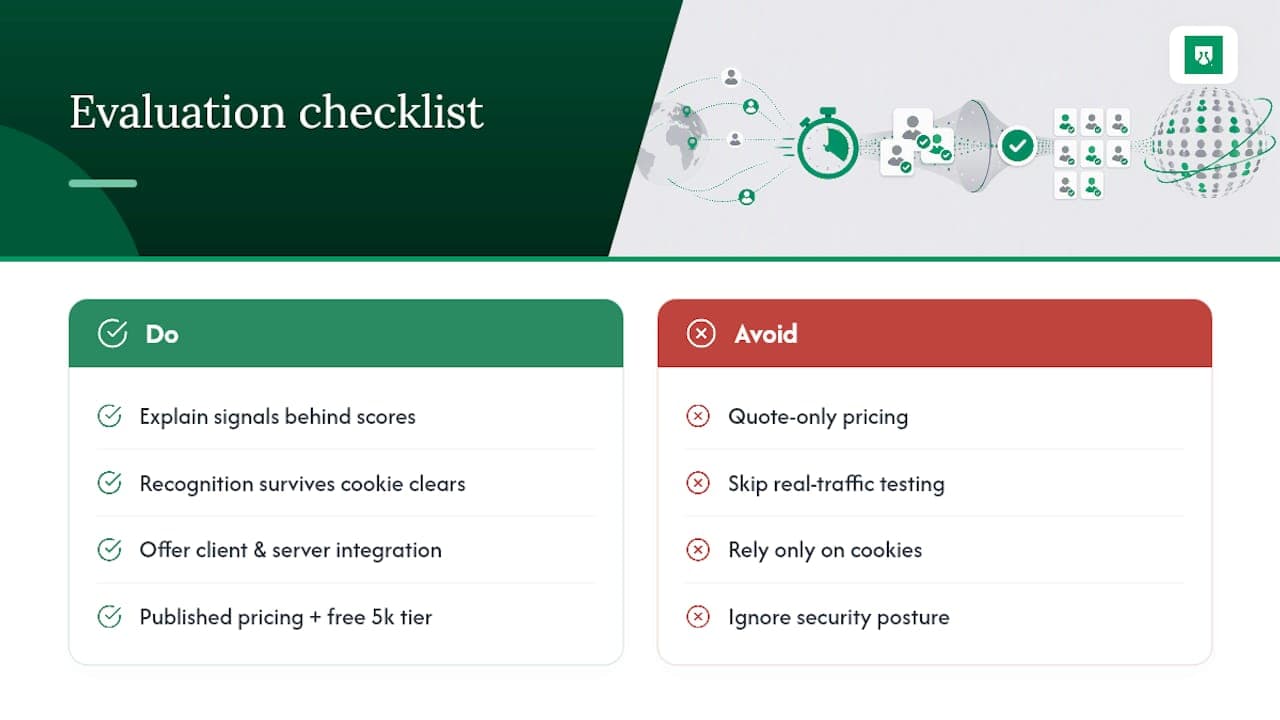
Before picking a provider, run through a short checklist: does it explain the signals behind each score, does recognition persist across cleared cookies and rotating IPs, does it offer both client-side and server-side integration, is pricing published rather than quote-gated, and can you test it on real traffic before paying?
Pricing is published and a free tier with 5,000 identifications (one time) is available, so your team can validate match rates on live traffic before committing budget. The risk signal detection product covers VPNs, proxies, Tor, Private Relay, and anti-detect browser configurations, while risk scoring and ready-made multi-accounting detection flag the cross-account behavior directly. For teams weighing broader operational security posture alongside identification, TradeDupe's security practices are worth a look as part of that evaluation.
Setup takes about five minutes with the JavaScript snippet, and framework guides cover React, Next.js, Vue, Angular, Svelte, and Preact. Start by reviewing the visitor identification product page and running your first integration against a staging environment this week.
Sources
- Browser privacy changes are breaking visitor identification accuracy
- Why Visitor Identification Tools Miss Visitors: 7 Causes and Fixes (2026)
Recommended
Related articles
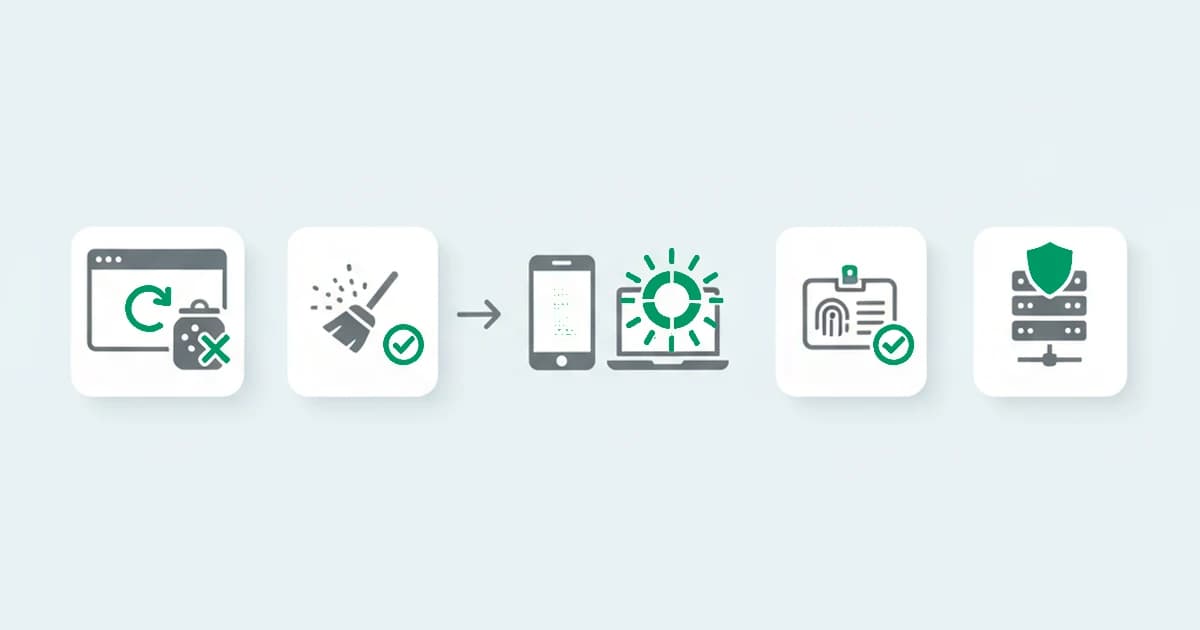
Cookieless device identification: how to recognize a returning device without cookies
What cookieless device identification is, how it recognizes a returning device without a stored cookie, and why it is not the same as cookieless analytics.


Developers: 5 Steps to Reliable Persistent Device IDs
Implement persistent device IDs on Android, iOS, and web: MediaDrm and Keychain storage, migration, privacy best practices, and where ShieldLabs fits.

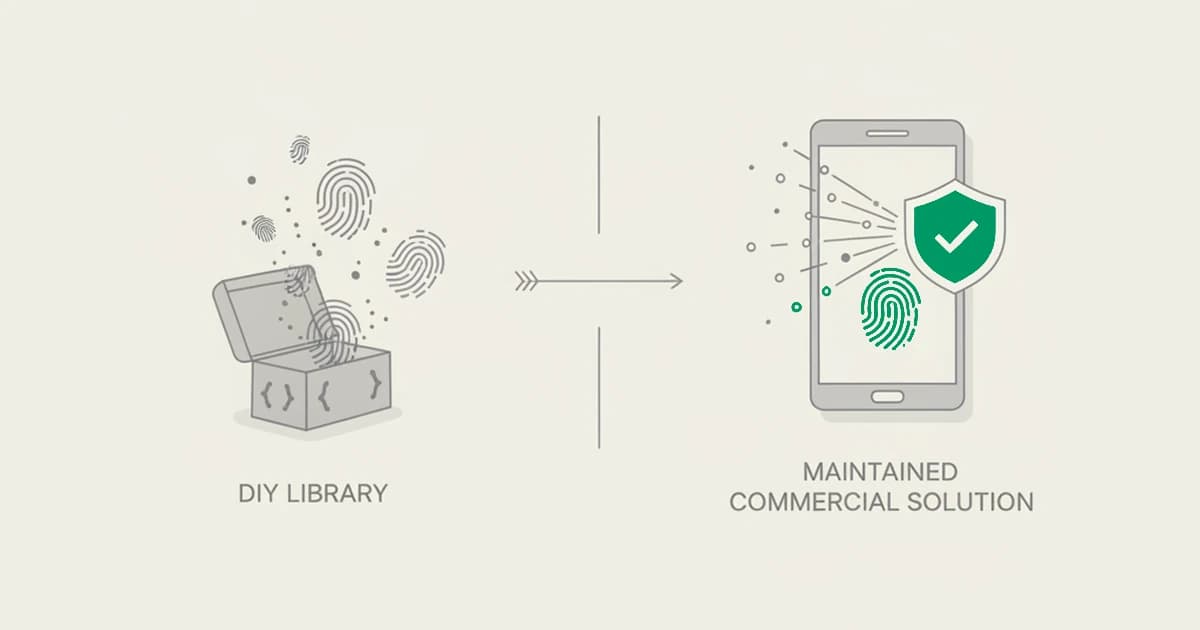
The best device fingerprinting solutions in 2026: build vs buy
The best device fingerprinting solutions in 2026, split into open-source libraries you self-host and commercial ones that maintain the identifier.