

Setup Multi Accounting Detection in 5 Minutes for Fraud Teams


Last updated on September 23, 2026 · 11 min read
Detect multi-accounting early by scoring registrations and logins with device, network, and behavioral signals, then correlating accounts through link analysis before payment or reward changes hands. The practical sequence: capture a device fingerprint at signup, store hashed identifiers so accounts can be graphed against each other, and gate promotions or payouts behind staged verification rather than a single hard rule.
TL;DR:
- Device fingerprinting and network signals can reliably identify infrastructure reuse, such as proxy pools and shared IP ranges, aiding early detection before payouts.
- Combining multiple signals, including device behavior, network data, identity reuse, and activity patterns, significantly improves accuracy over relying on any single indicator.
- Graph analysis clusters accounts with shared identifiers, enabling retroactive review of coordinated fraudulent rings once one account is flagged.
- Staged responses, like multi-factor challenges and payout holds, help reduce friction for genuine users while protecting against high-risk multi-account activity.
- Shieldlabs collects over 100 signals per visit and offers scalable tools that provide transparent risk scores with detailed evidence to justify enforcement decisions.
Table of Contents
- What Is Multi-Accounting Detection and Why It Matters
- How Fraud Rings Hide Multi-Accounting
- Signal Groups That Catch Coordinated Accounts
- Device Intelligence, Graph Analysis, and Behavioral Models Compared
- Turning Detection Into Proportional Controls
- Author Standing and the Signals Behind ShieldLabs Scoring
- Where Friction Belongs in the Fraud Stack
- Evaluating ShieldLabs as a Detection Layer
- Sources
- FAQ
What Is Multi-Accounting Detection and Why It Matters
Multi-accounting means one person or one coordinated group operates several accounts to extract value a platform intends for a single user. That's distinct from account sharing, where legitimate credentials pass between people, though the two often produce similar signal patterns and get evaluated by the same systems.
The damage compounds when it goes uncaught:
- Promo and referral programs pay out multiple times for what should be one signup
- Free-trial cycling drains compute or inventory that never converts to revenue
- Ban evasion lets removed users return under a fresh identity
- Product analytics get distorted, masking real retention and inflating growth metrics
Gaming and iGaming operators see this hit bonus economics directly, fintech and crypto platforms see it around referral and KYC-linked incentives, and e-commerce or SaaS teams see it in trial abuse and loyalty programs. Any product with a per-account bonus, quota, or discount is a target.
How Fraud Rings Hide Multi-Accounting
Coordinated operators lean on infrastructure that mimics ordinary user diversity. Residential proxy pools rotate IPs to avoid the obvious "same address, ten accounts" pattern, while datacenter ranges get used when speed matters more than stealth. Autonomous system number (ASN) clustering often gives away both, since fraud infrastructure tends to concentrate on a handful of hosting providers.
Anti-detect browser detection matters because these browsers, along with emulators, virtual machines, and physical device farms, are built specifically to make one operator look like many distinct people. Add scripted signups at inhuman velocity, throwaway email domains, and virtual phone numbers rented for verification only, and a ring can look, on the surface, like organic growth.
- Residential and datacenter proxy rotation to defeat simple IP blocklists
- Anti-detect browsers, emulators, and virtual machines that fake distinct device fingerprints
- Disposable emails, virtual numbers, and scripted signup flows that move faster than a human ever could
Signal Groups That Catch Coordinated Accounts
No single signal proves multi-accounting. Effective detection stacks four families of evidence and looks for overlap.
- Device and browser fingerprints. Coarse-grained fingerprints (screen resolution, timezone, installed fonts) run cheaply at scale, while fine-grained checks add canvas rendering, WebGL output, and audio stack quirks. Research on browser fingerprinting at web scale shows coarse signals still expose repeated fraud environments when paired with behavioral checks and drift detection.
- Network signals. IP address, ASN, and even shared IPv6 /64 prefixes reveal infrastructure reuse; proxy and resolver detection flags traffic routed through anonymizing layers.
- Identity signals. Email pattern similarity, phone number reuse across "different" people, and repeated payment instruments are strong correlators once accounts are linked in a graph.
- Behavioral signals. Signup velocity, time-to-first-payout, and the sequence of in-app actions expose scripted journeys that don't match how real users actually behave.
Shared environments deserve nuance, not an automatic flag. Corporate NAT, university networks, and CGNAT put many legitimate users behind one visible IP address, so a single shared IP should weight a risk score, not trigger a block on its own.
Pro Tip: Weight signals instead of gating on any one of them. A shared device fingerprint plus a shared payment instrument plus signup velocity in the same hour is a very different signal than a shared IP alone.

Device Intelligence, Graph Analysis, and Behavioral Models Compared
Three approaches dominate multi-accounting detection, and mature programs run them together rather than picking one.
Device intelligence persists identification across cookie clears, incognito sessions, and IP rotation, which is exactly what a rotating-proxy operator is trying to defeat. Coarse fingerprints are fast and privacy-friendlier at scale; fine-grained fingerprints add precision but cost more to compute and maintain. The trade-off is speed and coverage against depth.
Graph and network analysis treats every identifier, device, IP prefix, email, payment instrument, as a node, then clusters accounts that share enough of them to look like one operator wearing different masks. This is what finds coordinated rings that no single-account review would ever catch, and it works retroactively: once one account in a cluster is confirmed fraudulent, the whole cluster can be reviewed. Graph learning methods applied to multi-account detection report strong classification accuracy for exactly this kind of coordinated abuse, outperforming rule-based lookups on independent identifiers alone.
Behavioral and lifecycle models track how accounts act over time rather than just at signup, catching scripted journeys, staged fraud sequences, and the specific rhythm of a farm cycling through promo redemptions.
- Device intelligence: strongest for defeating cookie clearing, incognito mode, and IP rotation
- Graph analysis: strongest for finding coordinated rings across independent identifiers, including retroactively
- Behavioral/lifecycle models: strongest for catching scripted or staged sequences that don't match organic use
Combining device features with relational graph learning at scale is what separates systems that catch isolated bad actors from systems that catch the network behind them, according to research on device and relationship network representation for fraud detection.
Machine learning models layered on top of these signals need retraining cadence, since fraud tactics drift, and a latency budget, since scoring has to happen inside the registration or checkout flow, not after the fact.
Turning Detection Into Proportional Controls
Detection only has value once it changes an outcome, and the outcome should scale with risk rather than block everyone equally.
- Score early. Evaluate risk at registration and login, not just at checkout, so device fingerprinting and account-linking signals inform the decision before payment or reward is granted.
- Stage the response. Move from observe, to challenge with multi-factor authentication, to restrict with a hold on payouts or promotions, to block, and reserve the harshest stage for confirmed high-risk clusters. Staged verification protects conversion for everyone else.
- Rate-limit by attribute, not just by account. Cap actions per device fingerprint, per IP prefix, and per payment instrument, since a fraud ring will exhaust one account limit and simply open another.
- Review clusters retroactively. Once one account in a graph is confirmed abusive, pull the full cluster for review rather than closing the single account and moving on.
Pro Tip: Track false positive rate, prevented loss, time-to-decision, and channel-specific abuse rates as ongoing KPIs. A detection system that never gets measured against these tends to drift toward either too much friction or too little.
Author Standing and the Signals Behind ShieldLabs Scoring
This analysis draws on operational patterns documented across account takeover detection research and a review of multi-accounting detection tooling, work that informs Jeff's writing on account abuse and detection architecture for this publication.
Shieldlabs approaches this problem by collecting more than 100 signals per visit, covering device fingerprints, network characteristics, and anti-detect browser detection, then persisting identification across sessions with up to 99% accuracy despite cleared cookies or rotating IPs. Every risk score ships with the specific signals behind it, which matters for two operational reasons:
- Teams can justify an enforcement decision internally with evidence, not a black-box number
- Audit trails hold up when a customer disputes a restriction or a regulator asks how a decision was made
Where Friction Belongs in the Fraud Stack
Friction is a budget, not a default. Spend it on high-value actions, payouts, promo redemption, account changes, and monitor everything else quietly in the background. Lifecycle monitoring catches farms that pass every signup check individually but reveal themselves through timing and correlation across weeks. Smaller teams should prioritize a good device signal and a graphing habit before they buy anything more elaborate; larger teams need retraining cadence and a dedicated review queue for flagged clusters.
— Jeff
Evaluating ShieldLabs as a Detection Layer
Running a pilot beats reading another comparison chart. Shieldlabs gives fraud and product teams a way to see the actual signals behind a risk score rather than trusting an opaque number, which matters when you need to defend an enforcement decision to a customer or a finance team. The device intelligence product collects over 100 signals per visit, and pattern detection for multi-accounting and account farms pre-computes the cluster relationships that would otherwise take an analyst hours to build by hand.
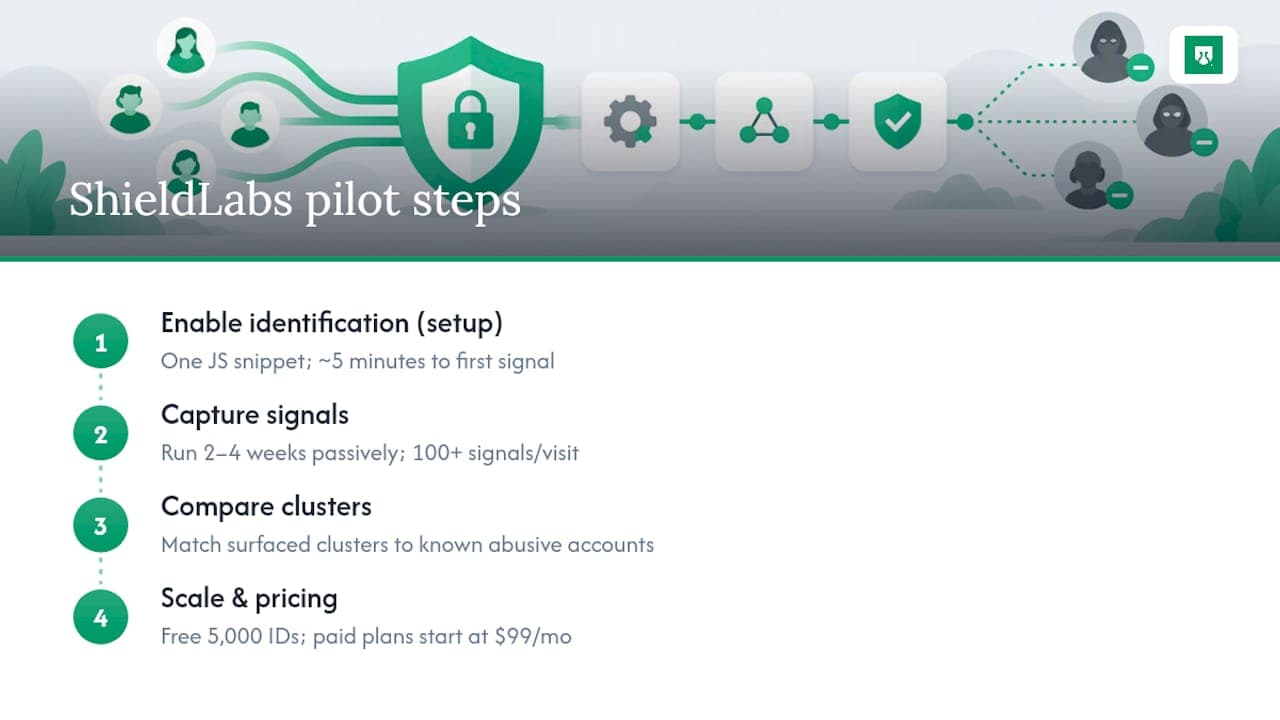
A practical pilot: enable identification on registration, let it run for two to four weeks capturing signals passively, then compare the clusters it surfaces against accounts your team already knows were abusive. The free tier covers up to 5,000 identifications with no card required, and paid plans on the pricing page start at $99 a month once you scale past that. Setup is one JavaScript snippet, roughly five minutes to the first signal, with framework guides ready for common stacks.
Sources
- Multi-account and account-sharing abuse · Stripe Radar docs
- Graph learning approaches for multi-account detection (arXiv)
- Browser Polygraph: Efficient Deployment of Coarse-Grained Browser Fingerprints for Web-Scale Detection of Fraud Browsers
FAQ
Is Making Multiple Accounts Illegal?
It depends on jurisdiction and platform terms rather than a universal law. Most platforms prohibit multiple accounts through their terms of service, which makes it a contract violation and grounds for account action, even where no criminal statute applies; multi-accounting tied to payment fraud or identity theft can cross into criminal territory depending on local law.
What If My Mobile Number Is Linked to Multiple Accounts?
A shared phone number across accounts raises risk score but isn't automatic proof of abuse, since households and shared devices are common. Platforms typically weight phone reuse alongside device and payment signals rather than acting on it alone, consistent with guidance on avoiding single-signal enforcement.
What Are the Risks of Having Multiple Accounts?
Account suspension or permanent ban is the most common consequence once a platform's detection flags a cluster. Forfeited bonuses, held payouts, and loss of purchase or loyalty history across every linked account are also standard outcomes, since enforcement usually applies to the whole cluster once one account is confirmed.
What Does "Multiple Accounts" Actually Mean for a Platform?
It means one person, household, or coordinated group controls more than one account on a service that expects one account per user. The distinction that matters operationally is intent: a family sharing a streaming login is different from a scripted operation opening accounts to farm promo credit, and detection systems are built to tell those two apart using device, network, and behavioral signals together.
How Much Does ShieldLabs Cost to Try?
Shieldlabs offers a free tier covering up to 5,000 identifications with no card required and no expiry. Paid plans start at $99 per month, with pricing detailed on the ShieldLabs pricing page.
Recommended
Related articles
3 Checks to Catch Click Spamming: Detection Playbook for Marketers
Operational playbook for marketers and fraud analysts: three checks, CTIT, conversion baselines and device fingerprints, to detect click spamming early.

Operators: Persistent IDs for Bonus Abuse Detection in 24–72 Hours
Capture deposit to withdraw events, prioritise persistent visitor IDs and cohort signals, and score bonus claims in real time to stop abuse.
Fingerprinting vs Cookies: Key Differences for Fraud Teams
How cookies differ from server-side fingerprinting, why many cookieless claims mislead, and practical steps for developers and fraud teams.