

3 Checks to Catch Click Spamming: Detection Playbook for Marketers

Last updated on September 23, 2026 · 15 min read
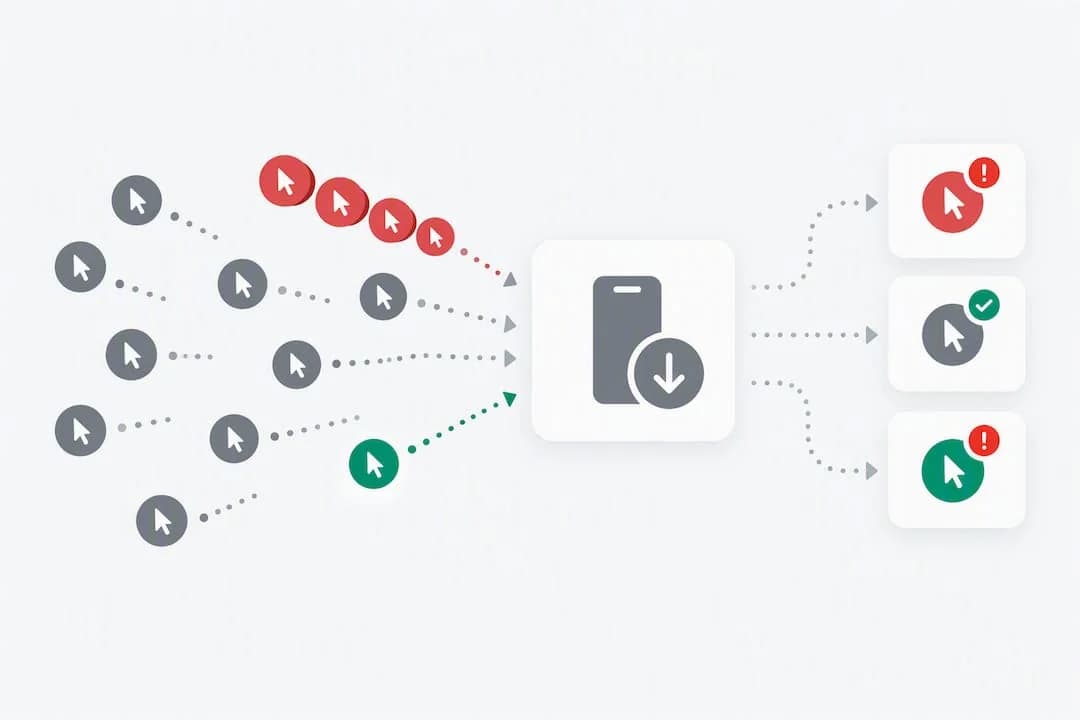
Click spamming detection identifies fraudulent or reused ad clicks by inspecting click-to-install timing, conversion-rate patterns, and persistent-device signals rather than trusting the click alone. The fastest read on any campaign comes from three checks: does the click-to-install time (CTIT) distribution cluster near zero or repeat identically, does a publisher's conversion rate collapse against its own baseline, and do device fingerprints show the same identity claiming credit for installs it never touched. Run those three checks at the publisher level before anything else: they catch most click spamming without a single line of custom modeling.
TL;DR:
- Click spamming is best detected by analyzing click-to-install timing, conversion rates, and device fingerprinting at the publisher level to identify anomalies.
- While active injection fires clicks exactly during install events, replay-based spamming reuses legitimate metadata to blend into normal traffic patterns and evade simple rules.
- Combining multiple detection methods, such as CTIT distribution analysis, ROI anomalies, pattern clustering, and bait-click watermarking, improves accuracy and reduces false positives.
- Statistical and clustering techniques, often combined with AI, are increasingly essential to detect low-rate, distributed, and randomized click spamming attacks.
- Cross-checking suspicious signals against multiple independent metrics remains critical, as no single indicator can reliably identify all forms of click spam on its own.
What Is Click Spamming and Why It Wrecks Attribution
Click spamming is a form of invalid traffic in which a publisher or malicious SDK fires a high volume of clicks, hoping one lands close enough to a real install to steal the attribution credit. It differs from click injection in that it doesn't need to detect the install in progress. It just floods the attribution window with clicks and lets statistics do the stealing.
The mechanics vary, but three vectors dominate:
- Infected or low-quality apps that fire background clicks through a hidden webview while the device sits idle.
- SDKs bundled into unrelated apps that replay click identifiers pulled from other ad networks or previously seen traffic.
- Ad placements stacked invisibly behind other content, generating clicks no person ever saw or intended to make.
The damage shows up downstream, not at the point of fraud. A marketing team sees a spike in installs from a publisher, assumes the campaign is working, and shifts budget toward it. Lifetime value calculations get diluted because the "acquired" users were never exposed to the ad and convert at organic rates, if at all. One common scenario: an app goes viral organically through word of mouth, users search for it and install directly, and a click-spamming publisher's flood of clicks happens to overlap the install window. The network gets the credit and the budget, and the real driver of growth, word of mouth, gets none of the analysis it deserves.
How Click Spamming Works: Timing, Replay, and Injection
Click spamming splits into two operational patterns, and the distinction matters for detection strategy. Organic-replay clickspam takes real click metadata (device ID, IP address, timestamp, campaign ID) captured from legitimate traffic and re-fires it at high volume, betting that one replayed click aligns with a genuine install. Active injection is more aggressive: malware or an SDK detects that an install is happening in real time and fires a click at that exact moment to claim credit deterministically.
Attribution platforms typically see a limited but consistent set of metadata on every click: device identifier, IP address, click timestamp, and campaign or creative ID. Fraud operators lean on this transparency. Reusing legitimate traces, rather than fabricating new ones, is what makes organic replay clickspam blend into normal traffic logs.
What makes both patterns hard to catch with simple rules:
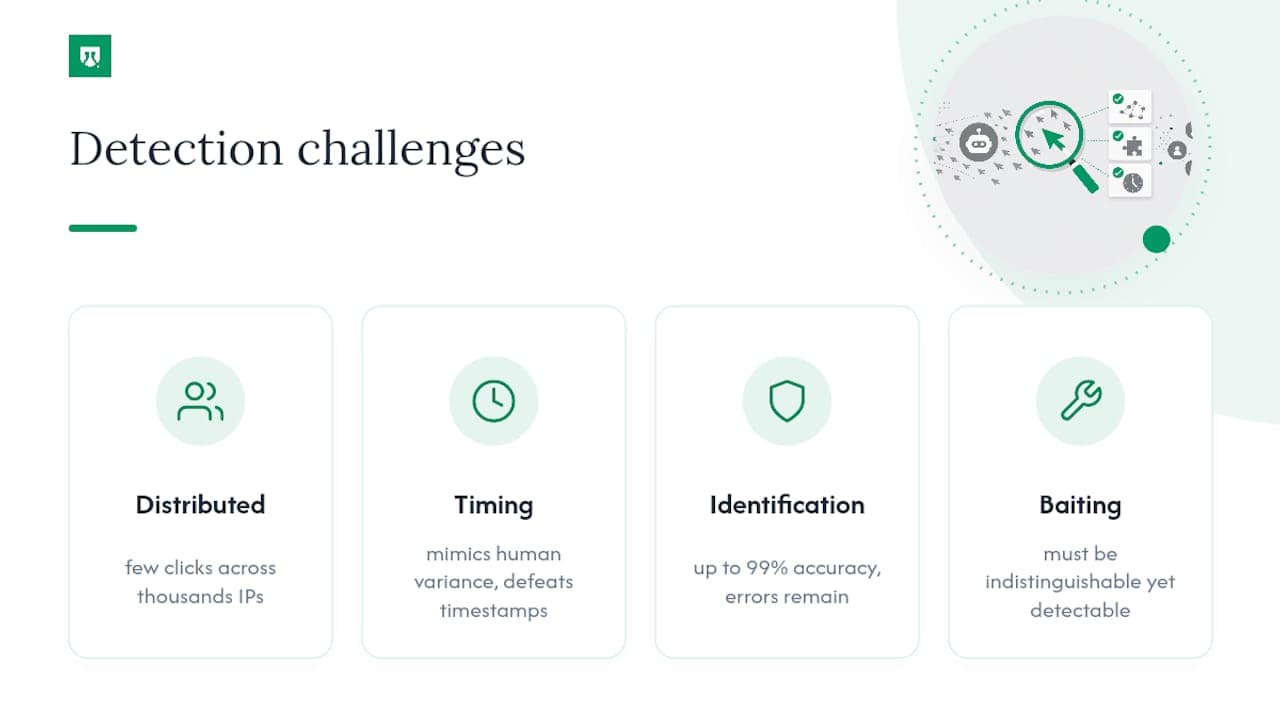
- A single publisher sending 10,000 clicks an hour is obvious. The same publisher sending clicks across thousands of IP addresses at low rates per address is not.
- Distributed, low-rate attacks stay under almost any static threshold, since no single source ever crosses the volume that would trigger a rule.
- Randomized inter-click timing designed to mimic human variance defeats naive timestamp-gap filters, which is why detection has moved toward statistical distribution analysis instead of hard cutoffs.
Detection Methods Compared: What Each One Actually Catches
No single technique catches every flavor of click spamming, and treating one as sufficient is the most common operational mistake. Here's how the major methods stack up against each other.
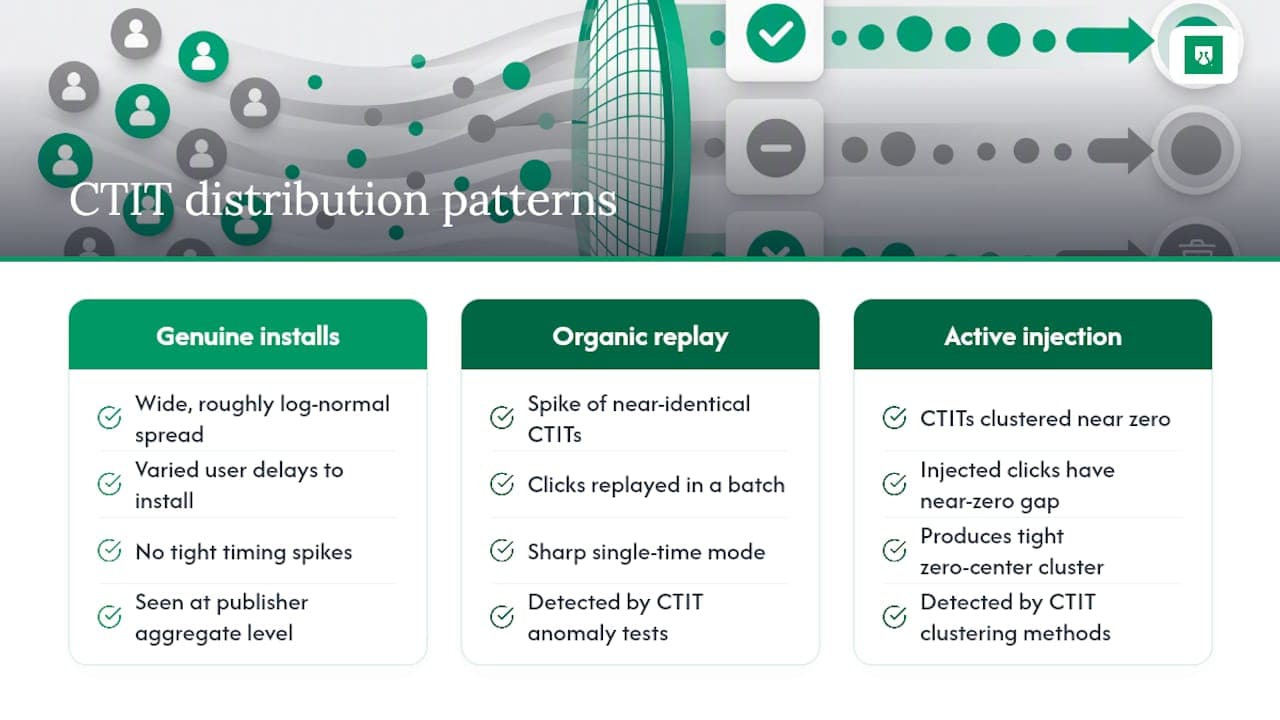
CTIT distribution analysis looks at the click-to-install time, the gap between the recorded click and the recorded install, across a publisher's traffic. Genuine installs produce a wide, roughly log-normal spread of CTITs because real users browse, get distracted, and install at different points after clicking. Click spamming produces telltale anomalies: a spike of near-identical CTITs (because clicks were replayed in a batch) or CTITs clustered near zero (active injection). A multiple-testing statistical procedure applied to CTIT data correctly cleared every legitimate publisher in a 30-publisher study while flagging 73% of the fraudulent ones, with a proven worst-case false-positive rate of 5%. The caveat: this works at the publisher aggregate level, not on a single click, so you need volume before the statistics are meaningful.
Device fingerprinting and persistent identification solve a different problem: correlating clicks and installs to the same real-world device even after a cookie clear, an app reinstall, or months of gap between sessions. This matters because fraud rings rotate IPs and clear identifiers specifically to defeat naive matching.
Timing and pattern decomposition, using techniques like non-negative matrix factorization and entropy scoring, isolates recurring timing signatures inside large click logs, which is how research into search engine click spam separates replayed clickstreams from organic variance even at low, distributed rates.
Publisher-level ROI anomaly detection, the approach behind Viceroi's click-spam catching method, flags publishers whose apparent return on investment is statistically implausible given real conversion economics, and it caught six distinct classes of click-spam in live ad-network data without needing separate tuning for each attack type.
Bait-click and mimicry defenses, the active approach used in Clicktok's mimicry and bait-click research, plant watermarked clicks and measure whether fraud reproduces their timing signature, reaching detection rates as high as around 95% with meaningfully lower false positives than passive-only methods.
Pro Tip: Never act on a single method's flag alone. A CTIT spike can come from a genuine ad network outage that delayed timestamp logging just as easily as from spamming. Cross-check any flagged publisher against at least one independent signal, fingerprint clustering or ROI anomaly, before you cut a placement.
Metrics to Watch Before Fraud Becomes a Budget Problem
Four numbers deserve a permanent spot on any attribution dashboard, and each catches a different failure mode.
- Median CTIT and its distribution shape by publisher and placement, watched for sudden compression toward zero or unnatural clustering.
- Click-to-install conversion rate benchmarked against each publisher's own historical baseline, not a network-wide average, since normal conversion rates vary enormously by placement type.
- Click redundancy, meaning the rate of duplicate or near-duplicate click signatures (same device ID, same campaign, suspiciously close timestamps) hitting the same campaign.
- Click volume spikes paired with flat or falling install yield, the classic signature of a publisher flooding clicks without generating matching genuine interest.
A workable alert rule: flag any publisher whose median CTIT drops by a meaningful margin week over week, or whose conversion rate falls several standard deviations below its own trailing baseline. Slice every metric by publisher, placement, device fingerprint cluster, and campaign separately. Fraud almost never distributes evenly, and network-wide averages hide the exact publishers you need to isolate.
A Step-by-Step Workflow for Investigating Suspected Click Spamming
- Triage. Pull CTIT distributions and conversion rates for the campaign in question and compare them against a 30 to 90 day baseline. Anything materially outside normal range earns a closer look.
- Isolate. Pivot the flagged traffic down to the specific publisher or app placement responsible. Check device fingerprint overlap (are the same identifiers reappearing across unrelated campaigns) and timing patterns within that narrower slice.
- Validate. Apply pattern clustering and entropy checks to confirm the traffic shows the repetitive signature associated with replay attacks, and run bait-click tests where your infrastructure supports them.
- Act. Tag or exclude the confirmed placement inside your attribution platform, route the underlying risk signals into whatever system your team uses to block or throttle the traffic, and adjust campaign targeting to stop future spend from reaching that source.
- Verify. Track the same metrics for the following reporting cycle to confirm the anomaly disappears, and document what triggered the investigation so the next analyst recognizes the pattern faster.
Pro Tip: Keep a running log of confirmed click-spamming publishers and the specific signal that caught each one. Over a few quarters, this becomes a far better early-warning list than any generic industry blacklist, because it reflects the fraud patterns actually hitting your campaigns.
What the Research Says About Detection Accuracy
Academic results give practitioners something rare in fraud prevention: actual published detection and false-positive numbers instead of vendor claims.
Mimicry-based detection identified roughly 81% of stealthy, low-rate attacks in controlled experiments, and adding bait-click watermarking pushed that figure to as high as 95% while cutting false positives well below passive-only baselines.
The Clicktok mimicry and bait-click study is the strongest evidence that active defenses outperform passive observation for the hardest category of fraud: low-rate, distributed replay attacks specifically designed to blend into normal variance. On the publisher side, Viceroi's ROI-anomaly approach demonstrated it could flag multiple distinct attack classes in real ad-network data without per-attack tuning, a meaningful advantage for teams that can't build a custom model for every new fraud pattern. And the CTIT multiple-testing method offers something statisticians will appreciate: a proven worst-case false-positive bound of 5%, not just an empirical average that might not hold on new data.
AI and Statistical Advances Reshaping Detection
The shift underway in click spamming detection is a move from single-signal thresholds to layered statistical and pattern-recognition systems that combine evidence rather than relying on any one metric.
Clustering and entropy-based methods, the same family used to isolate replayed clickstreams in search click fraud research, are increasingly applied to mobile attribution logs to find repetitive timing fingerprints across thousands of clicks per publisher, catching patterns a human analyst would never spot by eye. Nonparametric statistical testing, rather than fixed thresholds, lets teams set a target false-positive rate mathematically instead of guessing at a cutoff number.
Persistent device identification has also matured. Rather than relying only on cookies, which clear, or IP addresses, which rotate, modern identification correlates behavioral and device-level signals across sessions to recognize the same underlying identity weeks or months apart. That persistence is what makes fingerprint clustering useful against fraud rings that deliberately churn through identifiers to avoid detection.
The common thread across every credible advance in this space: none of them replace the fundamentals. CTIT analysis, conversion-rate baselining, and publisher-level ROI checks remain the backbone. Newer statistical and clustering techniques make those checks sharper and reduce the manual load of chasing down every anomaly by hand, but they operate on the same underlying signals rather than inventing new ones.
Case Studies: What Click Spamming Looks Like in Practice
Three recurring scenarios illustrate how click spamming actually surfaces in reporting, long before anyone calls it fraud.
The overnight CTIT collapse. A publisher's median CTIT, historically spread across several minutes to a few hours, suddenly compresses to under 10 seconds across thousands of clicks in a single day. This is the textbook signature of active click injection, where a malicious SDK detects an install event and fires a click at that instant to claim credit. Isolating the publisher and comparing CTIT distributions against the campaign baseline typically confirms the pattern within a single triage session.
The high-ROI outlier. A mid-tier publisher's reported conversion rate suddenly outperforms every other placement in the campaign by a wide margin, with no change in creative or targeting. Applying a publisher ROI anomaly check, the same logic behind Viceroi's detection approach, flags the placement as statistically implausible given the app category's real conversion economics.
The replayed traffic set. A campaign shows a spike in click volume from a specific device fingerprint cluster, but install yield from that cluster stays flat. Pattern decomposition on the click log reveals dozens of clicks sharing near-identical timing gaps, a signature of a batch-replay attack reusing old legitimate click metadata rather than generating new device signals.
In each case, no single metric told the full story. The confirmation came from cross-checking timing, conversion, and device signals together.
Why Sophisticated Click Spamming Is Still Hard to Catch
Detection has improved, but attackers adapt just as fast, and a few structural challenges persist regardless of which method a team deploys.
Distributed, low-rate attacks remain the hardest category because they're specifically engineered to stay under any static threshold. An attacker spreading a few clicks across thousands of IP addresses produces traffic that looks unremarkable at the individual level and only reveals itself through aggregate statistical analysis, which requires enough volume and enough historical baseline to be meaningful in the first place.
Randomized timing designed to mimic human variance defeats simple timestamp-gap rules by design, which is exactly why the field moved toward entropy and clustering methods rather than fixed cutoffs. But even those methods carry false-positive risk: a legitimate publisher running a flash promotion can produce a genuine, temporary spike that superficially resembles fraud, and cutting that placement erroneously costs real revenue.
Persistent identification helps correlate fraud across sessions, but privacy-conscious browser changes and device resets constantly push identification methods to adapt. Strong persistent identification, with 99.9% accuracy in recognizing returning visitors, keeps that correlation reliable.
Active defenses like bait-click watermarking require careful instrumentation. The bait click has to be indistinguishable from a real one to the attacker, yet detectable in aggregate to the defender, and building that without leaking data or degrading user experience takes real engineering investment most teams underestimate going in.
Industry Standards and How Ad Networks Classify Invalid Traffic
Ad networks and attribution platforms generally sort invalid traffic into two buckets, and the distinction shapes how click spamming gets caught in practice. Google's Display & Video 360 filtration guidance separates general invalid traffic (GIVT), which covers obviously non-human sources like known bots and crawlers, from sophisticated invalid traffic (SIVT), which covers exactly the kind of disguised, statistically camouflaged fraud that click spamming represents.
GIVT gets filtered largely through automated rule matching against known bad actors, IP ranges, and declared bot lists. SIVT requires the layered statistical approach this article has walked through: CTIT distribution analysis, publisher ROI anomaly detection, and pattern clustering, often combined with human review for the ambiguous cases that automated filters can't confidently resolve on their own.
There's no single global regulatory body mandating specific click spamming detection methods the way there is for, say, financial reporting standards. What exists instead is a mix of ad-network self-policing (each major network runs its own invalid traffic filtration, often disclosed only at a high level), industry working groups that publish best-practice guidance, and contractual terms between advertisers and networks that define what counts as billable, valid traffic. For marketers and app developers, that means the practical standard to hold your own campaigns to is whatever your ad network's invalid traffic policy defines, cross-checked against your own independent detection rather than relying solely on the network's self-reported filtering.
Setting Realistic Expectations for Detection Teams
Detection platforms supply risk signals and risk scores, and you choose the action for each case in your attribution and blocking systems. Persistent identification reaches 99.9% accuracy for recognizing a returning visitor, and statistical methods like CTIT testing carry measurable, provable false-positive rates rather than perfect certainty. The realistic operational model combines deterministic device signals with periodic manual review and automated alerting, not a single tool you trust blindly and never revisit.
Where ShieldLabs Fits in Your Detection Stack
ShieldLabs brings fraud detection and prevention with traffic quality scoring directly into the workflow above. It identifies devices and connections through more than 300 device and network signals, including anti-detect browser detection, VPN and proxy activity, and datacenter traffic, then attaches a transparent risk score with the underlying signals visible, not hidden inside a black box your team has to trust blindly.
For a click spamming investigation, that means you can pull persistent device identification to confirm whether a device claiming an install actually matches historical traffic from that publisher, or use multi-accounting detection to spot the same fraud ring running many accounts, even after it clears cookies or rotates IPs. Once ShieldLabs flags the traffic, you choose the action for each case: tag the placement, exclude the traffic, or feed the risk score into your existing blocking middleware.
Setup runs through a single JavaScript snippet on the web side, with server side SDKs for common programming languages for teams that need the detection logic closer to their attribution pipeline. The free tier covers 5,000 one-time identifications with no card required, and paid plans start at published prices, all listed on the ShieldLabs pricing page. A reasonable pilot: run one active campaign through ShieldLabs for two to three weeks, cross-reference flagged high-risk traffic against the CTIT and conversion anomalies you're already tracking, and see how much of your existing manual triage the signals cut down.
Sources
- Clicktok: Defenses using mimicry and bait-click (arXiv)
- Viceroi: Catching click-spam in search ad networks (CCS paper)
- Filtering invalid traffic to ensure quality - Display & Video 360 Help
Recommended
Frequently asked questions
- What Is a Spam Click?
- A spam click is a click generated specifically to steal attribution credit for an install or conversion the click never actually influenced, often by replaying old click metadata or firing clicks in the background without a real user's involvement. It differs from a simple accidental or duplicate click because it's generated deliberately, usually at volume, to game an ad network's attribution window.
- How Do You Identify Click Spamming?
- Start with click-to-install time (CTIT) distributions: click spamming produces either unnaturally short CTITs from active injection or suspicious clustering from batch replay. Cross-check any anomaly against the publisher's conversion-rate baseline and device fingerprint patterns, since a multiple-testing CTIT procedure detected 73% of fraudulent publishers in controlled experiments while clearing every legitimate one.
- What's the Difference Between Click Spamming and Click Injection?
- Click spamming floods the attribution window with clicks hoping one aligns with a real install by chance, while click injection detects an install happening in real time and fires a matching click deterministically. Both exploit the same attribution metadata, but injection produces near-zero CTITs while spamming often shows batch-replay timing patterns instead.
- Can ShieldLabs Block Click Spamming Directly?
- ShieldLabs helps block fraudulent and abusive traffic, backed by the risk signals and persistent device identification your team uses to confirm suspicious placements. You choose the action for each case (tag, exclude, or block). Pricing is listed on the ShieldLabs pricing page.
- Do Simple IP Blacklists Stop Click Spamming?
- Rarely on their own. Distributed, low-rate attacks spread clicks across many IP addresses specifically to stay under blacklist thresholds, which is why research on ad-network click-spam points to statistical and ROI-based detection as more reliable than static IP rules alone.
Related articles

Setup Multi Accounting Detection in 5 Minutes for Fraud Teams
Fraud teams: detect multi accounting with device, graph, and behavioral signals. Five minute setup; free tier: 5,000 identifications.


Operators: Persistent IDs for Bonus Abuse Detection in 24–72 Hours
Capture deposit to withdraw events, prioritise persistent visitor IDs and cohort signals, and score bonus claims in real time to stop abuse.

Fingerprinting vs Cookies: Key Differences for Fraud Teams
How cookies differ from server-side fingerprinting, why many cookieless claims mislead, and practical steps for developers and fraud teams.