

Four Stage Risk Funnel for Fake Signup Detection with Persistent ID


Last updated on September 23, 2026 · 19 min read
The most effective way to stop most fake signups is to evaluate every registration in real time using layered signals and escalate verification proportionally. That means correlating device, network, email, phone, and behavioral signals into a single risk score rather than trusting any one check. Detection surfaces the evidence; you choose the action for each case. Done well, this approach cuts fake account creation before it happens and starves the downstream abuse, from promo fraud to account takeover, that follows.
TL;DR:
- Layered signals such as email, phone, device, network, and behavioral data must be correlated to accurately detect fake signups, not relying on any single red flag.
- Fraud rings rotate emails, IPs, and device fingerprints at scale, which raises the cost for fraudsters and necessitates multi-family signal correlation to identify coordinated activity.
- Progressive, risk-based verification allows legitimate users to proceed with minimal friction while escalating checks for higher-risk signups, reducing false positives.
- Building a detection system requires instrumenting signals at form time, integrating them into scoring, and continuously tuning thresholds based on monitoring KPIs.
- Effective fraud prevention depends on organizational processes that enable ongoing system adjustments, explainable signals, and thorough testing of detection vendors before deployment.
What Is Fake Signup Detection?
Fake signup detection is the practice of scoring a registration attempt against dozens of technical and behavioral signals before an account is fully provisioned, then routing that score into a decision: approve, challenge, or hold. It differs from simple form validation because it looks at who is behind the browser, not just whether the fields are filled out correctly.
The standard industry term for this discipline is fraudulent registration screening, and it overlaps heavily with account creation fraud prevention and new-account risk scoring. Whatever term a vendor uses, the underlying job is the same: separate a real, single human opening one account from a script, a fraud ring, or a serial abuser opening dozens.
Five signal families make up nearly every serious detection stack:
- Email signals: disposable domains, alias patterns, newly registered domains
- Phone signals: VoIP and virtual numbers, carrier-type lookups
- Device signals: fingerprinting, persistence across sessions, anti-detect browser detection
- Network signals: IP reputation, datacenter versus residential proxies, ASN data
- Behavioral signals: form-fill timing, mouse and typing patterns, submission velocity
No single signal is reliable on its own. A VoIP number might belong to a legitimate remote worker. A datacenter IP might be a corporate VPN. The strength of this approach comes from correlation, not any one red flag, and that correlation is what separates a mature detection program from a rules-based blocklist that fraud rings learn to route around within days.
Disposable email domains remain one of the most common tells in fake registrations, alongside abnormal registration bursts from narrow IP ranges and inconsistent behavioral sequences during account setup, according to Auth0's analysis of signup fraud patterns. Alias patterns matter too. An email like [email protected], [email protected] is technically one inbox generating what looks like ten distinct signups. Domain age adds another layer: a domain registered three days ago has no reputation history to draw on, which is itself informative.
Phone signals work similarly but carry more nuance. VoIP and virtual numbers are cheap, disposable, and easy to provision in bulk, so a carrier-type lookup that flags a number as VoIP is a meaningful risk input. It is not disqualifying by itself. Plenty of legitimate users route calls through VoIP services for entirely ordinary reasons, which is why phone checks work best as one input among several rather than a gate.
Device fingerprinting adds a layer that survives what fraudsters expect to defeat detection: clearing cookies, switching to incognito mode, or rotating IP addresses. A well-built fingerprint persists because it draws on hardware and browser characteristics that don't reset when a cache does. Anti-detect browser detection matters here specifically because that category of tooling exists to defeat exactly this kind of persistence, and its signatures differ from a normal browser's in ways a fingerprinting engine can catch.
Network signals round out the picture. IP reputation databases flag known abuse sources, but the real nuance sits in distinguishing datacenter IPs from residential proxies. Datacenter traffic is comparatively easy to flag. Residential proxies route through real home connections, which makes them look legitimate to network-only defenses. ASN data helps close that gap by identifying the hosting or telecom provider behind an IP, even when the IP itself looks clean.
Behavioral signals are the quiet workhorses of low-friction detection. Form-fill timing, mouse movement, and typing cadence run invisibly in the background with no user-facing challenge at all. Auth0's logging analysis found that behavioral and device signals can be applied without the user ever noticing, which keeps false positives lower than a stack that leans on CAPTCHAs or SMS challenges for every signup.
When registrations are linked, the next question is what those accounts do together. The multi-accounting prevention guide follows that account-level abuse beyond signup.
How Fraudsters Assemble Fake Signups At Scale
Coordinated abuse rarely comes from a single actor typing into a form. It comes from tooling built to look like thousands of unrelated humans doing it.
- Automation and scripted fill patterns: bots submit forms at machine speed, with timing and field-order patterns no human replicates consistently
- Identity rotation: disposable inboxes and virtual phone numbers get burned and replaced by the hundreds
- Infrastructure laundering: residential proxies and anti-detect browser tooling make each session look like a distinct, ordinary visitor
- Deliberate rotation: emails, IPs, and device fingerprints get cycled specifically to defeat single-signal blocklists
Large-scale fraud campaigns, including the AI-assisted scams the FBI has tracked costing Americans billions, are economically motivated operations, not one-off pranks. That framing matters for defenders: the goal isn't to build a perfect wall, it's to raise the fraudster's cost per successful account until the economics stop working. Rotating a single attribute is cheap. Rotating email, phone, IP, and device fingerprint simultaneously, consistently, at scale, is expensive, which is exactly why signal correlation forces fraud rings to spend more than the fake accounts are worth.
Building A Layered, Risk-Based Detection Funnel
A mature detection architecture works in four stages, moving from raw signal capture to a decision that escalates friction only when risk justifies it.
- Capture and persist signals at form time. Hash device fingerprints, log IP metadata, and record behavioral traces the moment someone starts filling out the form, not after they submit.
- Aggregate into a risk score. Combine signal families into a single score, then run graph or link analysis across accounts to surface identity attributes shared between registrations that claim to be unrelated.
- Apply progressive verification. Low-risk signups pass through untouched, leveraging adaptive authentication and assurance levels to escalate verification proportionally. Medium-risk signups get a proportional step-up, like email confirmation or a soft phone check. High-risk signups get gated from sensitive actions until they clear additional review.
- Monitor and tune with KPIs. Track false positive rate, verification completion rate, prevented abuse rate, and any conversion delta introduced by added friction.
Stripe's guidance on multi-accounting abuse frames this well: attribute risk to a session, then apply a proportional response rather than a binary allow or deny. That proportionality is the whole point. Blanket blocking punishes legitimate users caught by an imperfect signal, while progressive verification lets you gate high-value actions (payouts, promo redemptions, API access) without turning away a real customer over a single ambiguous flag.
Pro Tip: Treat verification completion itself as a trust signal. An account that clears a step-up challenge without abandoning the flow is behaving more like a real user than one that stalls at the first sign of friction.
Rate limits and velocity controls belong in this same layer. A form receiving twenty submissions per minute from adjacent IP ranges is a pattern worth scoring even before any single submission looks suspicious on its own. Combining device, network, and identity signals into graph clusters, as Stripe recommends, turns isolated red flags into confirmed coordinated activity.
Practical Controls To Add At The Signup Form
Most of the highest-value controls sit at the form itself, and most of them cost nothing in user friction.
- Check submitted emails against a disposable-domain registry and flag alias patterns like plus-addressing or sequential usernames
- Run a phone-line-type lookup before triggering a full SMS verification, so VoIP numbers get flagged rather than trusted by default
- Run behavioral checks invisibly, and reserve staged CAPTCHAs only for signups that land in an ambiguous middle risk band
- Check for fingerprint reuse across recent signups, score IP reputation, and rate-limit by attribute (email domain, IP range, device hash) rather than by account alone
hCaptcha's research on account creation fraud makes the case plainly: defenses that evaluate registrations in context, combining device, network, behavioral, and identity signals, consistently outperform static blocklists, because blocklists only catch what has already been seen. Contextual scoring catches variations on a known pattern, not just exact repeats.
Post-Signup Monitoring And Account Lifecycle Controls
Detection doesn't end at the form. Some of the clearest fraud signals only appear after an account exists and starts acting.
- Watch first high-value actions closely: promo claims, payout requests, and API calls are where abuse patterns concentrate
- Run retroactive graph queries the moment one account is confirmed abusive, since it frequently surfaces a whole cluster of linked accounts sharing hashed device or identity nodes
- Use limited-state accounts and delayed access for ambiguous cases instead of an outright block, holding new accounts back from sensitive features for a short window
- Re-score accounts over time, since behavioral drift, like a sudden change in login geography or usage pattern, can indicate a takeover of a previously legitimate account
Stripe's research on fake account creation points out that disposable emails, VoIP numbers, and automation define most fake registrations, but the defenses that hold up combine signup-time signals with this kind of ongoing monitoring. Gating promotional redemptions for a delay window, rather than blocking them outright, deters abuse while keeping legitimate conversion largely intact, a pattern Stripe's fraud research documents directly. A tool built around account takeover detection can extend this same lifecycle logic well past the signup moment.
Implementation: Data, Integration, And Measuring What Works
Getting a detection program running is less about picking the right vendor and more about instrumenting the right data from day one.
- Instrument before you decide. Log hashed device fingerprints, IP metadata, behavioral traces, and verification outcomes for every signup attempt, successful or not.
- Integrate signals into your decision path, not your enforcement path. Feed the risk score into whatever service makes the approve/challenge/hold call, so you choose the action for each case and can adjust thresholds without waiting on a vendor release cycle.
- A/B test thresholds before locking them in. Track false positive rate against conversion rate side by side, and tune progressively rather than flipping a single global threshold.
- Minimize retained personal data. Store hashed nodes for clustering rather than raw personally identifiable information, and log signal provenance so any decision is auditable after the fact.
The detection techniques that hold up over time share one trait: every score is explainable back to the signals that produced it. That auditability matters for two reasons. It lets fraud teams tune with confidence instead of guessing why the false positive rate jumped, and it lets compliance or support teams answer "why was this account flagged" without opening a support ticket to the vendor.
How Persistent Identification Strengthens Signal Correlation
Correlation only works if you can recognize the same visitor across sessions, and that's harder than it sounds once someone clears cookies, opens an incognito window, or rotates their IP address between attempts. Persistent visitor identification is built to solve exactly that gap. ShieldLabs identifies returning visitors with 99.9% accuracy despite cleared cookies, incognito mode, and IP rotation across months between visits, which turns what would otherwise look like a fresh, unrelated signup into a correctly linked returning identity.
That persistence covers the anonymity spectrum fraud teams actually deal with day to day:
- VPNs, proxies, and Tor exit traffic
- Apple Private Relay
- Datacenter IP ranges and residential proxy detection
- Anti-detect browser detection and browser automation
Every score arrives with the signals that produced it rather than a black-box number, which is what makes the verdict auditable. Detection works out of the box, and you choose the action for each case.
Machine Learning And AI Techniques In Fake Signup Detection
Rules catch known patterns. Machine learning catches the patterns nobody wrote a rule for yet, which is why most mature detection stacks run both side by side rather than choosing one.
Supervised models trained on confirmed fraud and confirmed legitimate signups can weight dozens of signals simultaneously, something a hand-written rule set struggles to do past a handful of conditions. Anomaly detection models take a different approach entirely: they don't need labeled fraud examples at all, they flag registrations that deviate from the statistical norm of a platform's typical signup, which catches novel attack patterns rules haven't been written for.
Graph neural networks extend the clustering approach described earlier into something more dynamic. Instead of a static query that links accounts sharing one hashed attribute, a graph model can weight the strength of dozens of shared attributes simultaneously and surface clusters that a simple join query would miss entirely.
The practical limitation worth naming plainly: a model is only as good as the signals feeding it. Feeding a well-tuned model garbage inputs, unhashed noise, missing device data, incomplete behavioral traces, produces confident, wrong scores. Model quality is a downstream problem of signal quality, not a substitute for it. Teams that expect machine learning to compensate for shallow signal collection are usually disappointed by their false positive rate within a quarter. The fix isn't a better model. It's better instrumentation feeding the model that already exists.
Integrating Third-Party Fraud Detection Services And APIs
Most teams don't build every signal in-house. A typical stack pulls device and network intelligence from one provider, email and phone validation from another, and stitches the outputs into a single decisioning layer.
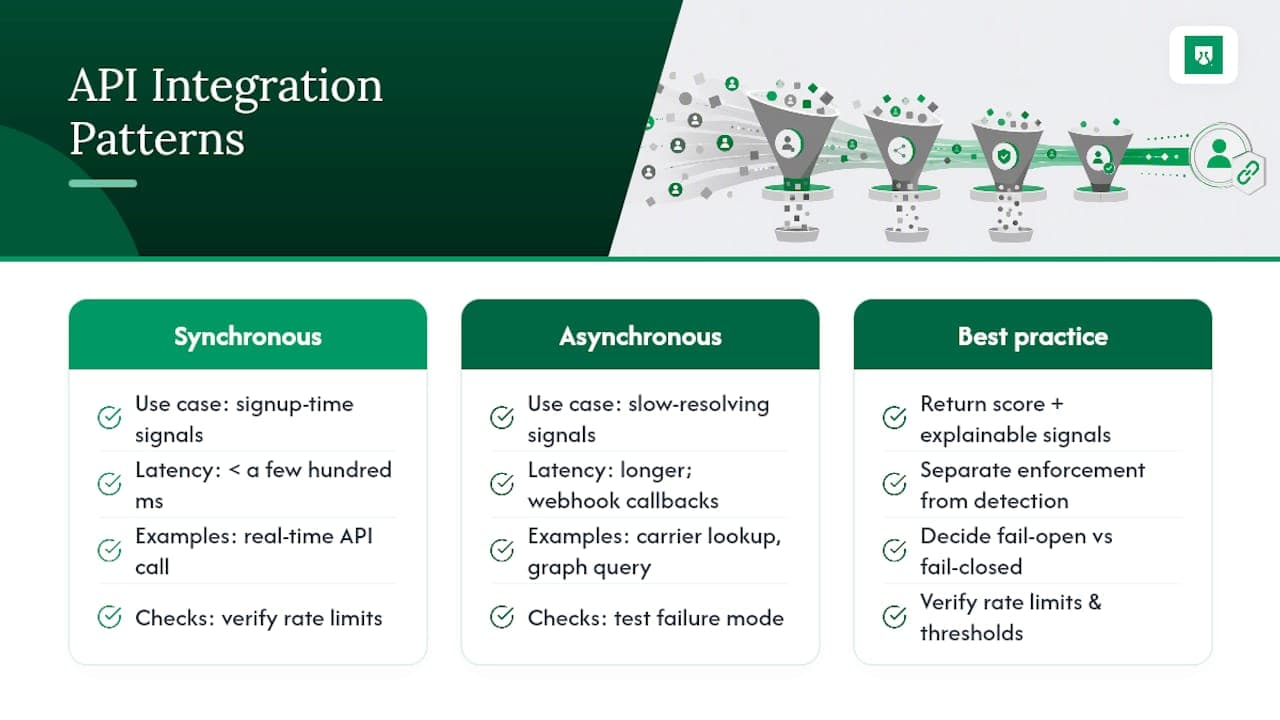
The integration pattern that scales best keeps the choice of action separate from detection input. A third-party API should return a score and the signals behind it, not a binary allow/deny verdict baked into the vendor's own black box. That separation matters operationally: when a vendor's threshold produces a spike in false positives, a team that sees the signals behind each score can adjust the threshold immediately. A team that outsourced the entire decision has to wait on a support ticket.
API integration typically follows one of two patterns. Synchronous calls at signup time work when the API responds fast enough not to add noticeable latency to the form, usually under a few hundred milliseconds. Asynchronous or webhook-based patterns fit better for signals that take longer to resolve, like a carrier lookup or a graph query across a large account base.
Whichever pattern a team uses, the integration checklist looks similar: confirm the API returns explainable signals rather than a single opaque score, verify rate limits match expected signup volume, and test the failure mode. If the third-party service times out or goes down, does the signup flow fail open (allow everyone through) or fail closed (block everyone)? Neither answer is universally correct, but a team that hasn't decided in advance will make that choice under pressure during an actual outage, which is the worst possible time.
Fake Signup Detection Across Industries
The signal families stay consistent across industries. What changes is which signal carries the most weight and which abuse pattern shows up first.
In iGaming, bonus abuse and Sybil attacks, one person controlling dozens of accounts to multiply signup bonuses, dominate the threat model. Device fingerprinting and cross-account clustering tend to matter more here than email checks alone, because bonus abusers are often willing to use real, unique email addresses per account while reusing the same device or the same residential proxy pool.
In fintech, the stakes shift toward identity verification and account takeover, since a fake account that clears onboarding can be used for payment fraud or laundering. Phone signals and behavioral drift monitoring after signup carry more weight, because the damage from a fake fintech account compounds over the account's lifetime rather than concentrating at signup.
In SaaS, free-trial abuse is the dominant pattern: the same person opening trial after trial to avoid ever paying. Email alias detection and IP-based velocity checks catch most of this, since trial abusers usually don't bother with sophisticated infrastructure for a product with a low-value free tier.
E-commerce sees referral fraud and promo abuse concentrated around specific campaign windows, which makes velocity and timing signals spike predictably around launches and sales events, giving fraud teams a known window to tighten thresholds temporarily.
Countermeasures Fraudsters Use, And How To Adapt
Detection is not a static defense. Every method described above has a corresponding evasion technique, and fraud rings iterate on both sides at once.
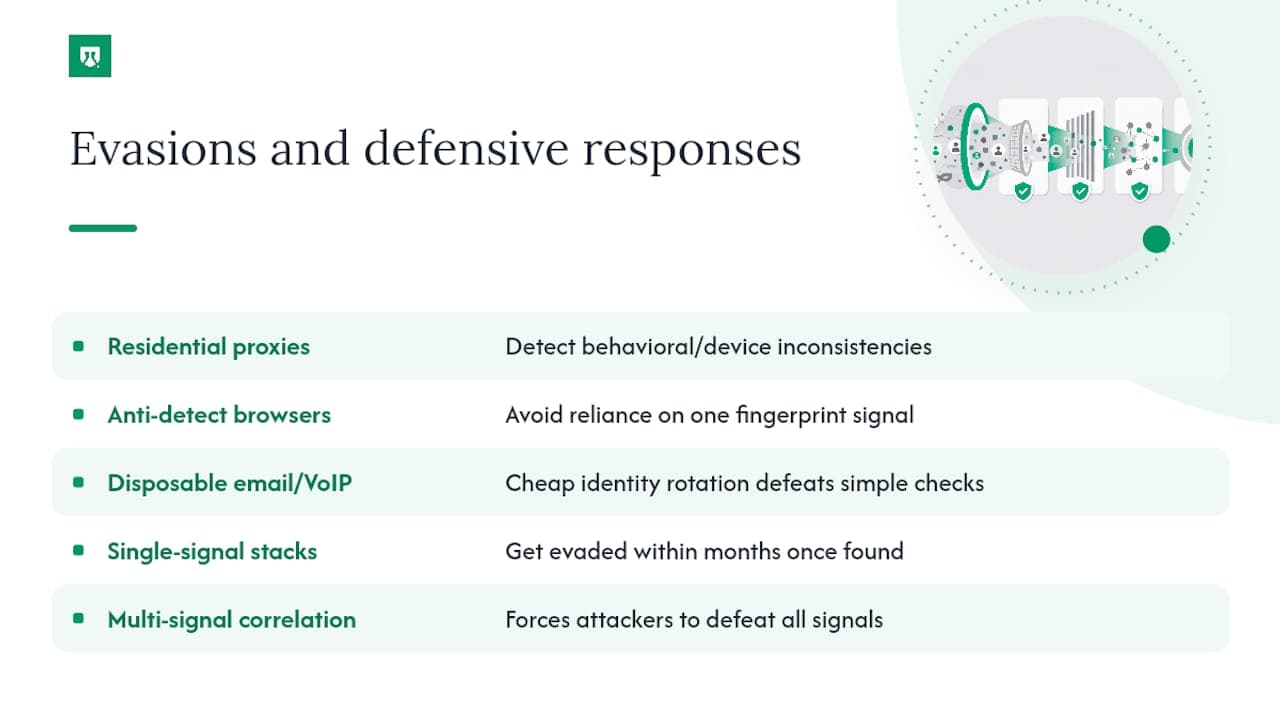
Residential proxies exist specifically to defeat network-based detection, since they make automated traffic look like it's coming from an ordinary home connection rather than a flagged datacenter range. Anti-detect browser tooling exists specifically to defeat device fingerprinting, spoofing the hardware and browser characteristics a fingerprint depends on. Disposable email and VoIP number services exist specifically to defeat identity-based checks, and they're cheap enough that rotating them costs almost nothing per attempt.
The industry response to all three, as hCaptcha's account defense research frames it, is the same shift: move from static allow/block lists toward contextual, risk-based decisioning that doesn't rely on any single signal staying unbeaten. A residential proxy detection approach, for instance, doesn't try to block every residential IP, since that would catch enormous numbers of real users. It looks for the behavioral and device inconsistencies that accompany proxy use, which are much harder to spoof convincingly than the IP address alone.
The practical takeaway for a fraud team is to expect this arms race and build for it. A detection stack that leans entirely on one signal family will get evaded within months once a fraud ring identifies the gap. A stack that correlates five signal families forces that same fraud ring to defeat all five simultaneously, which is a fundamentally more expensive problem to solve.
What Actually Matters In A Detection Program
Most advice on this topic treats signup fraud like a technical puzzle: add enough signals, tune enough thresholds, and the problem gets solved. That framing undersells the real constraint, which is organizational, not technical. The teams that get this right treat detection as a continuously tuned system, not a one-time integration, and they set thresholds that a fraud analyst can adjust without a deploy.
The conventional advice oversells blocking and undersells auditability. A false positive rate you can't explain is worse than a fraud rate you can measure, because an unexplainable block eventually costs you a legitimate customer's trust and a support escalation, while a measured fraud rate at least gives you a number to improve against. Prioritize signal transparency before you prioritize signal volume. Five well-understood, explainable signals beat fifteen opaque ones that a black-box score buries.
The single highest-leverage first move for most teams isn't a new tool at all. It's instrumenting device and behavioral capture at form time, before any decisioning logic exists, so that six months from now the historical data needed for graph clustering and threshold tuning already exists. Teams that skip this step spend their first year of fraud fighting reconstructing data they should have been logging from day one.
Yahor Papou, CMO at ShieldLabs
How To Evaluate A Fake Signup Detection Provider
A short checklist separates vendors worth a trial from vendors worth skipping. Look for signal coverage across all five families discussed above, not just network or just device. Confirm persistent recognition that survives cleared cookies and IP rotation, since that's what makes cross-session correlation possible in the first place. Check integration speed: a setup that takes weeks of custom engineering delays the entire program. Demand transparent signals behind every score, not an opaque number. And check whether pricing includes a real trial tier, since testing against your own traffic tells you more than any vendor's marketing page.
Running a short validation test before committing is worth the time it takes. Pull a sample of known-good and known-fraudulent signups from your own logs, run them through the candidate's API, and audit whether the signals returned actually explain the score, or whether you're left guessing why an account was flagged.
ShieldLabs is built around exactly that transparency: persistent visitor identification that recognizes returning visitors with 99.9% accuracy, a risk score delivered with the signals behind it, and detection across VPNs, proxies, Tor, Apple Private Relay, datacenter ranges, and anti-detect browser detection, all included on every plan rather than gated behind an enterprise contract. Multi-accounting, account sharing, impossible travel and account takeover are detected out of the box, each at Medium or High confidence. You choose the action for each case. The one-time free tier covers 5,000 identifications with no card required, which is enough to run a real validation test against your own signup traffic before deciding anything. Start there, check the signals against a batch of your own known accounts, and see whether the score explains itself the way it should.
Sources
- Detecting Signup Fraud: 3 Ways to Use Auth0 Logs to Protect Your Business
- How to detect fake users and multiaccount sign-up abuse | Stripe
- Account creation fraud: detection and prevention | hCaptcha
Recommended
Related articles
Detecting Device Farms Behind Fake Web Accounts
Investigate device farm fraud in web accounts using device relationships, signup timing and benefit eligibility, while keeping legitimate shared use visible.


How to detect fake reviews
What review fraud is, the main types of fake reviews, why the text alone won't catch them, and how the device behind a review ring gives it away.


Setup Multi Accounting Detection in 5 Minutes for Fraud Teams
How device and network signals reveal linked accounts, and how ShieldLabs detects Multi-accounting as a High-Risk Event with clear evidence.
