

Fraud Decisioning vs Fraud Detection: Choose the Right Layer
Last updated on October 21, 2026 · 8 min read
Last updated: October 21, 2026
A fraud detection tool evaluates activity and identifies risk. A fraud decisioning platform uses available evidence and a business policy to select what happens next. That distinction matters when a team has plenty of alerts but still cannot explain why an account was allowed, challenged or rejected.
Compare the functions at the action you need to protect. A useful device observation can arrive too late for a reward grant. A dashboard can explain an incident without having controlled the original payment. A decision engine can execute a policy consistently while relying on incomplete evidence.
This guide uses a hypothetical signup-and-reward example to show where each responsibility belongs. It is an implementation design, not a benchmark or a customer result.
Compare the outputs before comparing platforms
Product categories overlap. Some fraud detection software includes action policies and investigation tools; some decisioning products orchestrate evidence supplied by other services. Write down the output you need rather than assuming a category name guarantees it.
| Function | Main question | Useful output | What to verify |
|---|---|---|---|
| Detection | What risky activity is present? | Named signals, account relationships, scored observations | Meaning, timing and verification of the evidence |
| Decisioning | What should happen to this action? | Allow, verify, hold or reject with a reason | Policy owner, unavailable states and execution |
| Investigation | Why did this happen? | Searchable evidence and case history | Access to the original observation and later outcome |
| Analytics | Is the workflow improving? | Cohort measures and outcome reports | Consistent units, labels and unresolved cases |
Treat the table as a buying checklist. One product can cover several rows, and your application may already implement part of the workflow. The goal is to find an unowned responsibility rather than purchase another overlapping layer.
For a concrete example of combined detection and action controls, Stripe Radar documents payment rules that can allow, block, request authentication or send payments to review. Those are specific actions in a payment workflow, not a universal description of every fraud platform.
Work backward from the protected action
Choose one action, such as issuing a referral reward, changing an account email or confirming an order. Identify the last safe point at which it can wait, be verified or be reversed. That determines which evidence must be ready and which observations can be reviewed later.
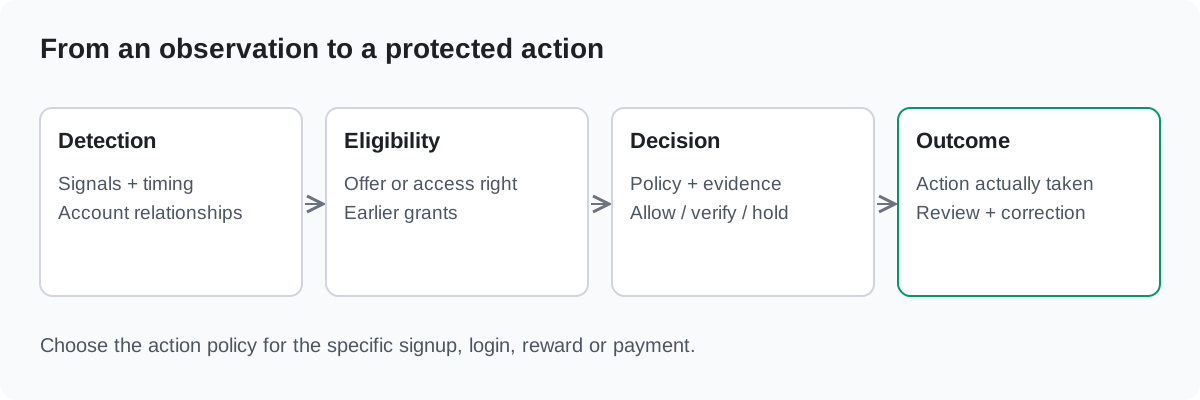
For an account change, authentication is only part of the sequence. The server also needs to confirm that the user can perform the requested operation and that the operation has not changed since it was verified. OWASP's transaction authorization guidance describes controls for sensitive operations, including server-side enforcement and binding authorization to the transaction.
A procurement conversation should therefore begin with an event. Ask the vendor to show what is collected before that event, what its verified response contains and which component performs the action. If the demonstration ends at a score, the response workflow still needs an owner.
A worked signup example: three different records
Imagine a SaaS product that grants an introductory credit once per eligible customer. The account can be created before the expensive benefit is allocated. The workflow keeps three records: the observation, the decision and the grant.
The observation describes the signup context. It includes the collection time, device reference, relevant risk signals and any supported account relationships. The decision records the offer version, the eligibility evidence, the chosen response and the policy version. The grant records whether the benefit was actually issued.
| Scenario | Evidence available | Example response | What must be recorded |
|---|---|---|---|
| New eligible account with sufficient evidence | Complete check and no prior qualifying grant | Issue the credit | Observation, eligibility result and unique grant reference |
| Linked activity with a disputed earlier claim | Account relationship and previous benefit record | Ask for verification or review | Relationship evidence, reason and resolution |
| Detection service times out | Eligibility known, device result unavailable | Apply the documented pending policy | Timeout state, time budget and eventual resolution |
| Delivery is retried | Existing approved grant reference | Return the existing grant | Retry reference and original result |
These are example policies, not universal risk thresholds. A referral reward, ordinary login and expensive compute job may justify different responses to the same missing observation.
The grant should be safe to retry. Receiving the same webhook or request twice must not create two balances. The fraud detection API integration guide explains the browser-to-server evidence path; the application still needs a consistent operation reference for the benefit it issues.
Make unavailable evidence a first-class result
An incomplete check is not a clean check. Record missing, delayed, stale and invalid observations separately so that a policy can handle each one deliberately. The response should depend on the cost and reversibility of the action.
For example, a product might allow a low-value content request to continue while holding a new reward grant for verification. Another product may require a supported fallback before allowing a sensitive account change. Document that behavior, the maximum waiting time and how a legitimate user continues when the dependency recovers.
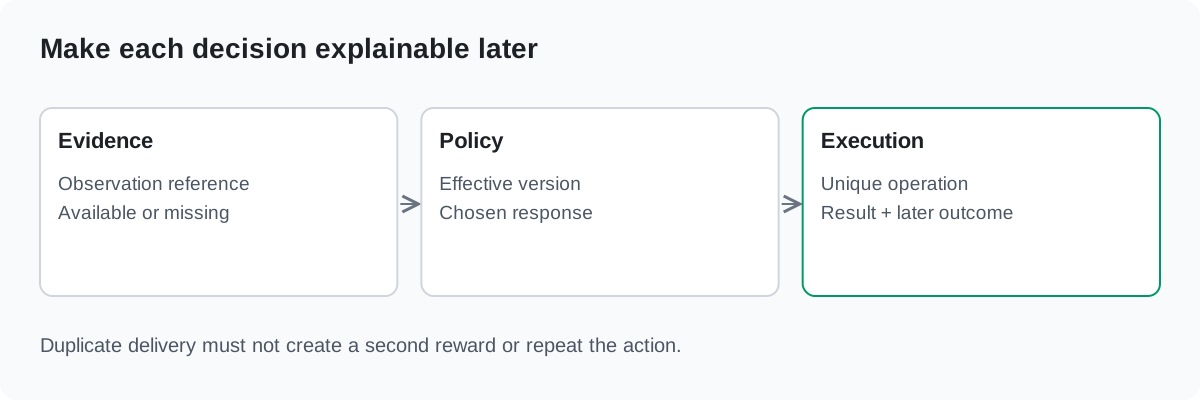
Keep result freshness explicit. A browser observation from an earlier session may be insufficient for a different account action. Bind the evidence to the expected context and retrieve or verify it through the documented server integration. A client-supplied “low risk” field is not an independent server result.
This is where fraud decisioning earns its place: the system applies the intended policy consistently across successful checks and operational failures, with a record of both.
Decide who needs to change the policy
A small team can implement a limited action policy in application code if it has stable requirements and clear ownership. A separate decision-management product becomes more relevant when several teams change policies, approvals matter or multiple evidence providers must be coordinated.
Ask who can change a policy, who reviews the change and how its effective version is recorded. Test rollback and inspect whether a past decision can be explained using the policy that actually ran. Replaying old observations against a new policy is useful for estimating how the action count would change; it does not reveal outcomes that were never observed.
Review workload matters as well. A policy that holds many cases may transfer the problem to a queue that nobody can clear. Specify what evidence the reviewer sees, how a corrected decision reaches the application and whether the customer has a usable recovery path.
Run a pilot that compares decisions and outcomes
Give each candidate the same representative scenarios and record the expected handling before testing. Include legitimate device changes, shared networks, repeated benefit claims, missing evidence and duplicate delivery. Verify the full action path rather than timing only an isolated API response.
Measure legitimate completion, confirmed ineligible activity, review volume and unresolved cases. Keep provider recommendations separate from the merchant's final action and any later issuer result. That separation is especially useful when investigating a decline that several systems influenced.
The false positive guide covers evaluation, and fraud analytics covers the reporting units. Use those records to decide whether a new platform fills a real operational gap. An attractive dashboard or a smaller alert total alone cannot answer that question. The fraud prevention strategy guide puts these decisions in the wider signup, login and payment workflow.
Use ShieldLabs for account and device risk evidence
ShieldLabs identifies visitors and users, combines device and network intelligence, and returns risk scoring, named risk signals and bot detections. It also detects four High-Risk Events out of the box: Multi-accounting, Account sharing, Impossible travel and Account takeover.
Connect the browser snippet with server-side API reads or webhooks for signup, login, benefit claims and other sensitive actions. Analytics provides the account and traffic context for investigations. The free plan includes 5,000 identifications, one time, so a team can inspect results on its own flows before choosing a paid plan.
Sources
- Stripe: fraud prevention rule actions
- OWASP: transaction authorization
- OWASP: authorization checks
- Stripe: idempotent API requests
Recommended
Frequently asked questions
- What is the difference between a fraud decisioning platform and a fraud detection tool?
- A fraud detection tool evaluates evidence and identifies risk. A fraud decisioning platform combines available evidence with business policy to select an action, such as allow, verify, hold or reject. Products can include both functions, so evaluate the actual outputs, action ownership and decision records rather than relying on the category name.
- Do fraud detection and decisioning have to come from one vendor?
- No. A business can combine an evidence provider with an existing application policy or a separate decisioning service. Define the result contract, action owner, time budget and response to unavailable evidence. One vendor may simplify coordination, while separate components can preserve an existing workflow; evaluate the full integration on the same scenarios.
- Can a fraud decision engine work without a rules dashboard?
- Yes. An application can implement a small action policy in server code when responsibilities and evidence are clear. A separate policy-management interface becomes useful when teams need frequent changes, several data sources, controlled approvals or replayable versions. In either design, preserve the evidence, policy version and result for each action.
- How do you compare fraud decisioning platforms?
- Give each platform the same scenarios and expected outcomes. Compare evidence availability, action timing, unavailable-result handling, policy versioning, review workflow and recovery after errors. Measure legitimate completion, confirmed abuse and operational effort on consistent cohorts. A lower alert count or a faster isolated API call is insufficient evidence of better decisions.
- Where does ShieldLabs fit in a fraud prevention workflow?
- ShieldLabs provides visitor and user identification, device and network intelligence, risk scoring, bot detection and ready-made account abuse detection. Results are available through the API and webhooks, with analytics for investigation. Connect that evidence to signup, login, benefit and payment workflows. Start Free includes 5,000 identifications, one time.
Related articles
How to prevent marketplace fraud: types, signals, and the actor behind them
The main types of marketplace fraud, from triangulation fraud to seller and buyer scams, and how reading the device behind each account links the ring.

How to prevent online travel fraud: the types and the actor behind them
What online travel fraud is, the main types from stolen-card bookings to miles theft and fake listings, and how the device behind a booking ties them together.
Audit Ready Velocity Checks for Fraud Teams With ShieldLabs Signals
Audit ready playbook for velocity checks: industry backed rules, a 90 day rollout checklist, reviewer workflows, and ShieldLabs signals.
