

Measure First: Reduce False Positives, Keep Coverage for Fraud Ops


Last updated on September 23, 2026 · 18 min read
Measure your current false positive rate over a 30-day window, apply narrow compound exclusions in shadow mode, run regression tests against known fraud cases, then layer in data and model fixes. That sequence, in that order, is what separates teams who cut noise sustainably from teams who create blind spots. The three highest-leverage levers are data quality, model calibration, and manual-review triage. Start by measuring your recent rule-level false positive rates and ranking rules by noise contribution.
TL;DR:
- Regularly measure rule-level false positive rates over a 30-day period and rank rules by alert volume times the FPR for targeted tuning efforts.
- Address common false positive causes by refreshing stale data, narrowing broad rules, enriching with context signals, and adjusting miscalibrated thresholds.
- Test rule changes in shadow mode for at least a week and validate against historical true positives before deploying incrementally.
- Incorporate data and model improvements such as label hygiene, feature engineering, and cost-sensitive learning to achieve sustained false positive reductions.
- Segment customers by risk profile and revisit thresholds periodically to balance false positives and negatives across different customer groups.
Causes of False Positives and Why They Matter Operationally
False positives don't come from one bad rule. They come from a handful of recurring failure modes that compound quietly until an analyst queue backs up or a legitimate customer gets blocked at checkout.
Stale data is the most common culprit. A rule built on IP reputation data from two years ago flags residential proxy ranges that internet service providers have long since reassigned to ordinary households. Rules also get written too broadly on purpose, because a wide net feels safer than a narrow one at launch. That instinct is exactly backwards: overly broad rules generate the review volume that eventually gets rules disabled entirely rather than fixed.
Missing context is another driver. A transaction monitoring rule that only looks at amount and velocity, without customer history or device signals, treats a loyal customer's first big purchase the same as a stranger's. Miscalibrated thresholds sit close behind: a threshold tuned once at launch and never revisited drifts out of step with how the actual customer base behaves as it grows.
Common causes worth auditing first:
- Stale reference data: outdated IP reputation lists, device blocklists, or geolocation databases that no longer match current infrastructure.
- Overly broad rule logic: single-field triggers (an amount threshold, one flagged country) with no supporting context.
- Missing contextual signals: no customer history, no device fingerprint, no returning-visitor recognition.
- Miscalibrated thresholds: static cutoffs that never adjust as transaction volume or customer mix shifts.
- Duplicate rule coverage: two or more rules independently flagging the same behavior, multiplying alert volume without adding detection value.
Each cause maps to a specific fix. Stale data gets refreshed or replaced. Broad rules get a narrow compound exclusion. Missing context gets enriched with device and identity signals. The cost of ignoring these isn't abstract: every false positive burns analyst time, delays legitimate revenue, and, if it happens often enough, trains compliance teams to rubber-stamp alerts instead of reading them.
Measure First: The Metrics and Baselines You Need Before Changing Rules
Tuning without measurement is guesswork with better documentation. Before touching a single rule, establish your baseline false positive rate (FPR) at both the rule level and the system level.
FPR = false positives ÷ total alerts, calculated over a rolling 30-day sample large enough to smooth out weekly volume swings. Run this per rule, not just in aggregate, because a healthy overall FPR often hides two or three rules doing almost all the damage.
Pro Tip: Rank rules by absolute alert volume multiplied by FPR, not by FPR alone. A rule with a 90% false positive rate but ten alerts a month matters far less than one with a 40% rate generating ten thousand.
Track these alongside FPR:
- Signal-to-noise ratio: confirmed fraud alerts against total alerts fired.
- Authorization rate: the share of legitimate transactions approved without friction.
- Revenue per 1,000 transactions: catches revenue lost to unnecessary declines that FPR alone won't show.
- Manual-review throughput: alerts closed per analyst per shift, a direct measure of queue health.
Once you have clean metrics over a suitable period, sort every rule into one of three buckets: tune (fixable with a narrow exclusion), suppress (valid signal, wrong frequency), or retire (no longer earning its alert volume).
Four-Step Tuning Methodology You Can Run This Week
Every durable false positive reduction program follows a version of the same sequence: measure, narrow, test, verify. Skipping a step is how teams create the exact blind spots they were trying to avoid.
-
Measure the top offenders. Pull your 30-day alert population for the noisiest rule and pull every field value on the false positive cases: merchant category, device type, customer tenure, geography. Look for the two or three fields that consistently distinguish false positives from true positives. This is detective work, not statistics. You're looking for a pattern a human analyst could describe in one sentence.
-
Write the narrowest possible compound exclusion. A compound exclusion combines multiple conditions (customer tenure over 12 months AND device previously seen AND transaction under a category-specific ceiling) rather than excluding on a single broad field. Document the rule name, the exact condition, the business justification, the author, and an expiry date. An exclusion with no expiry is a permanent blind spot waiting to be discovered by whoever is willing to fit the pattern. Elastic's guidance on reducing noise draws a useful distinction here: tuning changes the detection logic itself, while an exception permanently suppresses alerts for a known-safe case. Choose the mechanism deliberately, not by default.
-
Run it in staging or alert-only mode for at least seven days. Shadow mode lets the exclusion fire without affecting live decisions, so you can watch its actual effect on alert volume and confirm it isn't quietly swallowing real fraud. Dynatrace recommends starting new detection logic at a less sensitive threshold, observing for one to two weeks, and using sliding-window evaluation, such as requiring three violating samples within a five-minute window, before trusting a change enough to promote it. The same discipline applies to fraud rule changes: observe before you commit.
-
Run regression tests against historical true positives, then roll out incrementally. Take a labeled set of confirmed fraud cases from the past six to twelve months and confirm your new exclusion doesn't accidentally exclude any of them. If it passes, roll the change out to a subset of traffic first, not all of it at once, and keep watching the same metrics you measured in step one.
Pro Tip: Keep a rollback script ready before you promote any exclusion to production. The five minutes it takes to write one is nothing compared to the hours lost reverting a change manually during an active fraud spike.
Data and Model Changes That Reduce False Positives Sustainably
Rule tuning buys you speed. Data and model work buys you durability. The two aren't competing strategies, they're sequential ones, and skipping the second means re-fighting the same fires every quarter.
Label hygiene comes first because a model is only as good as the ground truth it learns from. Provenance tags, showing where each label came from, and confidence scores on ambiguous cases, let you weight training data instead of treating every historical label as equally trustworthy. Human-reviewed samples, even a modest set pulled monthly from the manual review queue, catch labeling drift before it poisons a model's next training cycle.
Feature engineering is where risk and identity signals earn their place. Session behavior, graph relationships between accounts, and device or IP reputation each add context that a transaction-only view misses entirely. A returning-visitor signal that recognizes a device despite cleared cookies or a new IP address turns "unknown customer, high risk" into "customer we've seen 40 times before, low risk" without a single manual lookup.
Combining label hygiene, feature engineering, and cost-sensitive models can materially cut false positives while preserving safety. Documented programs report false positive rate reductions in the 50 to 75 percent range when data fixes are paired with operational changes, not deployed alone.
On the model side, four techniques do most of the work:
- Cost-sensitive learning: weight the training objective so a missed fraud case costs more than a false alarm, matching the model's incentives to the business's actual risk tolerance.
- Calibration: methods like Platt scaling or isotonic regression correct a model's raw output so a "70% risk" score actually corresponds to a 70% real-world likelihood.
- Ensembles and per-segment thresholds: different customer segments carry different baseline risk, so a single global threshold will always be wrong for someone.
- Versioning and rollback plans: every model deployment needs a way to revert instantly if live performance diverges from what testing predicted.
Monitor for drift continuously, and check that offline evaluation metrics match what the model actually does in production. A model that scores beautifully in a backtest but disagrees with its own live behavior is telling you something about how the training data diverged from reality.
Testing, Rollout, and Manual-Review Operations to Keep Reviewers Productive
A tuning change that isn't tested in the wild before going live is a bet, not a decision. Shadow mode and staged A/B testing turn that bet into a measurement.
Run new rules or threshold changes in alert-only mode first, logging what they would have done without acting on it. Once the shadow data confirms the change behaves as expected, promote it to a small percentage of live traffic before rolling it out everywhere. Dynatrace's approach to threshold tuning favors starting loose and tightening gradually, observing behavior for one to two weeks between adjustments, rather than jumping straight to an aggressive setting and hoping it holds.
Pro Tip: Treat every threshold change like a one-way ratchet you can only tighten slowly. Loosening a threshold after tightening it too fast erodes trust in the whole tuning program, even when the fix is quick.
Manual review queues need their own tuning, separate from the rules feeding them:
- Risk-based prioritization: route the highest-risk alerts to the top of the queue instead of processing first-in-first-out.
- Quick-release paths: build a fast lane for patterns with historically high false positive rates so analysts can clear them without full investigation.
- Step-up authentication for medium risk: instead of a manual review, ask the customer for one more verification step and let their response resolve the ambiguity automatically.
- Deduplication and sliding-window suppression: collapse repeated alerts on the same underlying event into one ticket instead of flooding the queue with duplicates.
Alert storms, where one root cause fires dozens of near-identical alerts, are one of the fastest ways to burn analyst goodwill. Suppression logic that recognizes repeated triggers within a short window prevents a single glitch from consuming an entire shift.
Governance and Cadence: How to Prevent Drift and Blind Spots Long Term
A tuning program that isn't governed decays. Exclusions pile up, thresholds drift, and six months later nobody remembers why a specific rule stopped firing on a specific customer segment.
Document every exclusion the moment you create it: the rule it modifies, the exact condition, the business justification, the author's name, and an expiry date. Elastic's framework treats exceptions, suppressions, and tuning as distinct mechanisms with different forensic trails, and that distinction matters when an auditor or a new team member asks why a given pattern goes unflagged. Require a review of every exclusion regularly (for example quarterly or semiannually). If nobody can justify keeping it, retire it.
Build the review cadence around these checks:
- Quarterly rule audits: review every active rule's FPR and alert volume against its original justification.
- Retirement criteria: a rule with an FPR above 80% that hasn't earned a narrow exclusion is a candidate for retirement, not another patch.
- Detection-as-code: version-control your rules and exclusions the same way you version application code, with peer review before merging.
- Automated regression checks: run every rule change against your historical true-positive set automatically, not manually, before it ships.
Track your KPIs continuously rather than only during scheduled reviews. A rule whose false positive rate creeps upward for weeks without anyone noticing is a sign the underlying data or customer behavior has shifted, and that signal is worth an alert of its own.
Where a Detection Layer Like ShieldLabs Plugs In
A tuning methodology is only as good as the signals feeding it. Rules built on transaction data alone can't tell the difference between a customer using a residential proxy for privacy reasons and one using an anti-detect browser to run a fraud ring. That's a gap an identification and risk signal layer is built to close.
ShieldLabs supplies visitor identification and risk scoring drawn from 300+ device and network signals, including VPN, proxy, Tor, iCloud Private Relay, datacenter IP ranges, anti-detect browser detection, and browser automation. That kind of returning-visitor signal is exactly the missing context described earlier as a leading cause of false positives.
- Explainable scoring: every risk score arrives with the specific signals behind it, so manual reviewers can audit why a visit was flagged instead of trusting a black box, and regression tests have something concrete to check against.
- Fast integration: a single JavaScript snippet gets a first signal in about five minutes, with SDKs for Node.js, Python, Go, and PHP for server-side use.
- Free tier for shadow testing: 5,000 free identifications (one time) with no card required make it practical to run ShieldLabs alongside an existing stack in shadow mode before committing to a paid plan.
The detection layer supplies the score and the signals behind it; you choose the action for each case, whether that's an automatic block, a step-up challenge, or a routing decision in the manual review queue.
Building Feedback Loops From Manual Review Into Your Rules and Models
Every manual review decision is training data if you capture it correctly. Most teams don't, and the result is a tuning program that fixes the same false positive pattern every few months instead of learning from it once.
Set up a structured feedback path where every reviewer disposition, confirmed fraud, confirmed legitimate, or inconclusive, writes back into a labeled dataset with the original alert's field values attached. That dataset becomes the source for both the compound exclusions described earlier and the retraining data for any model in production. Without it, you're relying on institutional memory, and institutional memory leaves the company when the analyst who built it does.
The loop works best on a fixed schedule rather than ad hoc. A weekly pull of the past week's reviewed alerts, tagged by outcome, feeds into a monthly retraining or rule-review cycle. That cadence is tight enough to catch a new fraud pattern before it does much damage, and loose enough that you're not chasing statistical noise from a handful of edge cases.
Watch for one specific failure mode: reviewers get faster and more consistent over time, which quietly changes what "confirmed legitimate" means in your data. A reviewer three months into the job flags differently than one three years in. Track reviewer-level disposition rates alongside the aggregate numbers, and if one reviewer's false-positive confirmation rate diverges sharply from the team average, that's worth a conversation before it's worth a model update.
Balancing False Positive Reduction Against False Negative Risk
Every false positive you eliminate carries a question you should ask before shipping the fix: what does this change let through? A rule loosened to stop flagging legitimate repeat customers might also stop flagging a fraud ring that has learned to mimic repeat-customer behavior.
The regression testing step in the tuning methodology exists specifically to catch this trade-off, but regression testing against historical fraud only works if your historical fraud sample is current. Fraud patterns shift. A compound exclusion validated against last year's confirmed fraud cases can miss a new pattern that emerged after that dataset was built. Stripe's approach to fraud detection stresses feeding post-authorization outcomes, chargebacks and confirmed fraud alike, back into the model continuously, precisely because a static training set goes stale.
Cost-sensitive model design gives you a more principled way to manage this trade-off than manual threshold guessing. Instead of picking a single cutoff and hoping it balances both error types, weight the training objective so the model reflects the actual asymmetric cost: a missed fraud case might cost the business ten times what an unnecessary manual review costs. That ratio, not intuition, should drive where the threshold sits.
Set a floor. Before loosening any rule or widening any exclusion, define the maximum acceptable increase in false negatives, in dollars or in fraud rate, that a given change is allowed to cause. Measure against that floor in shadow mode before rollout, not after.

Setting Dynamic Thresholds by Risk Profile and Customer Segment
A single global threshold is a compromise that fits no one well. A threshold tuned to protect against fraud on new accounts will generate constant false positives on customers with three years of clean transaction history. A threshold loose enough to leave long-tenured customers alone will miss fraud on brand-new accounts, where fraud rates are structurally higher.
Segment your customer base by risk profile before setting thresholds, not after. Tenure is the simplest starting segment: a customer active for two years with no prior flags carries a fundamentally different risk profile than one who signed up an hour ago. Transaction category matters too. High-value electronics purchases warrant tighter scrutiny than a recurring subscription renewal from the same customer.
Device and identity signals refine segmentation further. A returning visitor recognized through persistent identification, even without a login, carries less uncertainty than a first-time visitor with no identifying history. That distinction lets you set a looser threshold for recognized, low-risk visitors and reserve tighter scrutiny for visits carrying risk signals like a residential proxy or a detected anti-detect browser.
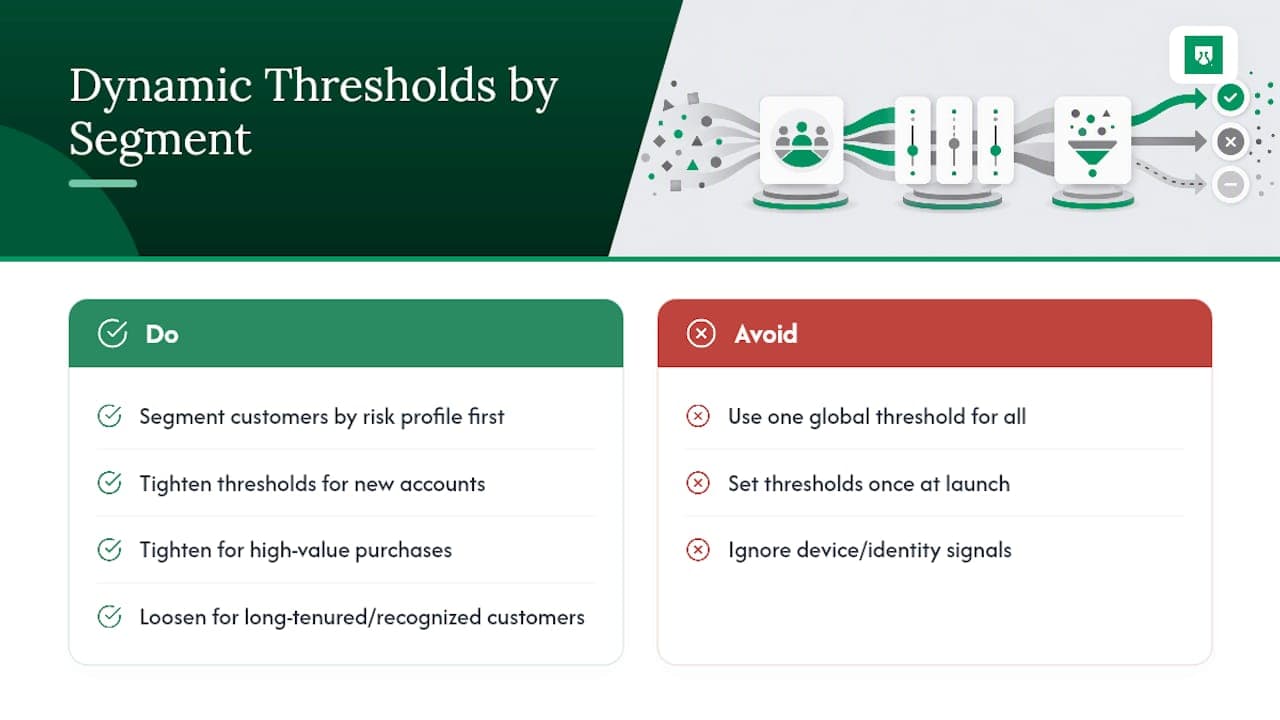
Rebuild segment thresholds on a schedule, not once at launch. Customer mix shifts as a business grows, marketing campaigns bring in new acquisition channels with different baseline risk, and a threshold set for last year's customer base drifts out of alignment with this year's. Revisit segment definitions and their associated thresholds at the same cadence you audit rules, quarterly at minimum, using the FPR and authorization-rate metrics established earlier in the measurement phase.
A Practitioner's Note on What Actually Moves the Needle
Most false positive reduction programs fail for the same avoidable reason: someone reaches for a broad exclusion under deadline pressure and never comes back to narrow it. A permanent allowlist feels efficient in the moment and becomes the exact gap a persistent abuser eventually finds. Every exclusion needs an owner's name and an expiry date attached at creation, no exceptions.
The unglamorous truth is that measurement and label hygiene deliver more durable improvement than clever modeling. Teams jump straight to ensembles and calibration curves while their training labels are contaminated by inconsistent reviewer judgment. Fix the labels first. The model gets better almost as a side effect.
If your team is stretched thin, don't try to tune everything. Rank rules by alert volume times false positive rate, and you'll usually find the top 20% of rules account for roughly 80% of the noise. Fix those first, measure the result, and only then move down the list.
Yahor Papou, CMO at ShieldLabs
How to Evaluate ShieldLabs as Part of Your Tuning Program
If the measurement phase of your tuning program keeps surfacing the same gap, alerts firing on legitimate repeat customers because your rules can't tell a returning visitor from a stranger, that's a signal quality problem, not a rule problem. ShieldLabs closes that gap with persistent visitor identification that recognizes a returning customer with 99.9% identification accuracy, even across cleared cookies and rotated IPs, feeding your models context they didn't have before.
Start with the free tier: 5,000 identifications, one time, no card required, enough to run ShieldLabs in shadow mode alongside your existing stack and compare its risk scoring against your current false positive population before committing to anything. Every score ships with the signals behind it, so your manual review team can audit the reasoning directly. Integration takes about five minutes with a JavaScript snippet, with SDKs available for backend systems. From there, exporting those signals into your feature store and regression tests is the next concrete step.
Sources
- Avoid overalerting (Dynatrace)
- Reduce noise and false positives (Elastic)
- Payment fraud detection: how it works (Stripe)
- Reduce false positives with data & predictive models (Payhub)
Recommended
Related articles
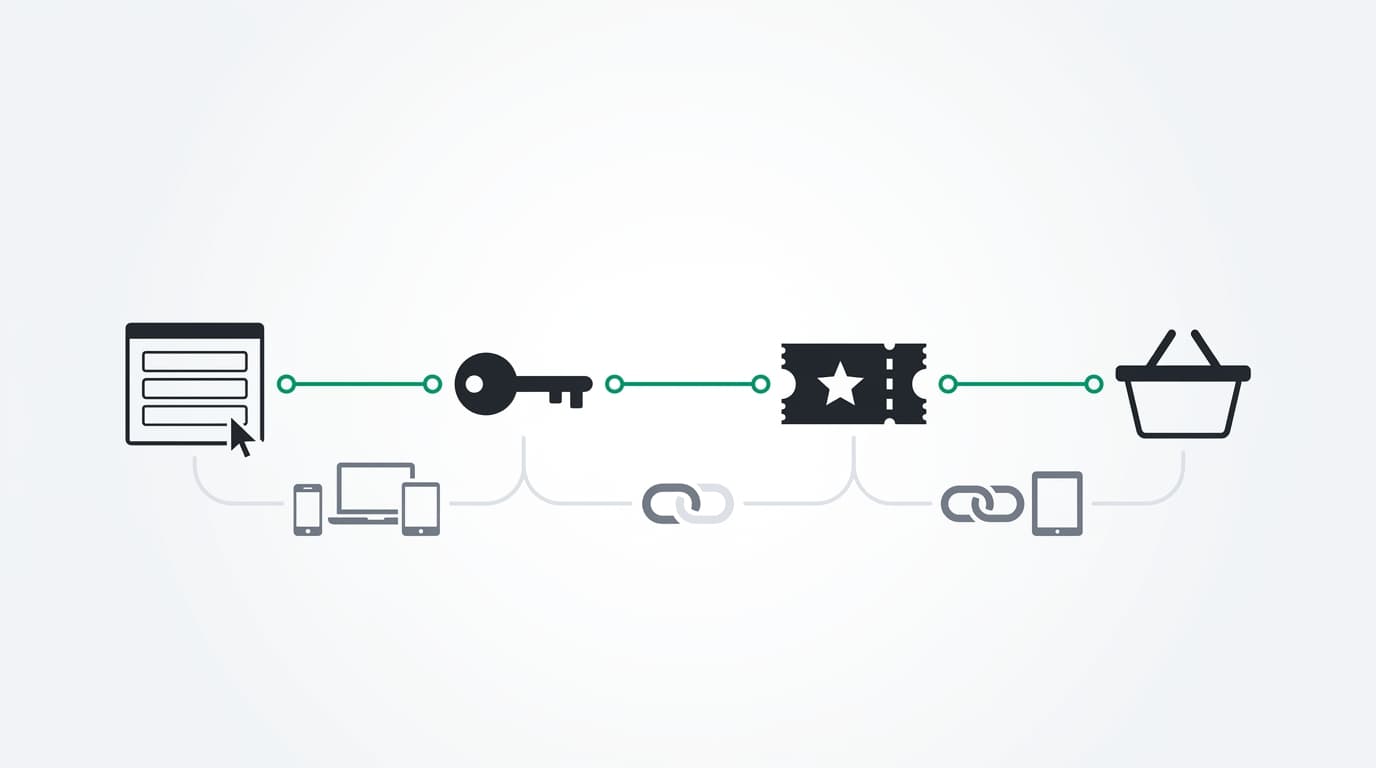
Fraud Prevention Strategies for Web Apps
Practical fraud prevention strategies for web apps, from signup and login to offers and checkout. Match controls to the abuse at each step.


Audit Ready Velocity Checks for Fraud Teams With ShieldLabs Signals
Audit ready playbook for velocity checks: industry backed rules, a 90 day rollout checklist, reviewer workflows, and ShieldLabs signals.
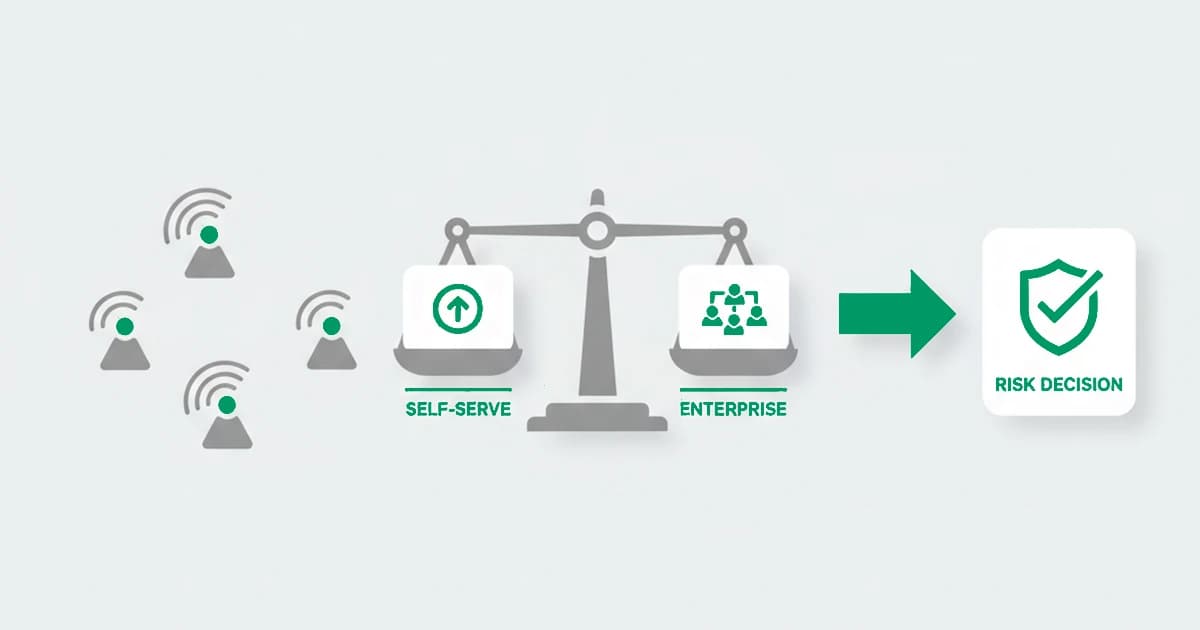
10 best fraud prevention software tools in 2026
Compare 10 fraud prevention and detection tools for device intelligence, account abuse, payment risk, and chargebacks. Features, fit, and pricing models.
