

Account and offer abuse in ecommerce: a merchant's playbook

Last updated on July 6, 2026 · 9 min read
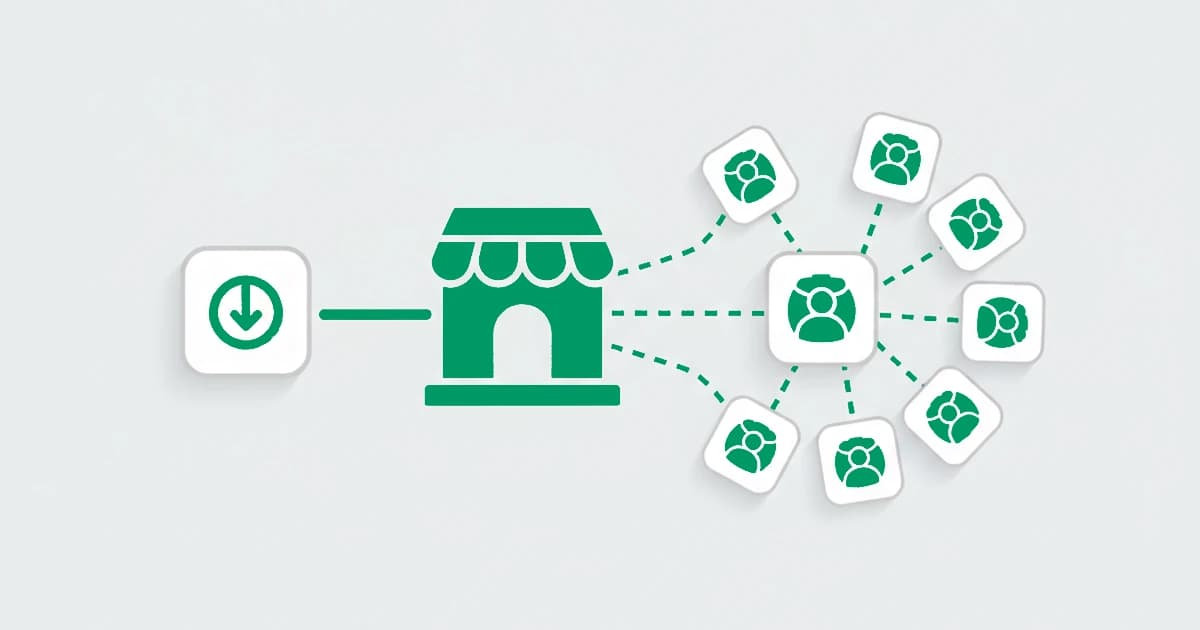
Most of what an ecommerce store calls "fraud" is two different problems wearing one word. One is payment fraud: stolen cards, chargebacks, the things a payment-fraud tool and a card network handle. The other is account and offer abuse: real-looking accounts created to claim a discount, a coupon, or a referral more times than the rules allow. They need different answers, and this guide is about the second one.
Across online businesses, the share of "new customer" traffic that is really returning customers in disguise tends to follow the same pattern: the email and the card change, the device behind the account does not. This playbook maps the account-side abuse a store actually faces and shows how reading the device behind each signup stops it without forcing a login or an identity check on every shopper.
Key takeaways
- Account and offer abuse is one shopper presenting as many to claim an incentive again and again. It is distinct from payment fraud, and a payment-fraud tool does not catch it.
- An ecommerce store faces a handful of recognizable forms: fake signups, first-order-discount farming, promo and coupon abuse, reseller multi-accounting, referral self-dealing, loyalty farming, and the multi-account side of refund and fake-review abuse.
- The common thread under all of them is one device behind many "separate" accounts, which is what makes the whole family catchable at one layer.
- You read it at the device and network level, not the email or the card, and you score it at signup or checkout before the discount is granted.
- Detection flags the risky accounts with the evidence behind them, and you choose what each one gets, so a real shopper checks out untouched.
What is account and offer abuse?
Account and offer abuse is when one shopper presents as many separate accounts to claim a store incentive, such as a first-order discount, a coupon, or a referral payout, more times than the rules intend. The payment is usually legitimate and the cards are the abuser's own, so the only thing fabricated is the "new customer" identity behind each redemption. It is distinct from payment fraud, which is about stolen cards and chargebacks, and a payment-fraud tool does not catch it. The shared mechanic is one person behind many look-alike accounts, which is what makes the whole family detectable at a single layer.
What account and offer abuse does an ecommerce store face?
The account-side abuse hitting an online store is not one thing, but the list is short and the forms repeat across every catalog. Naming them in one place helps, because they share a root and a fix even though they wear different offers. Each one has its own deeper guide; this is the map.
| Abuse type | What it is | Covered in depth |
|---|---|---|
| Fake accounts at signup | accounts created only to look like new customers, before any offer is even claimed | multi-accounting |
| First-order-discount farming | one shopper re-claiming the "new customer" discount from a fresh account every order | promo abuse |
| Promo and coupon code abuse | re-running a one-per-customer code under new accounts, or stacking it through duplicates | promo abuse and coupon abuse |
| Reseller multi-accounting | one operation cornering a limited drop or a fixed discount pool across many accounts to resell | promo abuse |
| Referral self-dealing | inviting your own throwaway accounts to collect both sides of a refer-a-friend payout | promo abuse |
| Loyalty and cashback farming | accounts cycled just long enough to qualify for points or cashback, then abandoned | promo abuse |
| Refund and return abuse | a return or refund ring run across many accounts, or refunds funneled back to one device, card, or address | refund and return abuse |
| Fake reviews and ratings | clusters of fabricated accounts posting reviews to inflate a listing or bury a rival | multi-accounting |
The forms differ, but read down the middle column and the same sentence keeps appearing: one shopper, many accounts. That is the whole reason these can be handled together instead of one campaign at a time. The last two carry a behavioral half as well, a single account that returns too much or posts one fake review, which lives in your order and review data; the device layer's job is the multi-account half, linking the accounts behind a return ring or a review cluster so the pattern stops hiding as unrelated shoppers.
The scale is not trivial. The National Retail Federation projects $849.9 billion in 2025 returns and puts 9 percent of them as fraudulent, which works out to roughly 76 billion dollars, and a slice of that is organized return rings running many accounts rather than one disappointed shopper. Discount and signup abuse rarely make a headline number because each instance is small, but they leak from the same place: accounts a store treats as new that are not.
This is not payment fraud, and the difference matters
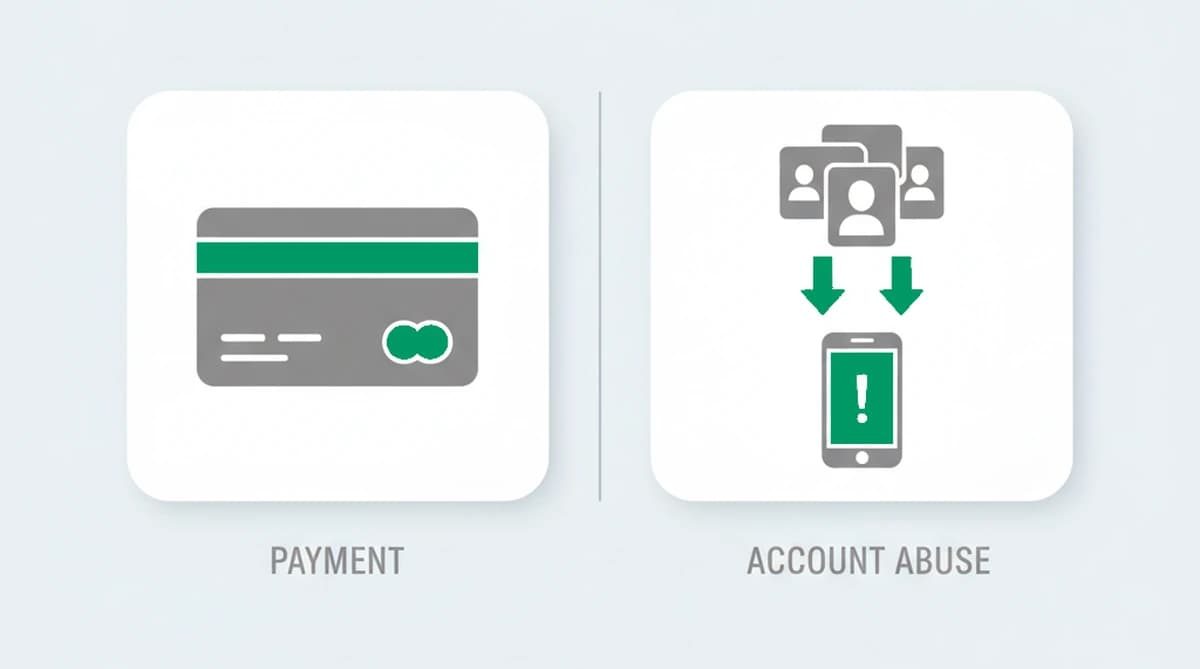
The single most useful distinction a store can draw is between payment fraud and offer abuse, because they look similar in a dashboard and need opposite tools.
Payment fraud is about money that is not the buyer's
Payment fraud is the stolen card, the chargeback, the card-testing run. It is caught by the things a payment stack already does: address and card-verification checks, machine-screening of transactions, and a chargeback process with the card networks. The work happens at the card and the transaction.
Offer abuse is about an identity that is not real
Offer abuse is different. The cards are usually the abuser's own and the charges are real; the only thing fabricated is the identity claiming "new customer" again. No card check flags that, because nothing about the payment is wrong, and a returns-and-chargeback tool will not see it either, because the orders are legitimate purchases at an unfair discount.
That is why a store can run a capable payment-fraud platform and still bleed margin to discount farming: the two problems do not overlap. Offer abuse is read at the identity layer, by linking the accounts behind the redemptions, the same broad problem research presented at USENIX NSDI tackled when it showed fabricated accounts can be flagged at scale, though it worked from the social graph rather than the device. That is a different control set than the payment one.
ShieldLabs sits on the identity side of that line. It reads the device and network behind an account, scores that session on a 0 to 100 risk score, names the risk signals that fired, and flags the risky accounts through the analytics dashboard, API and webhooks, so the offer-abuse slice stops being invisible. Naming the line keeps you from pointing a payment tool at an identity problem and wondering why the numbers do not move.
The one thread: one shopper, many accounts
Strip the offer away and every form on the list above is the same move: a single shopper produces a stream of accounts that each look like a first-time customer. It is the one-user-many-accounts pattern behind multi-accounting, where a fresh email and a rotated IP still fail to stop a determined shopper.
What ties the accounts back together is what the shopper cannot cheaply reissue per account. The email is disposable, the IP is rentable, the coupon code is shareable, but the device behind the checkout and the network it rides stay the same from one "separate" account to the next. So a store does not have to solve six problems; it has to answer one question at the moment an account acts: how new is this shopper, really. The same redemption-time signals and layered playbook that work against promo abuse apply across these account and offer-abuse cases.
How a store reads it without blocking shoppers
The reflex when abuse climbs is to add friction: force a login, demand a phone number, gate the first order behind a verification step. That tax falls on every honest shopper to catch a few abusers, and at an ecommerce checkout friction is measured directly in lost conversion. Reading the device first inverts the order.
Read the device, not the order
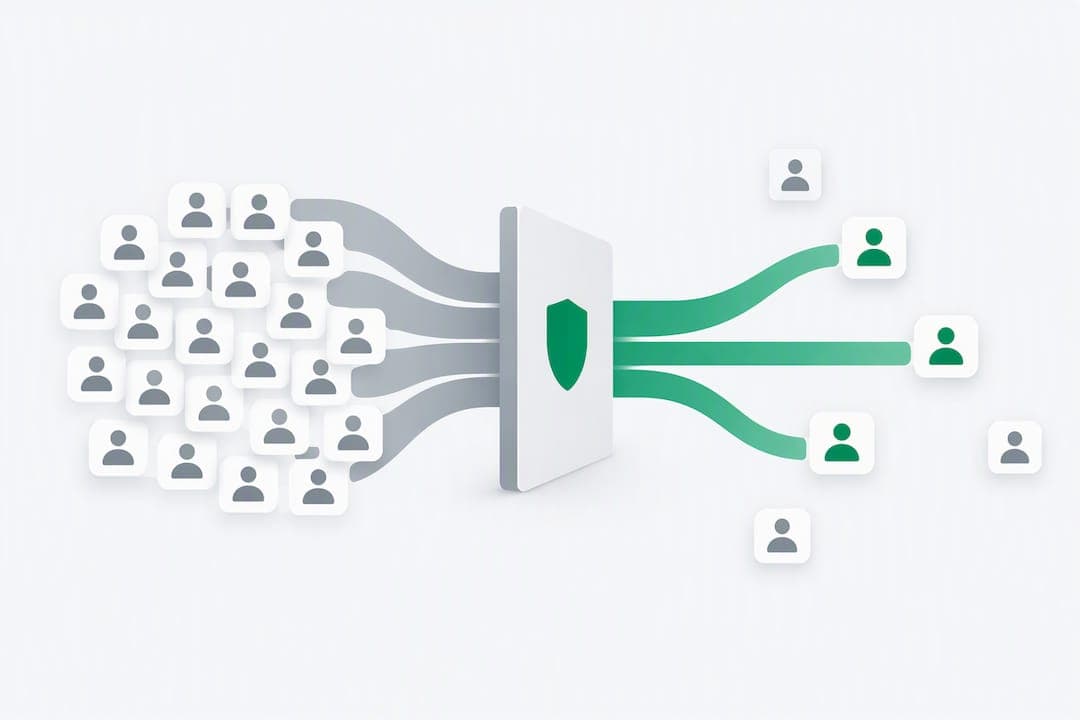
A JavaScript snippet identifies the visitor on the page, and your store reads a risk score for that session when an account signs up or a discount is redeemed. A device already seen behind a dozen first-order discounts scores high; a genuine first-time shopper on a normal connection scores clean and checks out with nothing added.
Because the score is separate from the action, you choose what a risky account gets: hold the discount for review, step up to a verification check, or let it through, while the real shopper never feels a thing. That separation, detect quietly and decide explicitly, is what lets a store cut abuse without turning checkout into an obstacle course. It works the same on a hosted platform like Shopify or BigCommerce as on a custom storefront, because it reads the browser and device rather than hooking into the payment flow.
The claim is easy to check, so we ran it directly. We sent the same shopper back through a store on a new email, an emptied cookie jar, and a different IP, and we measured that the device behind the checkout still tied back to an account we had already seen, even though every disposable layer had changed. That gap only widened after Safari began expiring script-set cookies within about a week in 2019, so a cleared browser now says even less about whether a shopper is genuinely new, and the device is the signal that holds.
Preventing ecommerce account abuse with ShieldLabs
ShieldLabs runs on your signup, checkout, or redemption page through one JavaScript snippet, and it risk-scores every visitor on the first visit, so you have a read on the shopper behind an account before a discount applies. At the center is persistent identification that ties a "fresh" account back to a device already seen, even after the shopper switches email, clears cookies, and rotates IP. It works in the background, with no login and no identity document required.
Each visit returns a risk score from 0 to 100 with the risk signals behind it, and multi-accounting detection, one of the four High-Risk Events, flags the accounts that trace back to one device, so a discount farm reads as a trend in the analytics dashboard rather than a pile of separate orders. You read the risk score and named risk signals through the API and webhooks and choose the action for each risky account; because the evidence is named, you can always say why an account was held. The same identity layer carries across the offer-abuse family, from promo abuse prevention to multi-accounting prevention, and it complements rather than replaces the payment-fraud tooling on the other side of the line.
Sources
- Wikipedia: Disposable email address
- Cao, Sirivianos, Yang, Pregueiro: Aiding the Detection of Fake Accounts in Large Scale Social Online Services (USENIX NSDI, 2012)
- National Retail Federation: 2025 Retail Returns Landscape (2025)
Frequently asked questions
- What is the difference between ecommerce fraud and offer abuse?
- Ecommerce fraud is usually used to mean payment fraud: stolen cards, chargebacks, and card testing, which a payment-fraud platform and the card networks handle. Offer abuse is a separate problem where the payment is legitimate and only the identity is fabricated, one shopper opening many accounts to claim a discount, coupon, or referral repeatedly. They overlap in a dashboard but need different tools: payment fraud is caught at the card and transaction layer, offer abuse at the identity and device layer. A store often needs both, because one does not catch the other.
- Do I need this if I already have a payment-fraud tool?
- Often yes, because the two cover different problems. A payment-fraud tool screens the card and the transaction and is built to catch stolen-card and chargeback risk. It does not flag a real shopper using their own card to claim a first-order discount for the tenth time under a new account, since nothing about that payment is wrong. Reading the device and network behind the account is what catches the offer-abuse slice, and it runs alongside the payment tool rather than replacing it.
- How do you stop multi-account abuse without blocking real shoppers?
- You read the device and network behind each signup or redemption instead of trusting the email and the card, then score how new the shopper really is and act only on the high-risk accounts. A genuine first-time buyer on a normal connection scores clean and checks out with no extra step, while a device already behind a dozen discounts stands out. Because the score is separate from the action, you hold or step up only the accounts flagged as duplicated, so friction lands on the farm and not the shopper.
- Does this work on Shopify or BigCommerce?
- Yes. The detection is a JavaScript snippet that reads the browser and device on your signup and checkout pages, so it works the same on a hosted platform like Shopify or BigCommerce as on a custom storefront. It does not hook into the payment flow or require a platform-specific integration; you read the risk score and named risk signals through the API and webhooks and choose the action for each risky account.
- How does ShieldLabs help ecommerce stores?
- ShieldLabs adds one JavaScript snippet to your signup or checkout page and, on the first visit, returns a risk score from 0 to 100 with the named risk signals and persistent identification behind it. That identifier ties a fresh account back to a device already seen even after a new email and a rotated IP, and the score weighs the signals so you can act on the risky accounts. It flags the risky accounts and helps stop offer abuse, and you choose the action for each case. The free tier covers your first 5,000 identifications, enough to watch real risk scores on your own traffic.
Related articles
Calculate Fraud Detection Pricing With ShieldLabs' 5,000 Free Tier
Estimate fraud detection costs with a buyer-focused pricing workbook and worked examples. Validate your projection using ShieldLabs' 5,000 free...

Fraud Teams: GDPR Fingerprinting With Explainable Signals
Operational guide for fraud teams on GDPR-compliant device fingerprinting: legal tests, explainable signal scoring, drift handling, and cross-border rules.
Stop Sybil Attacks Without KYC: Evidence-First Prevention for Marketplaces
Build an evidence-first defense for marketplace Sybil attacks: payment-weighted reputation, graph-based detection, device and anonymity signals, plus...