

How to prevent refund and return abuse

Last updated on September 23, 2026 · 11 min read
Refund and return abuse covers a lot of ground, and most of it is not an identity problem. The slice this guide is about is narrow and specific: an online refund ring, where one operator runs many "separate" customer accounts and funnels the refunds, replacements, or "item not received" claims back to one device, card, or address. The National Retail Federation put 2025 return fraud at roughly $76.5 billion, about 9% of all returns, and organized rings are a slice of that total rather than the whole of it.
Refund abuse sits inside the broader category of first-party fraud, where the person filing the claim is the account holder rather than a stolen identity, and that category is growing: LexisNexis reported that first-party fraud now accounts for 36 percent of all fraud events.
You do not catch a ring by reading any single return in isolation; you catch it by reading the device and network behind the accounts and seeing that the "separate" shoppers are one. In years running operations for online stores, I measured how often a cluster of unrelated-looking refund claims resolved back to the same handful of devices, and the order form never showed it.
Key takeaways
- This guide is about one slice of return abuse: the online refund ring, many accounts run by one operator with refunds funneled back to one device, card, or address. It is read at the identity layer, not the order history.
- It is not the same as the retail loss-prevention problem (wardrobing, item swapping, receipt fraud, employee fraud) that single-account return behavior and in-store controls handle.
- It is not friendly fraud or a chargeback, which is a payment dispute at the card and the bank, a separate control set.
- The signal that exposes a ring is consistency the operator cannot reissue per account: the device and network behind the claims, even when the email, card, and address are swapped.
- Detection produces evidence, not a verdict. Honest high-volume returners exist, so the device link flags the ring for review and you choose the action for each case.
What is refund and return abuse, and what is it not?
Return fraud is an umbrella over several different problems, and aiming the wrong tool at the wrong one is the common mistake. The version this guide covers is read at the identity layer: many accounts that look like separate shoppers but trace back to one operator. The rest are real problems with different fixes, named here so you do not point device detection at them.
It is not single-account return behavior
Most of what gets called return fraud is one real person abusing a return policy: wardrobing (buying, using, and returning), item swapping, returning an empty box, receipt fraud, or a serial returner who keeps too much. That behavior lives in your order and returns history, and it is handled the way retail loss-prevention teams handle it, with return windows, restocking fees, return-rate limits per customer, and inspection on receipt. It is a real cost, but it is one identity acting as itself, so it is an order-history and policy question rather than an identity-detection one.
It is not friendly fraud or a chargeback
When a buyer disputes a legitimate charge with their bank to claw the money back while keeping the goods, that is friendly fraud, settled as a chargeback at the card network and the issuer. It rides the payment rail, and the controls are representment, evidence, and the dispute process your payment stack already runs. That is a payment-side problem, settled at the card and the bank, separate from the account layer this guide reads.
It is not a marketplace buyer-seller dispute
On a peer-to-peer marketplace, an "item not as described" or "never arrived" claim between a buyer and a third-party seller is a platform dispute, mediated by the marketplace's own resolution process. That is a different relationship than a store reading its own customers, and a different fix.
What is left after those three, the slice device detection actually reads, is the organized online refund ring: one operator, many accounts, refunds and replacements collected over and over because each account looks like a new, unrelated shopper.
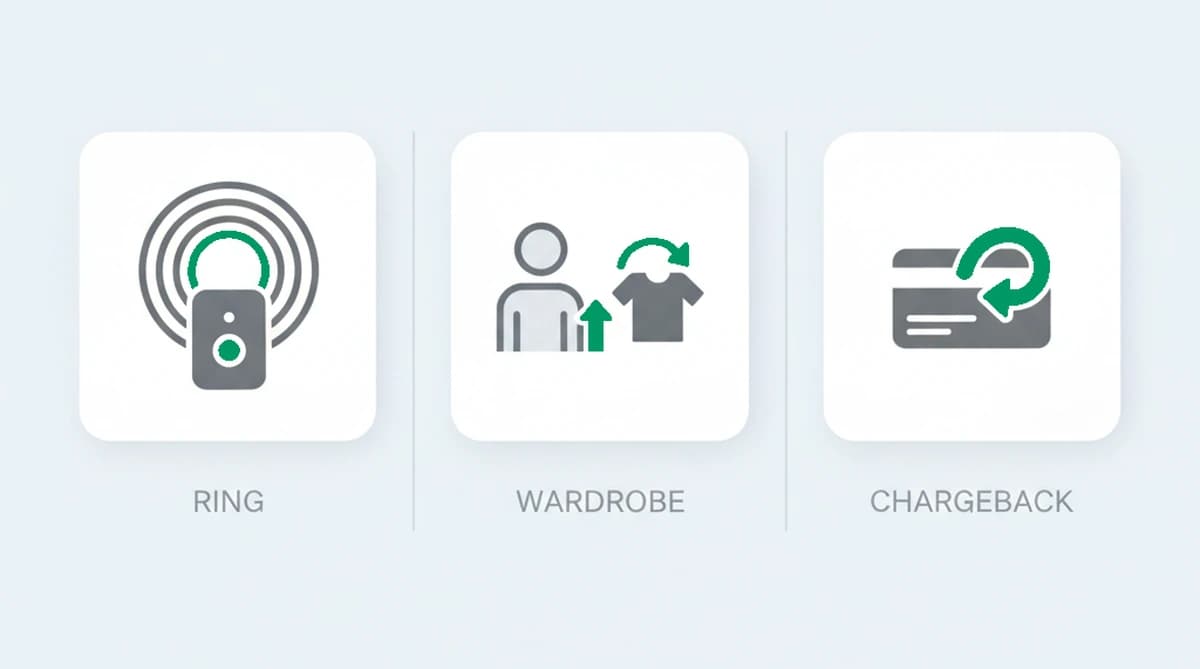
The shape you can detect: refund rings across many accounts
A refund ring is multi-accounting pointed at the returns process. One operator stands up a stream of accounts, each placing orders and then filing refunds, replacement requests, or "item not received" claims, and routes the recovered money or goods back to a small number of cards, payout destinations, or drop addresses. It is the same one-user-many-accounts pattern behind multi-accounting, aimed at the refund instead of the signup bonus, and the reason a fresh email and a rotated IP fail to link the accounts is covered there rather than repeated here.
The tell is that the accounts have to look unrelated on the surface to keep working, but the operation has to stay consistent underneath to scale. Each account gets a new email, often a new card, sometimes a new shipping address, but the device making the claims and the network it rides do not change as cheaply, and the money has to land somewhere. So a set of refund claims that look like a dozen disappointed customers, and resolve to one device or one payout trail, is the ring showing through. Reading that link is what separates a coordinated operation from a run of genuine returns.
What signals flag a refund ring?
What exposes a ring is the gap between what an operator can reissue per account and what they cannot. A disposable inbox, a fresh card, and a new address are cheap to produce for every account; a genuinely different device and home network for every claim are not, and the recovered value has to funnel somewhere. That cheap-attributes-move-while-costly-ones-repeat principle is the device-layer counterpart to a well-studied problem, detecting fabricated accounts at scale, that USENIX NSDI research approached from the social graph. So the useful question is never whether one return looks odd, but how many independent signals land on the same operator. The ones that carry the most weight, and the risk each points to:
| What you can read across return claims | Why it points to a refund ring | Risk it carries |
|---|---|---|
| The same device behind several "separate" refunding accounts | one operator running many accounts, not many shoppers | High |
| An anti-detect browser or a spoofed device profile | a profile rebuilt to look unique per account | High |
| A VPN, anonymous proxy, or datacenter connection | network cover routed under each account | High |
| The same network footprint behind many refunding accounts | a ring working from one place | Medium-High |
| A burst of refund or "item not received" claims from one footprint | coordinated claiming, not organic returns | Medium-High |
| A reused payout destination, card, or drop address across accounts | recovered value funneled back to one hand | Medium-High |
| A refund or shipping region that disagrees with the network origin | one place reused behind many faked shoppers | Medium |
| Near-identical contact details across "separate" accounts | accounts minted from one template | Medium |
No single row is proof. A real customer can shop over a VPN, and two people in one household can share a network and a delivery address. The read is correlation: a claim that lights up several rows at once, especially a device already seen behind other refunding accounts, is the cluster worth holding. Swapping the email or rotating the IP changes none of the device traits underneath, which is why the device, not the address, is the anchor that holds the accounts together.
When we ran the device and network read across clusters of unrelated-looking refund claims, the pattern the order form hid showed plainly: a fresh email, card, and address on every account, but the device and home network behind the claims repeating, so a dozen "separate" shoppers collapsed onto one operator. The scale underneath is real. The National Retail Federation put return fraud at about 9 percent of all returns in 2025, and organized multi-account rings are a slice of that total, the slice this device link is built to surface.
How do you read it without punishing honest returners?
The risk with returns is over-correction. Plenty of good customers return a lot, and treating a high return rate as guilt drives away exactly the shoppers you want. The device link avoids that trap, because it does not flag a person for returning often; it flags the moment several "separate" accounts turn out to be one.
A frequent returner who is one identity reads as one identity. A ring reads as multi-accounting, a different signal entirely, and ShieldLabs detects it directly.
With ShieldLabs, a JavaScript snippet identifies the visitor on your site, and your server reads a risk score for the session behind an account or a refund request. A scored session comes back with the visitor, the device behind it, a score, and the named signals that moved it:
{
  "event_type": "identification.scored",
  "schema_version": "2026-06-01",
  "created_at": "2026-06-12T10:20:00Z",
  "data": {
    "request_id": "a4f17c92-6b3e-4d80-9a25-1f8c0e7b3d46",
    "visitor_id": "e2c9b1d4-7a61-4f53-b0c8-9d2e4a6f1b30",
    "device_id": "6f1a3e84-2c57-49b0-bd13-8a0c5e7f2d94",
    "connection_type": "proxy",
    "risk_score": 80,
    "detection_flags": { "anti_detect_browser": true, "datacenter_ip": true },
    "observed_at": "2026-06-12T10:20:00Z"
  }
}
The score is one number from 0 to 100, and the signals name what is behind it rather than hiding it in a black box. A high score on a session whose device_id already sits behind other refunding accounts is the ring showing through, the kind your team holds for review before approving the refund. A clean account returning a sweater goes through untouched. Because the score is evidence and not a verdict, you choose what a flagged cluster gets: a manual review, a hold on the refund, or a step-up check, while the honest returner never feels it.
Preventing refund and return abuse with ShieldLabs
ShieldLabs runs on your store through one JavaScript snippet, and it risk-scores every visitor on the first visit, so you have a read on the account behind a return before you approve the refund. At the center is persistent identification that ties a "fresh" account back to a device already seen, even after the operator switches email, card, and address. It works in the background, with no friction for a real customer and no login required.
Each visit returns a risk score from 0 to 100 with the risk signals behind it, and across accounts ShieldLabs detects High-Risk Events such as Multi-accounting directly, each with Medium or High confidence, so a refund ring reads as a trend in the analytics dashboard rather than a pile of unrelated claims. You read the score and the events through the API and webhooks and choose the action for each case: ShieldLabs flags risky users and helps block fraudulent and abusive traffic, and you can always say why a refund was held. The same identity layer carries across the account and offer abuse a store faces and feeds refund-abuse prevention as a managed solution, and it complements rather than replaces the payment-side tooling that handles chargebacks.
Sources
- National Retail Federation: 2025 Retail Returns Landscape (2025)
- Wikipedia: Return fraud
- Cao, Sirivianos, Yang, Pregueiro: Aiding the Detection of Fake Accounts in Large Scale Social Online Services (USENIX NSDI, 2012)
- LexisNexis Risk Solutions: Global State of Fraud and Identity
Recommended
Frequently asked questions
- What is the difference between return fraud and return abuse?
- The useful split is by who is acting. Return abuse is usually one real customer stretching a policy, which lives in your order history. The organized end is many accounts run by one operator to collect refunds over and over, which lives at the identity layer. This guide covers the second, the refund ring, the slice device-level detection reads.
- Is a refund ring the same as a chargeback or friendly fraud?
- No. A chargeback is a payment dispute settled at the card network, the work your payment stack already does. A refund ring works inside your own returns process, with many accounts claiming refunds directly, and is read at the account and device layer. They are fixed at different layers, so a chargeback tool will not see the ring.
- How do you detect a refund ring without blocking good customers?
- You read the device and network behind each account rather than judging the return itself, then act only when several separate accounts resolve to one device or payout trail. A genuine customer, even one who returns often, is one identity and scores clean; a ring stands out because many accounts share the device underneath.
- Can this stop wardrobing or serial returns?
- Not directly, and it is not meant to. Wardrobing and a single customer returning too much are one identity acting as itself, so the fix is order-history limits, return windows, and policy. Device-level detection is for the multi-account case: not how one person returns, but how many separate accounts turn out to be one operator.
- How does ShieldLabs help with refund and return abuse?
- ShieldLabs adds one JavaScript snippet to your store and returns a risk score with named risk signals and persistent identification. That identifier ties a fresh account to a device already seen even after a new email and card, so a cluster of refund claims resolving to one device surfaces as a ring and is flagged as a Multi-accounting event. You choose the action for each case.
Related articles

How to prevent ticket scalping
What ticket scalping is, how scalpers beat per-person limits with fake accounts, and how the device behind those accounts links them back to one buyer.

How to prevent buy now, pay later (BNPL) fraud
What BNPL fraud is, the main types from account takeover to loan stacking, why the model is so exposed, and how to prevent it with device-level signals.

How to prevent friendly fraud with device evidence
Friendly fraud is when a real customer disputes a purchase they made. How it works, why it is hard to prove, and how device evidence helps you fight it.