

How to Evaluate Device Fingerprinting Accuracy on Real Traffic

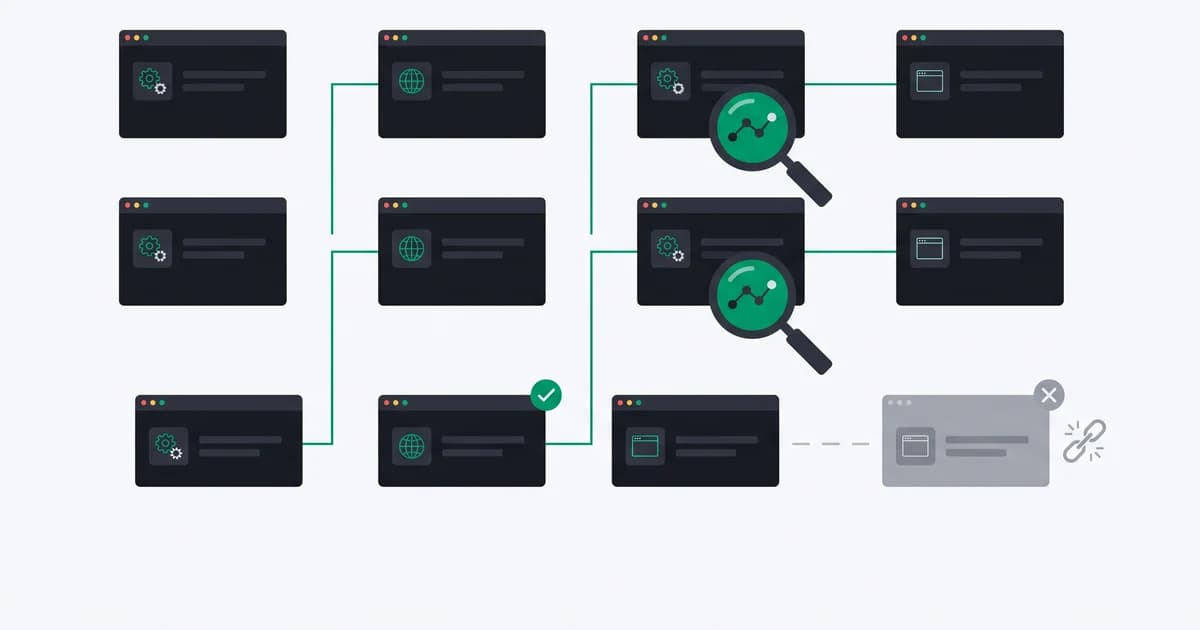
Last updated on October 9, 2026 · 8 min read
Last updated: October 9, 2026
Device fingerprinting accuracy is meaningful only when the test says what was recognized and how it knew the correct answer. A one-visit uniqueness score cannot tell you whether the same browser will be recognized next month. Mozilla describes fingerprinting as identification from a combination of observable browser and device attributes, while also documenting protections that affect those observations. That creates several different measurements, each with its own failure modes.
Evaluate a solution on your own surfaces with independently labelled return visits, different devices and realistic browser changes. Report recognition, mistaken merges, mistaken splits and missing results separately. Then evaluate fraud decisions against confirmed business outcomes; an accurate identifier and an accurate abuse decision are different claims.
TL;DR: Define the identity being tested, establish ground truth independently, run vendors on the same traffic, and measure collisions, splits, coverage and stability over time. Publish the sample, denominator, time horizon and uncertainty beside every accuracy figure.
What does fingerprinting accuracy actually measure?
Recognition accuracy asks whether an observed browser context is associated with the correct previously observed context. Uniqueness asks how often a fingerprint differs from others in a sample. Stability asks how often the association holds through changes and time. Detection accuracy asks whether an abuse or risk result agrees with independently established outcomes.
| Measure | Correct question | What it cannot establish alone |
|---|---|---|
| Uniqueness | How distinct are values in this sample? | Recognition across future visits |
| Return recognition | Did a labelled returning context match? | Whether that user committed fraud |
| Collision or mistaken merge | Were distinct labelled contexts linked? | Why the product linked them |
| Split | Was one labelled context assigned new identities? | Whether a changed browser should count as a new context |
| Coverage | How many attempted checks produced a usable result? | Correctness of those results |
Define the identity before running the test. A browser-scoped identifier and a physical-device identifier have different expected behavior when you switch browsers. An account is not a device: two devices can legitimately log into one account, and one browser can be used by several accounts.
How do you establish independent ground truth?
Use a controlled device inventory and an authenticated test harness to label what is actually returning. Assign test labels outside the fingerprinting system, record browser and profile boundaries, and decide how resets affect the expected identity. For production data, obtain appropriate consent and minimize the labels you retain.
MDN warns that “browsers and user agents routinely pretend to be another browser”. Keep ground truth independent of those declarations.
Cookies alone are a weak ground-truth source for a cookie-reset experiment. If your test label disappears when you clear storage, you can lose the very relationship you intended to evaluate. Similarly, using the vendor's own identifier as the correct answer makes the evaluation circular.
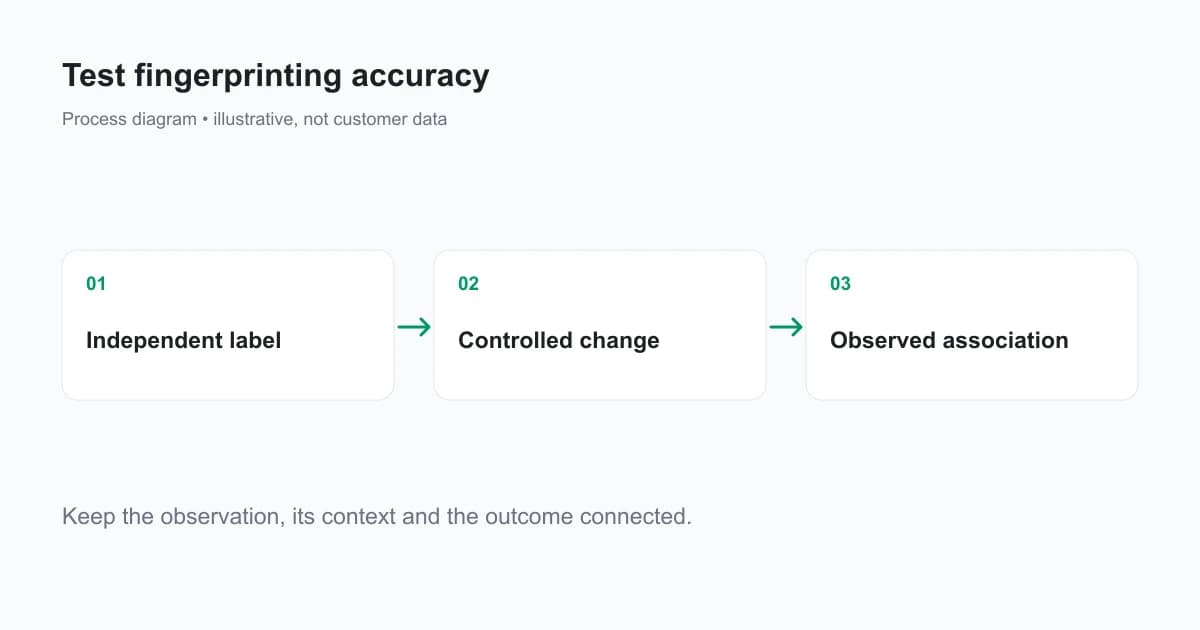
A practical test record can contain an independent device label, browser/profile label, scenario, observation time, attempted collection and returned identifier. Keep the private identity mapping separate from the analysis dataset. Include checks with no usable result instead of deleting them during cleaning.
Which scenarios should you test?
Test ordinary return visits first, then isolate one change at a time. Browser updates, IP changes, cookie deletion, private browsing and a new profile test different properties. Combining all changes into one scenario makes it hard to explain a failure.
| Scenario | Ground-truth question | Expected scope to document |
|---|---|---|
| Same browser, next day | Does the context return to its prior identity? | Same profile and device |
| Browser update | Does recognition survive normal software change? | Version before and after |
| Network change | Does the association depend on one IP? | Same browser, new network |
| Cookie reset | Can device recognition survive storage loss? | Distinguish device ID from visitor ID |
| Private browsing | Is the device association retained? | Product's declared browser scope |
| Different device, similar setup | Does the service merge unrelated contexts? | Distinct independent labels |
Include representative browsers and privacy settings. A result drawn only from desktop Chrome cannot support a claim about every web surface. Start with common traffic cohorts, then report small or uncommon cohorts separately so their results remain visible.
For adversarial tests, describe the broad class of manipulation and the conditions without publishing instructions for evasion. Separate recognition under environment changes from the service's risk signals about suspicious changes. A system may surface risky evidence even when its device association changes.
How do you calculate collisions, splits and coverage?
Use denominators that match the question. For labelled return attempts, recognition rate is correctly linked returns divided by eligible return attempts. For collision tests, mistaken-merge rate is incorrectly linked distinct contexts divided by the distinct-context comparisons your protocol evaluated. Coverage is usable results divided by attempted checks.
Do not mix an all-pairs collision denominator with a per-visit recognition denominator under one percentage called accuracy. State how candidate pairs were selected: every pair, sampled pairs or only pairs the system linked. The resulting rates mean different things.
Consider a hypothetical, deliberately small example: 100 labelled return attempts produce 92 correct links, 3 incorrect links and 5 missing results. Recognition on all attempts is 92%; on returned results it is about 96.8%. Reporting only the second value hides incomplete coverage. These numbers illustrate the calculation and are not ShieldLabs test results.
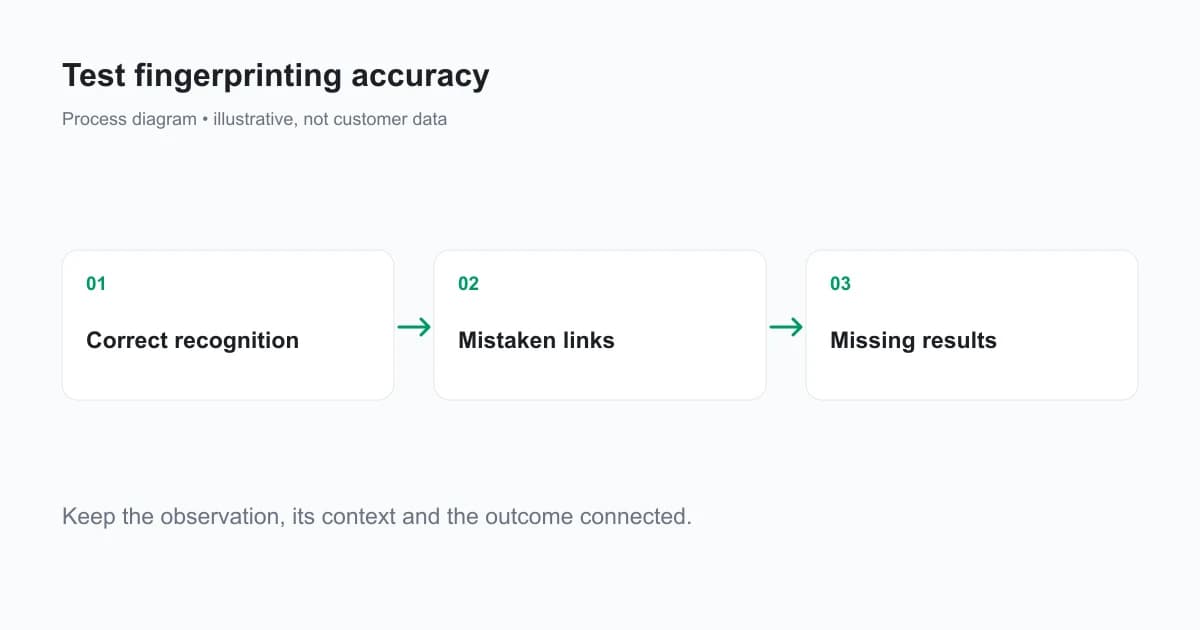
For large longitudinal tests, repeated visits from the same device are correlated. A device with hundreds of visits should not dominate the conclusion. Report device-level results as well as observation-level results, and account for that correlation in uncertainty estimates. Publish the protocol and sample sizes so a reviewer can interpret the percentages.
How do you compare vendors fairly?
Run solutions on the same traffic, time window and surfaces. Record each attempt independently, including script failures, blocked collection, timeouts and incomplete results. Compare only capabilities and identities each product actually promises.
Keep the integration conditions visible: script placement, consent timing, SDK version, result retrieval method and latency budget. A service initialized only after a form submission can look slower or produce fewer usable results than one given time to collect while the form is filled out.
Evaluate latency as a distribution, with the time to the first usable result and any subsequent refinement. Keep the values available at the decision time separate from information collected later. An offline replay that sees future data can overstate the value of a real-time decision.
Avoid turning a browser-testing website's uniqueness output into a vendor leaderboard. Such a sample may be self-selected and disproportionately include privacy-focused users. Its entropy or uniqueness result answers a sample-specific question, not a longitudinal recognition question for your product.
How should you evaluate ShieldLabs?
ShieldLabs delivers 99.9% identification accuracy and 99.9% risk signal detection accuracy. These are separate product claims. The procedure in this article is a suggested independent evaluation; it does not present a new ShieldLabs benchmark or imply that we ran this test on your traffic.
Use the documented identifier boundaries. ShieldLabs Device ID holds through cookie clearing, private browsing and IP changes within a browser context. Visitor ID combines a device and a cookie, so it changes when the cookie is cleared. Another browser on the same machine receives its own Device ID. The identifier reference explains the model.
Keep identification outcomes separate from risk scoring and the four High-Risk Events. For a fraud evaluation, review confirmed product outcomes and false positives alongside the named evidence. Recognition alone cannot establish whether several linked accounts violated your trial or referral terms.
What should an evaluation report include?
Publish the identity definition, independent labels, collection dates, SDK versions, tested browsers, scenario matrix, denominators and missing-result policy. Break out normal return visits, controlled environment changes and distinct-device tests.
Include at least one unresolved limitation. Examples include a short observation horizon, a small privacy-browser cohort or an unverified business-outcome label. A limitation gives readers the boundary of the result without invalidating the data you did collect.
Choose the next action from the failure type. Collection failures need integration investigation; frequent splits need a stability review; mistaken merges need a linkage review. A high challenge rate needs a separate analysis of risk evidence and user outcomes. One summary percentage cannot tell an engineering team which problem to fix.
Ready to evaluate device recognition on your traffic?
ShieldLabs provides device and visitor identification with explainable risk evidence for web products. Start Free with 5,000 one-time identifications and use an independent test protocol to assess your own integration.
Sources
- Mozilla: browser fingerprinting and protections
- ShieldLabs identification model
- ShieldLabs browser initialization and collection
- NIST Engineering Statistics Handbook
Recommended
Frequently asked questions
- How accurate is digital fingerprinting?
- For browser and device recognition, accuracy depends on the identity definition, test population, return horizon and available observations. Measure independently labelled return recognition, mistaken merges, mistaken splits and missing results separately. A uniqueness score from one visit cannot establish long-term recognition or confirmed-fraud detection accuracy.
Related articles
Remember This Device for MFA With a Persistent Device ID
Design remember this device for MFA with a revocable trust credential, persistent device context, expiry and step-up authentication for sensitive actions.

How to Detect AI Agents on a Website
Detect AI agents on a website by separating operator identity, automation evidence and authorization. Protect accounts while permitting useful public crawling.

Fraud Detection API for Web Apps: From Browser Signal to Backend Decision
Integrate a fraud detection API into web signup and login with browser collection, verified server results, signed webhooks and clear timeout handling.