

Paywall Abuse Prevention: Protect Access and Reading Limits
Last updated on October 21, 2026 · 8 min read
Last updated: October 21, 2026
Paywall abuse prevention protects the right to read an article, use an allowance or access a subscription. It requires two things to work together: the publishing system must enforce access, and the site must recognize when apparently separate visits are repeating the same claim.
Those problems need different fixes. If a premium article is already present in an unauthorized response, identifying the reader more accurately will not remove it. If a meter grants another allowance whenever a cookie changes, fixing the response alone will not connect the repeated claims.
This guide walks through an access audit for publishers and subscription teams. The examples are hypothetical design scenarios, not measured customer results.
Start by locating the access failure
Check what an unauthorized reader actually receives before adding another challenge. A page can show a subscription overlay while its HTML or a content endpoint still delivers the full article. It can also enforce delivery correctly while a separate meter incorrectly grants repeated allowances.
| Observation | First place to investigate | Evidence to preserve |
|---|---|---|
| Full premium text arrives without entitlement | Origin authorization and content endpoints | Request identity, resource and access result |
| One subscriber's response reaches another reader | Cache policy and response isolation | Cache key, response headers and authorization context |
| A reader receives a fresh allowance repeatedly | Meter identity and allowance updates | Grant record, recognized browser and article consumption |
| One subscription appears across recurring concurrent users | Account sharing and session policy | Account, device relationships and session times |
| A recognized subscriber is interrupted after renewal | Billing synchronization and access recovery | Subscription event, processed state and last successful access |
The table gives each failure a starting point. It does not establish fraud from one observation. A renewal delay, a household device or a cached response can produce a customer problem that needs correction rather than enforcement.
The OWASP authorization guidance calls for permission checks on every request. For a publication, that includes the content endpoint and downloadable resource, not just the page that links to them.
Authorize before delivering premium content
An entitlement is the current right to access a resource or feature. Resolve the account or applicable meter, evaluate the requested article and deliver only what that decision permits. Keep the public preview and the premium response deliberately separate.
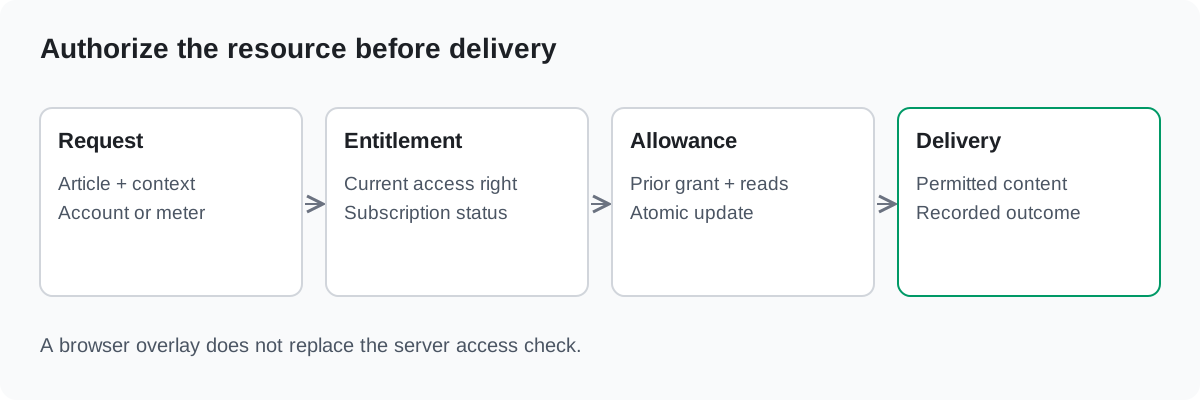
For example, imagine a publication that permits a limited number of unpaid articles during a defined period. The implementation needs a record of the allowance, its owner, its expiration and the articles already counted. It also needs to distinguish a genuinely new read from a retry after a network interruption.
Use a transaction or equivalent atomic update when consuming that allowance. If two requests arrive together, neither should decide from an outdated balance and grant access that the other has already consumed. When the same request is retried, a stable operation reference should let the system return the existing result rather than consume or create another grant.
Subscription state must reach the application as well. Stripe's entitlement documentation describes active entitlements and updates used to provision or remove feature access. Whatever billing system you use, record when its state was processed, how failed updates are retried and how support restores access when a valid subscriber is affected.
Keep the decision understandable. “Subscription inactive,” “allowance exhausted” and “verification pending” require different messages and recovery steps. Sending all three readers to an unexplained error page makes a correct control difficult to support.
Test the cache as part of the paywall
A correctly authorized origin can still be undermined by a cache that reuses the wrong response. Review the entire path through your CDN, application cache and browser cache, including alternate article formats and content APIs.
As MDN explains for Cache-Control, private prevents storage in shared caches, while no-store instructs caches not to store a response. Those directives serve different purposes. Choose the behavior for the resource and confirm that the infrastructure honors it; a header copied into a template is not an access test.
Use a controlled pair of test accounts. Request the same article as a subscriber and then as an unauthorized reader, including requests through the deployed CDN. Check the response body, not just the visible overlay. Repeat after logout, subscription changes and cache refreshes. Keep the test limited to accounts and content you control.
Search access also needs an explicit policy. Google's paywalled-content documentation explains how markup describes subscription content to Search. That markup describes the page; it is not an authorization mechanism. Keep preview, subscriber and crawler delivery consistent with the publication's intended access policy.
Keep reading limits attached to a useful identity
Metered paywall abuse occurs when a reader repeatedly obtains an allowance intended to apply once within the policy period. A browser cookie can store a meter reference, but cookie loss can make the same returning browser appear new. IP-based limits introduce another problem: unrelated readers can share a network.
Define what the allowance actually belongs to. An authenticated account, a recognized browser context and a household are different policy units. Cookieless device identification can help preserve browser continuity, while an account login can connect permitted activity to a subscription. Neither should be silently treated as proof of one human across every device.
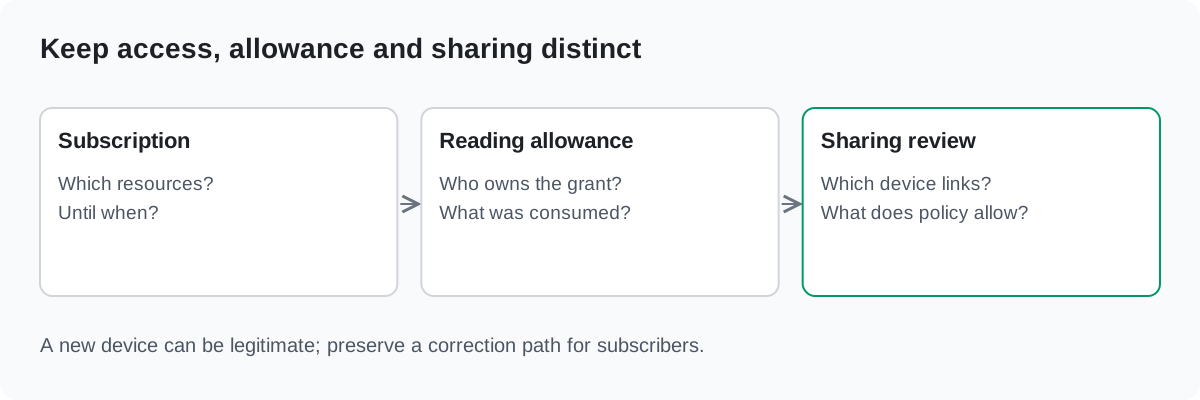
Preserve the allowance decision independently from the risk observation. In a hypothetical review, a returning browser has already consumed its allowance but now arrives with a new cookie. The useful evidence is the previous grant and subsequent reads associated with that browser context. A changed cookie by itself is not a confirmed policy violation.
Document exceptions too. Decide how interrupted loads, gifted articles, subscriber previews and accessibility routes affect the meter. A durable identity improves consistency only if the rules it connects are clear. If repeat registrations reset the allowance, use the multi-accounting prevention guide to investigate the account relationships.
Review shared subscriptions without treating every new device as abuse
Subscription account sharing concerns how access is used after authentication. Repeated concurrent activity across a recurring set of devices can deserve review, but a replacement phone or a normal work-and-home pattern needs different handling.
Compare the observations with the subscription terms and permitted device use. Keep the account's session history available to support, offer a confirmation route and explain how a subscriber can remove an old session. Where the business model permits it, an upgrade can be a better response than repeated interruptions.
The account sharing guide covers the evidence behind that investigation. Keep its result separate from a raw risk score: network masking, automation, entitlement and sharing describe different aspects of an access request.
Measure access quality as well as prevented abuse
Build a small acceptance set before a wider rollout. Include a returning unpaid reader, an active subscriber, an expired subscription, concurrent allowance claims, an interrupted request and a device change. Record the expected outcome before running the test.
Track subscriber access failures, corrected restrictions and successful upgrades alongside repeated ineligible claims. Keep unavailable checks in their own category. A fall in delivered articles can reflect better enforcement or a broken access path, so it is insufficient evidence of success by itself.
An operational review should answer three questions: which resource was requested, what right to access it existed at that time, and why did the system choose its response? If those answers cannot be reconstructed, fix the record before making a stronger restriction permanent.
Prevent repeat access abuse with ShieldLabs
ShieldLabs adds returning-visitor recognition, bot detection, named risk signals and account sharing detection around the content gate. The evidence can connect repeated allowance claims and suspicious subscriber activity while the publishing system maintains subscriptions, access grants and article delivery.
Install the browser snippet and retrieve results through the API or webhooks alongside the relevant content action. The paywall prevention workflow connects recognition with the access controls described above. Start Free provides 5,000 identifications, one time.
Sources
- OWASP: Authorization Cheat Sheet
- Stripe: active entitlements and access provisioning
- MDN: Cache-Control directives
- Google Search Central: subscription and paywalled content
Recommended
Frequently asked questions
- What is paywall fraud?
- Paywall fraud involves obtaining restricted content through deceptive or unauthorized access, such as repeated ineligible reading allowances or misuse of subscriber access. A content-delivery defect is a separate problem: if the server sends a premium article without checking access, fix authorization and caching before relying on visitor risk signals.
- How can publishers prevent metered paywall abuse?
- Maintain the reading allowance on the server, associate it with the identity your policy measures and update it safely when requests happen at the same time. Returning-browser recognition can help investigate repeated quota resets. Preserve exceptions for legitimate shared devices, paid subscribers and interrupted reads, and record the reason for each restriction.
- Can CAPTCHA protect a paywall?
- A CAPTCHA can add an automation check, but it does not establish that a reader has paid or has an unused reading allowance. Validate the challenge on the server and check entitlement separately. Deliver premium content only after the required access conditions are satisfied.
- What should an enterprise paywall solution be evaluated against?
- Evaluate server-side authorization, subscription-state synchronization, cache behavior, meter consistency, shared-account handling and operational recovery. Test direct content endpoints, canceled access, concurrent reads and incomplete checks. Integration fit and subscriber access matter more than an enterprise label; request evidence for the workflows your publication actually uses.
- How does ShieldLabs help prevent paywall bypass?
- ShieldLabs recognizes returning visitors, detects bots and identifies account sharing around content access. Its device and network evidence helps connect repeated allowance claims and suspicious subscriber activity. Combine those detections with the entitlement and delivery controls in the publishing system. Start Free includes 5,000 identifications, one time.
Related articles
Four Stage Risk Funnel for Fake Signup Detection with Persistent ID
Practitioner guide to fake signup detection: build a four stage risk funnel and use persistent visitor IDs and auditable signals to cut fake accounts.

How ban evasion detection works: re-identifying returning banned users
How ban evasion detection works: why account-only bans fail, and the signals that re-identify a returning banned user behind a brand-new signup.

How to detect fake reviews
What review fraud is, the main types of fake reviews, why the text alone won't catch them, and how the device behind a review ring gives it away.
