

Seat sharing in SaaS: how to detect it and turn sharers into seats
Last updated on September 23, 2026 · 8 min read
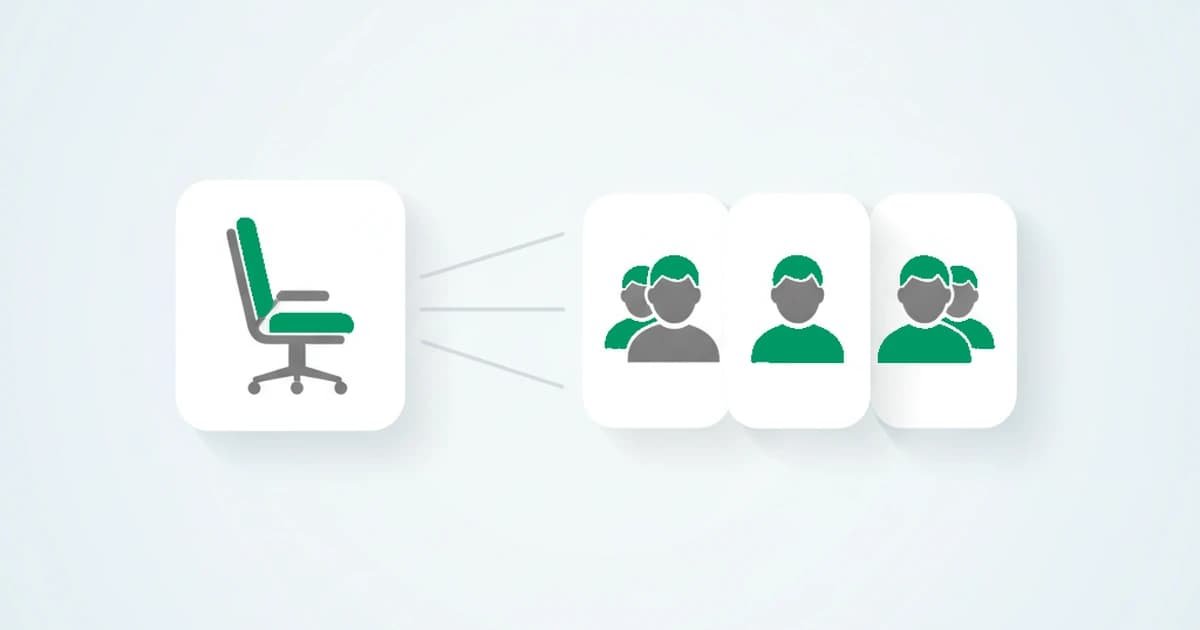
Seat sharing in a SaaS product is when one paid seat is used by several people on a team, rather than each person buying their own. It is the business-software version of account sharing, and it has nothing to do with the electoral term that dominates a plain search for the phrase. For a per-seat product, it is a direct revenue leak: every extra person on a shared seat is a seat that was never bought.
Seat sharing is the rare abuse problem with an upside. The same people quietly sharing a login are, by definition, getting value from your product. Detecting them is not about locking anyone out; it is about turning a leak into seats you can sell. This guide covers how to spot seat sharing in a SaaS account, the revenue it costs, and how to act on it without friction for the customers you want to keep.
Key takeaways
- Seat sharing is the SaaS form of account sharing: one paid seat used by a whole team. The detection method is the same, counting the distinct device identities behind a single login over time.
- For a per-seat product it maps straight to revenue. Each shared seat is a number of unbought seats, which makes the leak easy to size.
- The right response is rarely a block. It is an upgrade prompt, because the sharers already value the product and converting them adds seats rather than removing users.
- A raw device count overcounts. A single developer with a laptop, a desktop, and two browsers is not a sharer, which is why the Account sharing rule can be tuned to fit your product.
What is seat sharing in SaaS?
Seat sharing happens when a team buys fewer seats than it has people and passes the logins around. One license covers a role, a pod, or a whole department, and everyone signs in with the same credentials. It is common, it is rarely malicious, and on a per-seat plan it is exactly the revenue your pricing was built to capture.
It is worth separating from two neighbors. It is not free-trial abuse, where one person cycles through many trial accounts to avoid paying at all; seat sharing is people who already pay, just for fewer seats than they use. And it is the business-software case of the broader account sharing problem, which also covers consumer subscriptions and streaming. The mechanic is shared, but in SaaS the framing is per-seat licensing and the response is usually an upsell.
How to detect seat sharing
Detecting seat sharing uses the same foundation as any account sharing: give each session a persistent device identity, attach it to the account, and count how many distinct identities accumulate on one seat over time. That account sharing mechanic carries straight over, so this section focuses on what is specific to a SaaS seat. A 2021 Eindhoven University of Technology thesis on account-sharing detection in web login studies the same approach, examining how the set of devices behind a login reveals sharing that the credentials alone do not.
A shared seat tends to show a particular shape:
- Many distinct devices on one seat, more than a single employee with a few machines would produce, persisting across cleared cookies and rotated IPs.
- A spread of work environments, different operating systems and browser profiles that read like several people rather than one person's setup.
- Geographic or schedule spread, logins from offices or time zones a single user would not span, or activity at hours that imply a handoff between people.
- Sequential, take-turns use, where no two sessions overlap, so a concurrent session limit never trips even though the seat clearly serves several people.
That last point is why a session cap alone misses most seat sharing: teams take turns. Identity-based counting catches it because it measures distinct devices over time, not sessions at one instant.
We measured this on our own accounts before trusting it on anyone else's. One engineer working across a laptop, a desktop, and two browser profiles showed up as several distinct identities, while a login genuinely shared by a team kept piling up far more devices than any single person's hardware explains. The pattern is consistent: the count of distinct devices, not anything in the credentials, is what separates a busy developer from a shared seat, which is why the number raises a flag for review rather than deciding on its own.
The number that matters: per-seat revenue leak
Seat sharing is one of the few abuse problems you can put a clean dollar figure on, because per-seat pricing does the math for you. If an account pays for three seats but the device count says nine people use it, that is six seats of value being consumed and not billed. Multiply by your per-seat price and the leak is no longer abstract.
That framing changes how the work gets prioritized. Most abuse detection is loss-avoidance, hard to quantify and easy to deprioritize. Seat sharing is recoverable revenue sitting in your existing customer base, among accounts that already chose to pay you. The detection is the easy part; the value is in acting on it.
Turn sharers into seats, do not block them
Because the people sharing a seat already value your product, the worst response is to lock them out. The move that works is to convert them:
- Detect the pattern. Surface accounts whose distinct-device count sits well above the seats they pay for.
- Prompt the upgrade in-product. When the pattern appears, show the account a path to add seats or move to a team plan, framed as access for the people already using it.
- Make adding seats easy. Remove the friction from buying more, since the demand is already proven by the sharing itself.
- Reserve limits for the edge cases. Keep concurrent-session caps or re-authentication for accounts whose pattern looks like credential resale rather than an over-stretched team.
The thread is that detection feeds a sales motion, not a punishment. A sharing pattern is a buying signal in disguise: a team telling you, through their behavior, that they need more access than they bought.
Keeping false positives low
In a developer-heavy SaaS, false positives need extra care. One real engineer legitimately uses a laptop, a desktop, a remote dev box, and more than one browser, and each can register as a distinct device.
It gets subtler at the browser level. A device identity is read from the browser, so the same person working in two browsers on one machine can count as two identities, because the browser-level signals differ. That is why the detection reads the named signals behind a login rather than a raw device count, and why the Account sharing rule can be tuned in the dashboard to fit how your customers actually work. Prefer a reversible upgrade prompt over anything punitive.
Detecting seat sharing with ShieldLabs
ShieldLabs gives each session a persistent device identity and lets you attach it to the seat in your system, so it can count the distinct devices behind a single login over time. When a seat behaves like several people, ShieldLabs detects Account sharing directly as a High-Risk Event, with Medium or High confidence and the named signals behind it.
Each session returns a risk score from 0 to 100, alongside a stable device identifier and the risk signals that sometimes accompany shared logins. ShieldLabs scores and names the evidence. You read the risk score, named risk signals, and High-Risk Events through the API and webhooks and choose whether to prompt an upgrade, cap sessions, or ask a new device to re-authenticate, so the response fits your pricing and your product.
Sources
- Swinkels, Jesse (Eindhoven University of Technology): Account Sharing Detection in Web Login (thesis, 2021)
- Wikipedia: Software as a service
Frequently asked questions
- Is seat sharing the same as account sharing?
- Seat sharing is the SaaS form of account sharing, where one paid seat is used by several people on a team. The detection method is identical, counting the distinct device identities behind a single login, but in SaaS the framing is per-seat licensing and the usual response is an upgrade rather than a lockout.
- Why does a concurrent session limit miss seat sharing?
- A concurrent session limit only sees logins that are active at the same moment, and teams sharing a seat tend to take turns. One person works in the morning, another in the afternoon, so two sessions are never live at once and the cap never trips. Counting distinct devices over time catches the take-turns pattern a session limit lets through.
- Can seat sharing detection produce false positives?
- Yes. One real engineer uses several devices, and even two browsers on one machine can read as two identities, so a high device count is a signal rather than proof. Treat it as evidence for review, set the action threshold as a business decision, and prefer a reversible upgrade prompt over an automatic charge or a block.
- How does ShieldLabs detect seat sharing?
- ShieldLabs assigns each session a persistent device identity linked to your seat, then detects Account sharing directly as a High-Risk Event, with Medium or High confidence, when one seat accumulates many distinct devices. It returns a risk score with the named signals, and your team chooses whether to prompt an upgrade, cap sessions, or re-authenticate a new device. The free tier covers your first 5,000 identifications.
Related articles
Stop Sybil Attacks Without KYC: Evidence-First Prevention for Marketplaces
Build an evidence-first defense for marketplace Sybil attacks: payment-weighted reputation, graph-based detection, device and anonymity signals, plus...

How to stop multi-accounting in online gambling: sportsbooks, poker, and casinos
How to stop multi-accounting in online gambling: why players open multiple betting accounts, the signals that link them to one person, and an operator playbook.

How to detect betting bots on sportsbooks, casinos, and poker sites
How to detect betting bots: the five kinds operators face, the device, network, and timing signals that expose them, and how to stop bot-driven abuse.