

What IP reputation is, and why an IP score alone won't catch fraud

Last updated on June 27, 2026 · 9 min read
A clean IP reputation score is not the same thing as a trustworthy visitor. A residential proxy can hand a fraudster a real home IP address with a spotless history, and a shared mobile carrier address can carry a poor score because of something someone else did three states away. IP reputation is genuinely useful as a fast first pass and genuinely misleading as a verdict. This guide explains what IP reputation is, how the score is built, and the part that matters most for anyone fighting fraud: why a score alone will not catch it.
Key takeaways
- IP reputation is a trust score, usually 0 to 100, that estimates how trustworthy an IP address is from its past network behavior.
- The term covers two different jobs: sender reputation (will your outbound email reach inboxes) and inbound reputation (should you trust a visitor's IP). This article is about the second.
- A score is built from historical signals: blocklists, abuse reports, spam traps, and how the address is classified, so it always describes the past, not the request in front of you.
- A score alone misses fraud for four reasons: it lags (a fresh proxy has no bad history), it is shared (one IP can carry thousands of people), it is recycled (residential proxies ride clean home IPs), and it is evadable (rotate the address and the history resets).
- Read honestly, IP reputation is one corroborating network signal weighed with the device and the rest of the session, never the single gate that decides.
What is IP reputation?
IP reputation is a trust score, usually a number, that estimates how trustworthy an IP address is based on its past network behavior. The scale and even its direction vary by provider, though a 0 to 100 range is common. A low score means the address has a history tied to spam, abuse, or malicious traffic; a high score means it has stayed clean. Security tools, mail systems, and firewalls use it as a quick first-pass filter on traffic, so that obviously bad addresses can be slowed or stopped before anything else runs.
The term actually covers two different jobs that get confused constantly. Sender reputation asks whether your own outbound mail server is trusted enough to land in inboxes, which is the world of spam filters and email deliverability. Inbound reputation asks the opposite question: should you trust the IP address of a visitor arriving at your site, your signup form, or your API. This article is about inbound reputation, the read that matters for fraud and abuse, not about getting your newsletter delivered.
How an IP reputation score is built
No single authority assigns reputation. A score is an aggregate built from historical observations collected across many networks, and the inputs are broadly the same wherever you look:
- Blocklists and abuse reports, including DNS-based blocklists (DNSBLs, standardized in RFC 5782) that catalogue addresses seen sending spam or attacks.
- Spam traps and honeypots, addresses and services that exist only to be hit by automated abuse, so any contact is a strong negative mark.
- Historical activity, the volume and pattern of past requests, complaints, and flagged behavior tied to the address over time, including how long the address has been observed, since a brand-new address has no track record either way.
- Network classification, mapping the IP to its owning autonomous system number (ASN), reverse DNS, and registration to tell a home ISP from a hosting or cloud range.
- Anonymizer flags, whether the address is a known proxy, VPN endpoint, or Tor exit node.
Every one of these inputs is a record of the past. That is the quiet catch built into the whole idea: a reputation score is a summary of what an address has done before, applied to a request happening now.
What IP reputation is good for
Used as a first pass, reputation earns its place. It is cheap to check, it runs before anything heavier, and it reliably catches the obvious cases: addresses sitting on well-known abuse lists, ranges that belong to bulk hosting providers, and Tor exit nodes that announce themselves. For filtering the loudest and laziest traffic, a reputation lookup is a sensible opening move, and most teams should keep it.
The IP reputation lookup is the cheapest check to add and the easiest to over-trust. The trouble starts the moment it stops being the opening move and becomes the whole decision.
Why an IP score alone won't catch fraud
A reputation score answers a question about an address. Fraud is committed by a person or a script, and the link between the two is weaker than it looks. Four properties of IP reputation explain why a score on its own lets real fraud through and stops real customers.
It lags. Reputation is historical, so it can only flag an address that has already misbehaved and been recorded. A freshly rented datacenter IP, a just-rotated proxy, or a clean address pulled from a large pool has no bad history yet, which is exactly why fraud operations buy fresh addresses. The cleanest score often belongs to the address bought five minutes ago.
We tested this lag directly. When we measured a freshly rotated address pulled from a large pool, its reputation came back clean, because reputation only records what an address has already done, not the request in front of it. The blocklist machinery this leans on, the DNS-based blocklists that RFC 5782 standardized in 2010, can only catalogue an address after it misbehaves, so a clean score has to be corroborated by the device and the rest of the session rather than trusted on its own.
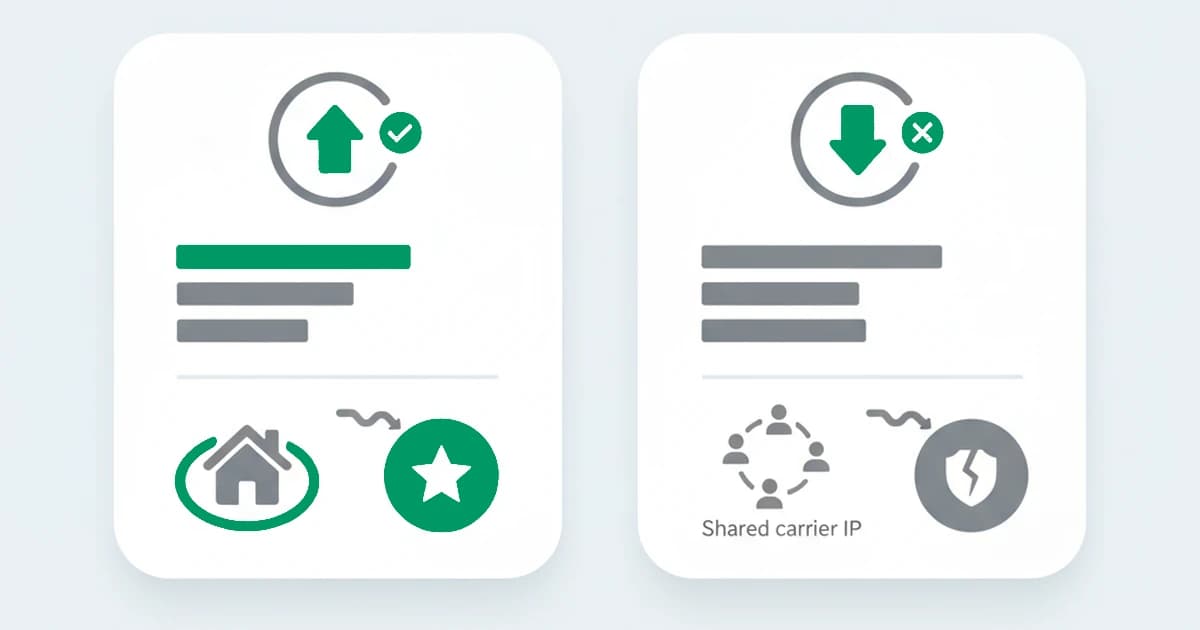
It is shared. Huge numbers of ordinary people sit behind a single public IP. Carrier-grade NAT, where an ISP funnels many subscribers through a few shared public addresses (RFC 6598), along with mobile networks, corporate offices, and university campuses, routes thousands of users through one address. A bad score on a shared IP punishes everyone behind it, and a clean score is no comfort because the next request from that same address could be anyone. The reverse holds too: addresses get reassigned over time, so a flag an address earned months ago may belong to a previous holder, not the person in front of you now.
It is recycled. Residential proxy networks route traffic through real consumer ISP addresses, the same home connections that carry the highest trust. So the harder a fraudster works to look legitimate, the cleaner the IP they borrow, and reputation rates them as safe. A 2026 GreyNoise study of 4 billion malicious sessions, reported by SC Media, found that 78 percent of the residential-proxy sessions it saw were invisible to existing IP reputation feeds, because each address surfaced in only a session or two before rotating away. This is the case reputation is worst at, and it is the case that matters most, which is why proxy detection for fraud prevention leans on more than the address itself.
It is evadable. Because the score is attached to the address and not to the actor, changing the address resets it. Rotating IPs, residential pools, and fresh hosting ranges all sidestep any list, which means a determined operator treats a bad reputation as a minor cost rather than a wall.
The result is a signal that is confident about the wrong thing. It tells you about an address's past while fraud lives in the present session, the device, and the behavior. The four failure modes line up cleanly:
| Why a score alone misses fraud | What happens |
|---|---|
| It lags | A freshly rented or just-rotated address has no bad record yet, so it scores clean |
| It is shared | Carrier-grade NAT and corporate or campus networks route thousands of users through one address |
| It is recycled | Residential proxies route traffic through clean home IPs that carry the highest trust |
| It is evadable | The score attaches to the address, so rotating to a new one resets the history |
How to use IP reputation well
The fix is not to throw the signal away. It is to demote it from a verdict to a vote. A reputation score is most useful as one corroborating network signal weighed alongside the device, the connection, and the rest of the session. A poor score on a session that also shows a masked connection and a device that has signed up ten times this week, which ShieldLabs detects as Multi-accounting, is a strong, consistent story. The same poor score on a normal returning customer behind a shared carrier IP is noise. The point is never the address by itself; it is whether the address agrees with everything else you can see.
Reading IP reputation with ShieldLabs
ShieldLabs treats the IP, including its reputation, as one input among many rather than the answer. Reputation is one of the network signals it weighs, cross-checked against the connection, the risk signals on it, and the device behind the session, so a clean address on a contradictory session raises the read and a poor address on a consistent one does not dominate it.
When an address shows up on abuse lists, ShieldLabs surfaces that as a named abuser signal rather than a silent penalty, and folds it into a risk score from 0 to 100 alongside the datacenter, proxy, and anonymity flags on the same session. You read the score and the named signals, the abuser flag among them, through the API and webhooks and choose the action for each case, with the address read in context. The address is a starting point, not the conclusion.
Sources
- IETF: RFC 5782: DNS Blacklists and Whitelists
- IETF: RFC 6598: IANA-Reserved IPv4 Prefix for Shared Address Space (carrier-grade NAT)
- Wikipedia: DNS-based blackhole list (DNSBL)
- Wikipedia: Autonomous system (Internet)
- Wikipedia: Carrier-grade NAT
- SC Media: Residential proxies undermine IP reputation systems, researchers warn (reporting GreyNoise research, 2026)
Frequently asked questions
- What is a good IP reputation score?
- On a 0 to 100 scale a higher score means a cleaner history, and many tools treat the low end as risky, but a single threshold is misleading. The right cutoff depends on what you are doing: email-deliverability systems and inbound-fraud systems read the same number for different reasons. For fraud, a good score is not a green light, because a freshly rented or residential-proxy address can score high and still belong to an attacker. Read the score as one input, not a pass or fail.
- How do you check an IP's reputation?
- You look the address up against reputation and blocklist data. Several free and paid lookup tools and DNS-based blocklists will return whether an IP appears on known abuse lists, how it is classified, and whether it is a proxy, VPN, or Tor node. A lookup is a useful spot check, but it only reflects recorded history, so a clean result does not prove the current request is safe.
- Can a clean IP still be risky?
- Yes, and this is the most important point. Reputation only records past behavior, so a freshly rotated address, a brand-new hosting IP, or a residential proxy riding a real home connection can all carry a clean score while being used for fraud right now. A clean reputation lowers suspicion; it does not remove it.
- Is IP reputation enough to stop fraud?
- No. Reputation lags, it is shared across many users behind one address, it is recycled through residential proxies, and it resets when the address changes. On its own it both misses fresh attackers and false-flags innocent people on shared IPs. It works as a first-pass filter, but stopping fraud means corroborating the address with the device and the rest of the session.
- Does ShieldLabs use IP reputation?
- ShieldLabs reads the IP and its reputation as one of several network inputs, cross-checked against the connection, the risk signals, and the device, then folded into a risk score from 0 to 100 with the signals named, including an abuser flag when the address appears on abuse lists. It never acts on the address alone. ShieldLabs scores the session and returns the result through its API and webhooks, so you can act on it in your backend, and the free tier covers your first 5,000 identifications.
Related articles

Headless Browser Detection Before JS Runs: JA4 for Dev & Security
Dev & Sec teams: detect headless browsers early with JA4/HTTP2 fingerprints, WebGL and CDP timing; includes test-harness practices and risk scoring.

VPN vs proxy vs Tor: how each hides traffic and how detection tells them apart
VPN vs proxy vs Tor: how each hides traffic, what each one still reveals, and how a detection layer tells them apart at the network level.

iCloud Private Relay: what it is, and what it means for fraud detection
iCloud Private Relay hides a Safari user's IP, but Apple publishes its egress ranges, so it is identifiable. What it is and how to read it for fraud.