

How to detect VPNs in 2026

Last updated on June 16, 2026 · 9 min read
In a nationally representative 2025 survey of U.S. adults, 32 percent said they currently use a VPN. At that scale, masked traffic is no longer an edge case you can wave away. It is a meaningful slice of every signup list, login flow, and checkout. Most of it is ordinary privacy behavior. A smaller share rides the same masking infrastructure to hide origin, fake a location, and scale abuse, from fake account creation to regional pricing fraud. The job in 2026 is no longer "is this a VPN, yes or no." It is telling normal privacy use apart from masked sessions that carry real risk.
Key takeaways
- VPN detection is not a single IP lookup. What matters is whether the full session is masked, how consistent its signals are, and whether it overlaps with abuse.
- An IP database check is a useful first pass, never a verdict. A clean IP can front a risky session, and a flagged IP can front a harmless one.
- No single method is reliable alone. Strong detection combines database checks, network-path analysis, leak detection, header evidence, and cross-layer consistency.
- Proxy detection is broader than VPN detection, but both are best handled as one masked-traffic model that ends in a risk decision, not a blanket block.
How do websites detect VPNs?
Websites detect VPNs by reading several independent signals from a session and scoring how consistently they describe one ordinary, direct connection. No single test is decisive. A database check classifies the IP, but the stronger evidence comes from comparing layers: does the network path look direct or routed, does the browser time zone match the IP location, do WebRTC or DNS reads leak a different origin than the visible request. When those layers disagree, the session is probably masked.
That is the whole shift. Old VPN detection asked a yes/no question about one IP. Modern detection asks whether the full picture holds together, then expresses the answer as a risk level rather than a hard label.
What is a VPN and how does it work?
A VPN (virtual private network) routes a user's traffic through a remote server, so the destination site sees the IP address of the exit server instead of the user's real IP. In most cases the connection between the device and the VPN endpoint is also encrypted. Relay-based privacy services work on similar logic: the real IP is hidden and exact geography is deliberately blurred. Apple's iCloud Private Relay, for example, maps a user to their general region through anonymous IPs without revealing exact location.
In practice, a VPN does three things:
- Hides the real source IP and replaces it with the exit server's address.
- Adds an intermediate network hop between the user and the site.
- Lets the user pick an exit location, often in a different country or region.
That is why one tool serves privacy, security, and geo-dependent access all at once. A user in France can choose a Polish exit server, and a site relying only on IP geolocation will record the visit as traffic from Poland even though the real origin is elsewhere.
Why is VPN detection harder in 2026?
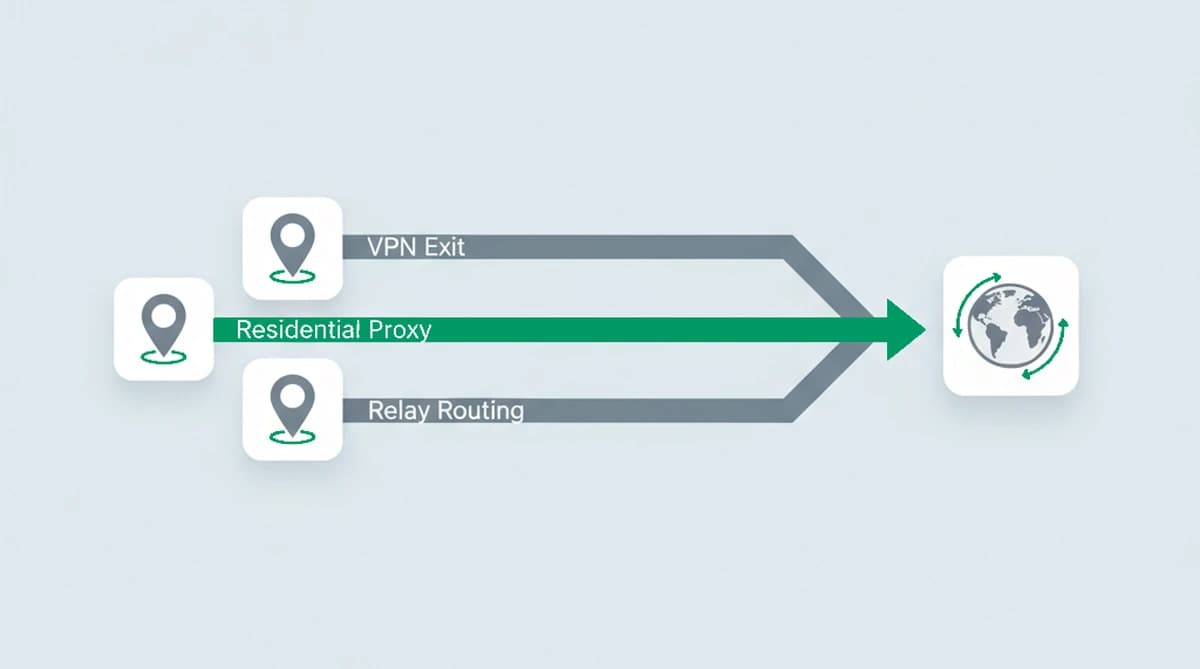
VPN detection is harder in 2026 because masking infrastructure is far more varied than it used to be. Classic VPN endpoints now sit alongside proxy routing, HTTP tunnels, relay-based privacy services, and Tor exits, and the line between them blurs in real traffic. Several trends pull in the same direction:
- Relays reduce precision instead of faking a country. iCloud Private Relay maps the visitor to a broad region through shared anonymous IPs, so a plausible-looking geolocation no longer guarantees a trustworthy origin.
- Residential and mobile proxies look like real users. Traffic exits through real consumer IPs and carrier-grade NAT ranges, so a flat "datacenter IP" rule misses it.
- Masking layers stack. An anti-detect browser on a residential proxy can pass a naive IP check while still leaving cross-layer contradictions.
The result: a session can present a nominally clean, local-looking IP and still be masked. Detection has to read past the IP.
What methods are used to detect VPNs?
The methods used to detect VPNs fall into four groups: IP and connection intelligence, network and transport fingerprinting, connection-leak checks, and cross-layer consistency. The strongest detection blends all four and weighs them into one risk score, because no single method is decisive. Each method below is weak alone and resilient in combination.
- IP and connection intelligence: match the address against VPN, proxy, Tor, relay, hosting, and datacenter ranges, then layer in reputation, ASN, reverse DNS, WHOIS ownership, geolocation, and datacenter-versus-residential classification, since most real visitors arrive on residential or mobile ranges.
- Network and transport fingerprinting: passive TCP/IP fingerprinting infers the real operating system, the TLS handshake exposes a tunneling stack that differs from the declared browser, and an unusual path MTU, round-trip latency, or open proxy and VPN ports point to an encapsulating tunnel rather than a direct home connection.
- Connection-leak checks: a WebRTC ICE candidate or a DNS query that bypasses the tunnel can surface a real-origin clue the visible IP hides, and forwarded headers sometimes carry traces of intermediary routing.
- Cross-layer consistency: the browser-reported timezone and language are checked against the IP location, Tor exits are treated as their own category, and every tell is weighed into one score, so a session whose layers can contradict each other becomes its own anomaly.
The pattern across all of them: detection is about correlation, not any single check. A residential proxy or a relay that maps to a plausible local region raises the difficulty, but the more a session masks, the more layers it has to keep perfectly consistent. Consistency at scale is exactly what gives masked traffic away.
We weighed each group in turn: we tested masked sessions across these four groups, and the single IP check was consistently the weakest input and the cross-layer read was the strongest. A residential proxy could front a clean, local-looking IP, yet the timezone, a WebRTC leak, or the TLS handshake would still disagree with it somewhere in the session. Apple shipped iCloud Private Relay in 2021, and after that even a plausible geolocation stopped guaranteeing a trustworthy origin, which is why we weigh the layers together rather than trust any one of them and return the result as a risk score for your team to act on.
Why does an IP-only check fail?
An IP-only check answers one narrow question: does this address resemble known masking infrastructure. It cannot tell you who is behind the visit, whether the environment is internally consistent, whether the same visitor appeared earlier under a different IP, or whether the session ties to a recurring pattern. That is why a single lookup almost always returns an incomplete answer.
Consider two signups from different IPs. The first is flagged as VPN traffic, the second is not. Look only at the IP and you treat them as unrelated. But device signals, time zone behavior, and a repeated account-creation flow can point to the same actor working both. The IP flag is an input. The decision needs device, browser, OS, network, and visitor-history context around it.
How is VPN detection different from proxy detection?
VPN detection and proxy detection overlap but are not the same. VPN detection is the narrower task, focused on encrypted tunneling services. Proxy detection is broader: it covers forward proxies, proxy tunnels, web proxies, and other intermediary routing methods, including HTTP tunnels where the proxy layer hides part of the original network path.
| VPN detection | Proxy detection | |
|---|---|---|
| Scope | Encrypted tunneling services | Any intermediary routing layer |
| Typical infrastructure | Commercial VPN endpoints | Forward/web proxies, tunnels, residential proxies |
| Detection overlap | IP reputation, leaks, path analysis | Same signals, wider IP and routing coverage |
For most businesses the more useful question is not "is this specifically a VPN" but "is this traffic masked, and does that masking raise the risk of evasion, abuse, or policy bypass." That framing covers both and points toward a risk decision instead of a label.
How do fraudsters misuse VPNs?
Fraudsters do not use VPNs because a VPN magically tricks a system. They use them because masking makes evasion cheaper: it hides real geography, rotates IPs, weakens IP-based rate limits, and lets the same user blend in with ordinary privacy traffic. So masked sessions show up across a familiar set of abuse cases:
- Multi-accounting and fake account creation: one user running many "separate" users.
- Bonus, promo, and free-trial abuse: cycling fresh sessions to claim a one-per-person reward again and again.
- Regional pricing fraud: choosing an exit in a lower-priced country to buy a plan meant for a different purchasing-power segment.
- Restriction and ban evasion: appearing to come from an allowed jurisdiction, or returning after a block under a fresh-looking session.
VPN use on its own is context, not a verdict. The risk climbs when masked traffic overlaps with environment inconsistencies, repeated account creation, linked devices, or recurring patterns. A corporate VPN login from an airport is masked and harmless; a masked session opening its tenth trial account this week is not. The difference is in the surrounding signals, which is exactly why detection has to look past the IP.
Detecting VPN and masked traffic with ShieldLabs
A VPN provider rotates its exit ranges constantly, so the IP list you blocked last month is already out of date. ShieldLabs keeps that read current for you instead. Drop in one JavaScript snippet and every visitor is scored in about five minutes, from install to first risk signal, with no friction for the person on the page.
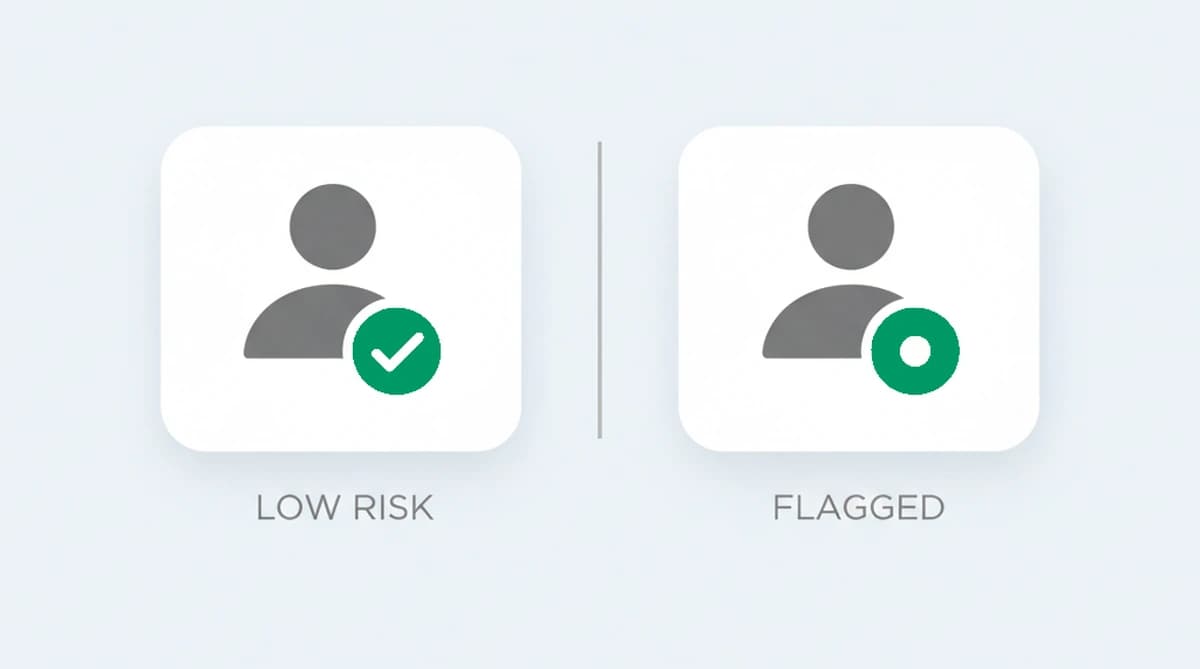
The output is two things working together. A dedicated VPN signal flags when a visitor is masking their connection through a VPN, and a risk score weighs that against the rest of the session inconsistencies. The signal arrives inside a full set of 300+ risk signals, including anonymous proxy detection, Tor exit and datacenter flags, and others, so a masked session is never read on its IP alone. The VPN read sits inside the same proxy and VPN detection layer, since a connection hiding behind a VPN often hides behind a proxy too.
Because masking is most dangerous when it repeats, a stable identifier ties a "fresh" visit back to a returning device even after cleared cookies and rotated IPs. ShieldLabs detects the cross-session behavior behind multi-accounting directly as High-Risk Events, such as Multi-accounting and Account sharing, each with Medium or High confidence. The analytics dashboard rolls the same data up by traffic quality, so your team can tell anonymous traffic apart from clean traffic at a glance and watch it as a trend over time rather than one visit at a time.
All of it, the risk score, the named risk signals, and the High-Risk Events, is available through an API and webhooks, so ShieldLabs helps block fraudulent and abusive traffic and your team acts on the result in its own flow.
Sources
- Security.org: 2025 VPN Trends, Statistics, and Consumer Opinions (nationally representative survey of 1,009 U.S. adults, 2025)
- Apple: About iCloud Private Relay
- IETF: RFC 1191: Path MTU Discovery
- MDN Web Docs: RTCIceCandidate (WebRTC)
- The Tor Project: Tor exit list service
- Wikipedia: Virtual private network
Frequently asked questions
- What is a VPN detector?
- A VPN detector is a tool or detection system that determines whether traffic is routed through a VPN, proxy, Tor exit, iCloud Private Relay, or other masking infrastructure. In practice, a strong VPN detector goes well beyond a simple IP lookup and evaluates the broader session context: network-path behavior, time-zone and OS consistency, and leak checks.
- How can I check if an IP is a VPN?
- The first step is to match the IP against anonymizer, relay, Tor, proxy, and hosting datasets, which classify known masking ranges. That is a useful first-pass signal but not a production verdict on its own, because a clean-looking IP can still front a masked or risky session. Pair the IP check with session-level context before acting.
- Does WebRTC help detect masked traffic?
- WebRTC helps detect masked traffic because its ICE candidates can expose routing-related information that is compared against the visible request path. When the main request looks masked but the WebRTC data reveals a different network clue, that contradiction is a strong sign of incomplete masking.
- How reliable is VPN detection against residential proxies?
- Residential proxies are the hardest case, because traffic exits through a real consumer IP that no datacenter rule will catch. A reputation lookup alone often misses them. Detection holds up by reading past the IP: the network path, leak checks, time-zone and OS consistency, and whether the session ties to a recurring pattern. No method is perfect against a well-configured residential exit, but the more the session masks, the more layers it has to keep consistent, and that is where it slips.
- Should companies block all VPN traffic?
- Usually not. Most VPN use is ordinary privacy behavior, so blanket blocking creates false positives and friction for legitimate users. Risk scoring and proportionate action, such as extra verification only on high-risk masked sessions, work better than blocking everyone behind a VPN.
- Is Tor the same as a VPN?
- Tor is not the same as a VPN. Tor is a separate anonymity category with its own multi-relay and exit-node model, and exit nodes are published in a public list. A VPN routes through a single chosen exit server, while Tor bounces traffic through several relays, so the two are classified and weighted differently in detection.
Related articles
Stop Sybil Attacks Without KYC: Evidence-First Prevention for Marketplaces
Build an evidence-first defense for marketplace Sybil attacks: payment-weighted reputation, graph-based detection, device and anonymity signals, plus...


How to stop multi-accounting in online gambling: sportsbooks, poker, and casinos
How to stop multi-accounting in online gambling: why players open multiple betting accounts, the signals that link them to one person, and an operator playbook.

How to detect betting bots on sportsbooks, casinos, and poker sites
How to detect betting bots: the five kinds operators face, the device, network, and timing signals that expose them, and how to stop bot-driven abuse.