

17–20% Cookieless Traffic: Marketers' Cookie Deprecation Playbook

Last updated on September 26, 2026 · 14 min read
Cookie deprecation impact means permanent, fragmented signal loss, not a single deadline you can wait out. Roughly a fifth of global browser traffic already blocks or partitions third-party cookies by default, and Chrome's 2025 reversal changed the measurement math without touching your legal obligations. The short-term priority list is fixed regardless of what Chrome does next: audit where you still depend on third-party cookies, build first-party data capture into every conversion path, and move event tracking server-side before your attribution gaps get worse.
TL;DR:
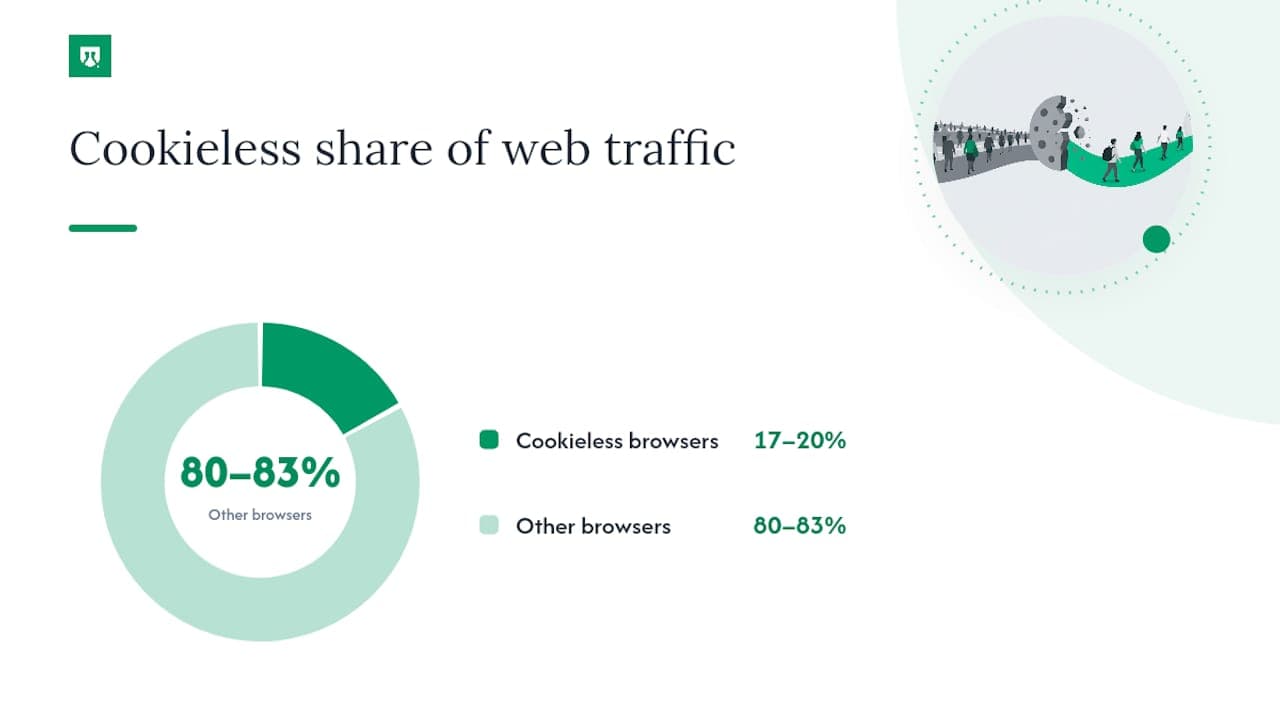
- Over 17% to 20% of global web traffic now operates in browsers that block or partition third-party cookies, limiting cross-site measurement.
- Attribution gaps emerge silently when third-party cookies are blocked, causing discrepancies between platform data and actual CRM transactions.
- Strategies such as first-party data collection, server-side event delivery, and contextual targeting are essential replacements for cookie-dependent tracking.
- Retargeting pools and frequency capping deteriorate as identifiers are wiped, especially on open-web sites that rely heavily on third-party cookies.
- Recognized visitors can still be identified through device and network signals, with tools like Shieldlabs providing accurate, privacy-compliant identification without cookies.
Table of Contents
- What Is the Real Cookie Deprecation Impact on the Browser Landscape Today?
- How Does Cookie Deprecation Break Attribution and Conversion Reporting?
- What Happens to Retargeting, Lookalikes, and Frequency Capping?
- What Should Marketers Fix First When Cookies Disappear?
- Does Cookieless Tracking Remove Your Privacy Obligations?
- What Does an Implementation Roadmap Look Like?
- How Does Persistent Visitor Recognition Fit Into a Cookieless Strategy?
- Where Marketing Leaders Should Put Budget Right Now
- Getting Lawful, Persistent Identification Without Third-Party Cookies
- Sources
- FAQ
What Is the Real Cookie Deprecation Impact on the Browser Landscape Today?
Every major browser now treats third-party cookies differently, and that inconsistency is the actual source of measurement pain, not any single vendor's roadmap. Safari's Intelligent Tracking Prevention has blocked third-party cookies by default since 2020 and caps first-party cookie life for click-through links. Firefox's Total Cookie Protection isolates cookies per site by default. Brave blocks third-party trackers out of the box. Chrome, which still carries the largest share of global browser traffic, reversed its plan to phase out third-party cookies in April 2025, keeping them available but under expanded user controls, according to reporting from Ars Technica.
That reversal did not restore the old measurement environment. Google is deprecating Related Website Sets and the associated Storage Access APIs it once pitched as bridge technology for cross-site identity, according to Chrome's own feature status notes, so the browser-level replacements many teams planned around are being wound down anyway.
The traffic numbers tell you why this matters even with Chrome standing pat:
- Somewhere between 17% and 20% of global web traffic already runs on browsers that block or partition third-party cookies by default, according to Consenteo's 2026 analysis.
- Logged-out web traffic on iOS Safari is effectively 100% cookieless, since Apple's private relay and ITP settings strip most persistent identifiers before your pixel fires.
- Chrome's decision changes the urgency curve, not the destination. Cross-site identity built on third-party cookies alone was already unreliable for a fifth of your audience before the reversal, and it still is.
How Does Cookie Deprecation Break Attribution and Conversion Reporting?
Attribution breaks first, and it breaks quietly. View-through attribution depends on a cookie planted during an ad impression matching a cookie present at conversion, often across different domains. When browsers block or partition that cookie, the stitching fails silently. You don't get an error. You get a conversion that shows up in your CRM but never gets credited to the campaign that actually drove it.
That gap widens the split between what ad platforms report and what your own systems record. Platforms model conversions using whatever signal survives inside their walled garden, while your CRM logs the transaction that actually happened. The two numbers diverge, and machine-learning bid optimizers trained on the platform's incomplete signal start optimizing toward the wrong outcomes, feeding your budget into audiences and placements that look effective only because measurement missed the alternative.
Three types of signal still hold up reasonably well, and prioritizing them is the fastest way to shrink the gap:
- UTM parameters and click IDs passed through the URL survive page loads and don't depend on cookie storage at all, according to Usermaven's 2026 analysis of what still works.
- Server-side conversion events sent directly from your backend to the ad platform's API bypass browser-level blocking entirely, though they can't recover impressions the platform never logged in the first place.
- CRM-recorded outcomes, tied to authenticated accounts or verified email addresses, give you a ground truth to reconcile platform numbers against, even when the platform's own attribution model gets it wrong.
What Happens to Retargeting, Lookalikes, and Frequency Capping?
Retargeting pools shrink first, and the shrinkage compounds. A pool built on third-party cookie matches loses members every time a browser update wipes the underlying identifier, and pools that used to refresh cleanly now leak users you can no longer re-identify. Lookalike modeling depends on a large, accurate seed audience, so a smaller, dirtier retargeting pool degrades every lookalike segment built from it.
Frequency capping runs into a related problem: cross-site deduplication. If a user sees your ad on three different publisher sites without a shared identifier connecting those sessions, your system can't tell it's the same person, and you either overspend showing the same creative repeatedly or undercount reach entirely.
The channel you're running on changes how badly this hits you:
- Platform-owned identity environments (social platforms and retail media networks with logged-in users) hold up better because the identity graph lives inside an authenticated ecosystem the platform controls directly, not in a third-party cookie.
- Open-web publisher inventory takes the harder hit, since programmatic buying across independent sites has historically leaned on third-party cookies for the exact cross-site matching that's now unreliable for a meaningful share of visitors.
- Real-time bidding pipelines built around cookie-synced identity graphs return weaker match rates on each bid request, which shows up as lower win rates on audiences that used to be addressable. It forces buyers back toward contextual or cohort-based targeting for that inventory.
- Data clean rooms are picking up more of the cross-party matching work that cookies used to handle informally, letting brands and publishers match hashed first-party identifiers without either side exposing raw customer lists.
What Should Marketers Fix First When Cookies Disappear?
Treat this as an infrastructure build, not a settings change. First-party data capture comes first: every login, email opt-in, loyalty signup, and account creation is an identity signal you own outright, one that doesn't depend on any browser vendor's cookie policy. If your checkout flow, newsletter signup, and account creation aren't feeding a unified customer record today, that's the highest-leverage fix available.
Server-side event delivery comes next. Sending conversion events directly from your server to ad platforms, rather than relying on a browser-side pixel, improves delivery reliability and lets you pass richer data with each event. It has a real ceiling, though: server-side delivery can't manufacture an impression the platform never logged, and it can't restore anonymous cross-site identity that no longer exists, according to Usermaven's technical breakdown.
Contextual targeting and cohort-based approaches fill part of the gap for prospecting, since they don't require any individual-level identity at all, just content or aggregate behavioral signals. Modeled conversions, where a platform statistically estimates outcomes it can't directly observe, extend your reporting further, but they're an estimate layered on incomplete data, not a substitute for it.
A few technical notes matter here:
- Click IDs (like those appended by ad platforms to landing page URLs) persist through the session and can be stored server-side against a conversion, independent of cookie state.
- Hashed email matching lets you connect a known customer across devices and channels without exposing the raw email address, but it only works once you've actually captured that email through a first-party form.
- Cookieless analytics tools use rotating, ephemeral server-derived identifiers instead of persistent device storage, which reduces ePrivacy storage triggers but breaks long-horizon user stitching unless you merge those sessions with consented, authenticated identity, according to Pug's explainer on cookieless analytics.
Pro Tip: Don't merge cookieless session data into your long-term customer cohorts by default. Keep it in aggregate and session-level metrics until a user authenticates, or you'll quietly pollute retention and lifetime-value numbers with sessions that were never actually the same person.
Does Cookieless Tracking Remove Your Privacy Obligations?
No, and this is where a lot of teams get the transition wrong. Article 5(3) of the ePrivacy Directive and the GDPR's consent and transparency requirements apply to storage and access on a user's device, not specifically to cookies. Switching to a cookieless technique that still writes or reads device-level data generally triggers the same consent requirement a cookie would.
The EDPB's coordinated enforcement action and guidance confirms this directly: transparency and consent obligations hold regardless of the underlying tracking mechanism. Regulators also treat fingerprinting as functionally equivalent to cookie-based tracking, so swapping a cookie for a fingerprint doesn't lower your compliance burden. It can raise it, since fingerprinting is harder for users to detect or refuse, which regulators view unfavorably.
Build these into your operational checklist rather than treating them as legal afterthoughts, referencing Browser Camera Capture, Code First and No App QR Uploads | SnapPix Blog for developer-oriented consent-capture workflow guidance:
- Capture and timestamp consent at the point of collection, not retroactively.
- Propagate consent state with every server-side event, so downstream systems know whether an event is cleared to forward to an ad platform.
- Apply data minimization: collect only the fields your measurement actually uses.
- Log consent receipts in a form you can produce during an audit.
What Does an Implementation Roadmap Look Like?
The sequence matters more than the individual tactic. Start with an audit of every tag, pixel, and data flow currently touching customer data, since you can't fix leakage you haven't mapped. From there, the order that practitioners consistently recommend is: instrument server-side events, strengthen first-party capture across every conversion point, then connect CRM outcomes back to platform reporting validating what actually improved, a sequence outlined in Cometly's 2026 implementation guide.
Four KPIs tell you whether the rebuild is working:
- Matched conversion lift, the percentage increase in conversions your platform can attribute after server-side delivery goes live.
- Platform-versus-CRM delta, tracked as an ongoing gap rather than a one-time check.
- Audience size by browser, so you can see how much of your addressable audience sits in cookie-restricted environments.
- Consented match rate, the share of traffic where you have both a legal basis and a usable identifier.
Roughly 17% to 20% of your traffic is already running on browsers where cookie-based measurement doesn't work at all, which makes audience size by browser a baseline metric, not a nice-to-have.
How Does Persistent Visitor Recognition Fit Into a Cookieless Strategy?
Device and network signals, evaluated lawfully and disclosed to the user under your consent framework, give you a way to recognize a returning visitor when cookies aren't available or have been cleared. Shieldlabs works this way: it scores each visit using more than 100 signals and identifies returning visitors with accuracy up to 99%, even after cleared cookies, incognito sessions, or months between visits.

The signals behind every score are exposed in the dashboard, not hidden inside a black box, which matters when your compliance team needs to explain why a visit was flagged a certain way.
For integration, that identity layer needs to feed your consent framework, not bypass it:
- Map the visitor or device signal to a server-side event only after consent state is confirmed for that session.
- Store the consent receipt alongside the identity match so an audit can reconstruct the decision.
- Treat the score as one input to your measurement stack, alongside first-party login data and CRM outcomes, not a replacement for either.
Setup runs through a single JavaScript snippet with SDKs for Node.js, Python, Go, and PHP for teams building the server-side event pipeline described above.
Where Marketing Leaders Should Put Budget Right Now
Fund this like an infrastructure project, not a marketing tactic. The teams closing their attribution gaps fastest are the ones putting data engineering and privacy resources against first-party capture and server-side event delivery, not the ones waiting for a browser vendor to solve it for them.
Measure success by CRM reconciliation, not vanity metrics. If the gap between what your CRM logs and what your ad platforms report is shrinking quarter over quarter, your investment is working. If you're chasing a single vendor's "cookieless" claim as a silver bullet, you're solving the wrong problem. This is a signal architecture question, and it needs the same discipline you'd apply to any other core data system.
— Jeff
Getting Lawful, Persistent Identification Without Third-Party Cookies
The teams building server-side measurement pipelines still need a way to recognize a returning visitor when the cookie that used to do that job is gone. Shieldlabs is built for exactly that gap: it identifies visitors and scores anonymity risk from multiple signals, covering VPNs, proxies, and anti-detect browser detection, and recognizes returning visitors with high accuracy despite cleared cookies or IP rotation. Every score comes with the underlying signals attached, to support auditability, and the final call on how to use that signal stays in your own code. Setup takes about five minutes with a single snippet, and pricing is published rather than gated behind a sales call: a free tier covers a limited number of identifications, with paid plans available. Current prices are on the pricing page. Check the current plans and pricing to see what fits your traffic volume, or look at the visitor identification product page for integration specifics.
Sources
- Third-Party Cookies in 2026: What Actually Happened After Google's Reversal | Consenteo
- Chromestatus
- Cookieless analytics: How it actually works · Pug
- EDPB coordinated enforcement action and guidance (2026) | EDPB
- Cookie deprecation impact on ad tracking: What still works in 2026
FAQ
Is Cookie Deprecation Still Happening?
Yes, in practice, even though Chrome reversed its plan to fully deprecate third-party cookies in April 2025. Safari, Firefox, and Brave already block or partition third-party cookies by default, and 17% to 20% of global traffic already runs cookieless regardless of what Chrome does.
Is It Better to Accept or Decline Cookies?
That decision belongs to the individual user based on their own privacy preference, since accepting enables personalization and more accurate measurement while declining limits both. For marketers, the practical takeaway is that your measurement strategy can't depend on a high acceptance rate, because a meaningful share of users will decline or run browsers that block cookies before the prompt even appears.
Is There a Downside to Deleting Cookies?
Deleting cookies removes saved logins, site preferences, and shopping cart contents, so you'll need to sign back into most sites and rebuild personalized settings. It doesn't create a security risk on its own, and it periodically resets tracking identifiers that advertisers use to build a profile of your browsing activity.
Which Browsers Don't Track You?
Safari and Firefox both block third-party cookies by default through Intelligent Tracking Prevention and Total Cookie Protection, respectively, and Brave blocks third-party trackers out of the box. None of these eliminate tracking entirely, since first-party analytics, fingerprinting, and authenticated logins can still identify a user; they specifically limit cross-site cookie-based tracking.
Does Shieldlabs Replace Third-Party Cookies for Ad Targeting?
Shieldlabs identifies and scores visitors using device and network signals rather than replacing cookie-based ad targeting outright. It gives marketing and fraud teams an auditable way to recognize returning visitors, with plans starting at $79 per month, detailed on the pricing page.
Recommended
Related articles
Stop Sybil Attacks Without KYC: Evidence-First Prevention for Marketplaces
Build an evidence-first defense for marketplace Sybil attacks: payment-weighted reputation, graph-based detection, device and anonymity signals, plus...


How to stop multi-accounting in online gambling: sportsbooks, poker, and casinos
How to stop multi-accounting in online gambling: why players open multiple betting accounts, the signals that link them to one person, and an operator playbook.

How to detect betting bots on sportsbooks, casinos, and poker sites
How to detect betting bots: the five kinds operators face, the device, network, and timing signals that expose them, and how to stop bot-driven abuse.