

The 11 best ecommerce fraud prevention tools for small businesses in 2026

Last updated on October 12, 2026 · 11 min read
Ecommerce fraud stopped being a checkout-only problem. In the 2026 MRC Global Payments and Fraud Report, 98% of merchants reported at least one fraud attack in the past 12 months, hit by an average of 3.7 different attack types. The same survey of 1,278 merchant professionals across 37 countries found 64% saw first-party misuse rise.
The losses behind that are large and still climbing, and Juniper Research projects global ecommerce fraud losses rising from $56 billion in 2025 to 131 billion dollars by 2030.
For a lean store, that means the question isn't only "approve or decline this order." It's "who is behind this traffic, what kind of abuse is happening, and how do we act without punishing real buyers?"
Key takeaways
- Ecommerce fraud now spans the whole funnel: anonymous traffic, fake accounts, multi-accounting, account takeover, and refund abuse, not just the payment step.
- The right tool for a small business matches where its abuse actually starts, not the longest enterprise feature list.
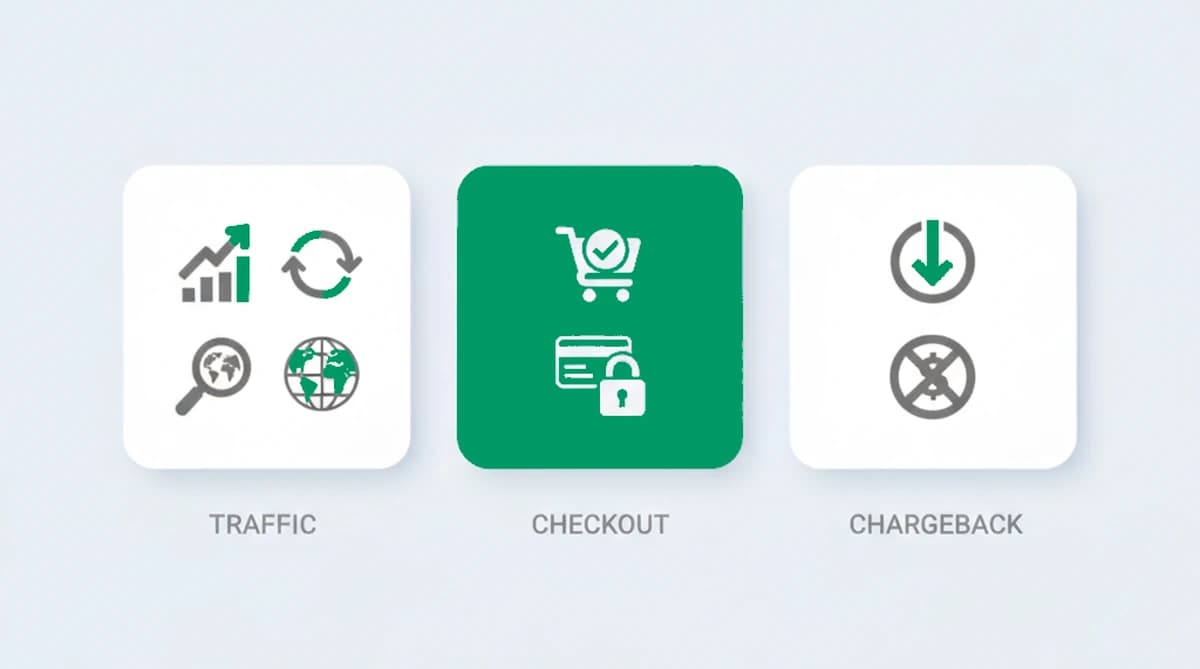
- Tools split into three jobs: visitor and traffic intelligence (upstream), checkout decisioning, and chargeback-guarantee or dispute recovery (downstream). Most stores need one or two layers, not all of them.
- Evaluate by pricing accessibility, self-serve deployment, signal depth, explainability, and how much manual review the tool removes.
What is ecommerce fraud prevention?
Ecommerce fraud prevention is the practice of detecting and reducing abuse across an online store's funnel, from anonymous traffic and fake accounts to checkout fraud, account takeover, and refund abuse.
It combines signals about identity, device, browser, network, and account behavior to tell whether activity comes from a genuine buyer or a likely abuser, then surfaces risk so a team can decide how to respond.
The goal is to limit fraud and abuse without adding friction for real customers, and it usually layers several tools because no single check covers the whole journey.
To compare payment-focused tools consistently, first map the layers in the payment gateway fraud detection guide, including the evidence collected before a transaction reaches the processor.
How we evaluated these tools
This ranking weighs small-business fit over enterprise reputation. The criteria are pricing accessibility, self-serve or fast-start deployment, platform compatibility, signal depth, abuse coverage, explainability, and how much manual work the tool removes from a small team.
It also uses a broad definition of ecommerce fraud prevention, because these products solve related but different problems:
- Visitor and traffic intelligence identifies who is behind the traffic before checkout, anonymous visitors, returning bad actors, multi-accounting.
- Checkout decisioning scores the order itself, often with automated risk models or analyst review.
- Chargeback guarantee and dispute recovery shifts financial liability or recovers disputed revenue after the sale.
A store rarely needs all three. Matching the tool to where abuse begins matters more than buying the widest platform.
What fraud problems do small ecommerce businesses face?
Small merchants face abuse across the entire funnel, not only at payment. The most common problems break down like this:
- Fake account creation. New profiles spun up to claim welcome discounts, referral rewards, or loyalty perks, wasting promo budget and distorting acquisition metrics.
- Multi-accounting. One person operating many accounts to reuse coupons, first-order discounts, or purchase limits, turning a single abuser into many apparent customers.
- Account takeover. Access to a legitimate account to drain saved payment methods, loyalty balances, or stored data, even when the session looks like a trusted returning user.
- Refund and return abuse. Exploiting post-purchase policies through false non-delivery claims, exaggerated issues, or repeated returns.
- First-party misuse. Real customers disputing legitimate purchases or gaming promotions, hard to classify because the identity is genuine.
- Suspicious anonymous traffic. Visits routed through VPNs, proxies, Tor, hosting infrastructure, or masked browser environments that reduce visibility into who is behind the activity.
- Repeat bad actors across identities. The same underlying user returning under new emails, devices, or IPs to look like a fresh visitor.
- Manual review overload. Too many suspicious orders and accounts for a small team to investigate, producing slow, inconsistent decisions.
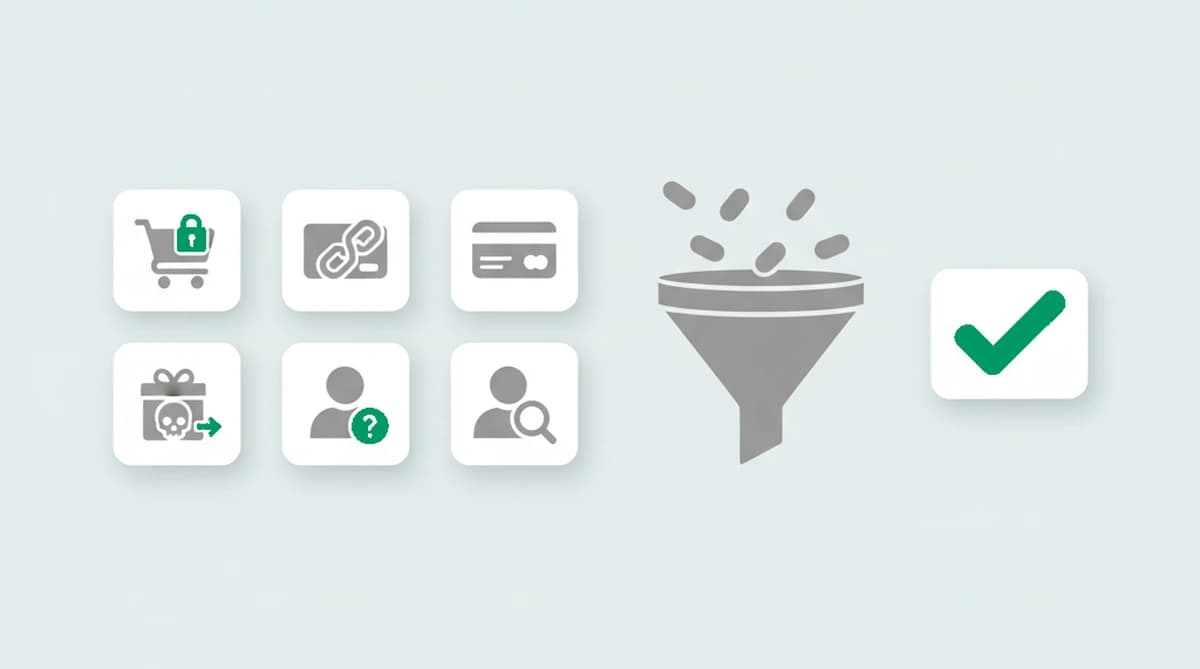
The pattern: most of this starts before checkout. By the time fraud surfaces as a chargeback or a flagged order, the marketing, promotional, and operational losses are often already absorbed.
What to look for in ecommerce fraud prevention software
Small businesses should look for tools that improve decision quality without adding operational drag. In practice, that means six things:
| Criterion | Why it matters for a small team |
|---|---|
| Fast integration | A snippet or quick connector beats a sales-led, multi-week rollout. |
| Signal depth | Strong detection correlates identity, device, browser, and network context instead of one isolated check. |
| Explainable decisions | A team should see why something is risky, not just get a black-box verdict it cannot defend. |
| Low-friction workflows | False declines are their own revenue problem; the tool should reduce abuse without taxing good buyers. |
| Transparent, predictable pricing | Public pricing a real ecommerce team can plan around, with a free or starter tier and no enterprise gate. |
| Platform fit | Compatibility with Shopify, WooCommerce, and common stacks often matters as much as raw model quality. |
The same 2026 MRC data underlines why operational fit matters: 64% of merchants report rising first-party misuse, and about a quarter saw it climb by 25% or more, the kind of hard-to-classify, real-identity abuse a small team can't fight by blocking harder. Small teams are buying speed and clarity, not just raw detection.
The tools below are grouped by the three jobs from the framework above: visitor and traffic intelligence upstream, checkout decisioning and chargeback guarantee at the sale, and dispute recovery downstream.
Pricing reflects published rates as of mid-2026 and changes often; confirm current pricing with each vendor.
The tools below are grouped by job.
Visitor and traffic intelligence
These tools identify who is behind the traffic before checkout, correlating device, browser, and network signals to recognize repeat visitors and anonymous activity.
ShieldLabs
ShieldLabs is a fraud detection and prevention platform with traffic quality scoring and enterprise-level functionality without enterprise pricing, which any ecommerce team can start on to detect risky users and suspicious traffic before abuse turns into fake accounts, multi-accounting, or refund losses.
It collects signals from device, browser, OS, IP, and network on every visit and assigns a persistent identifier, with 99.9% identification accuracy, that holds through cleared cookies and rotated IPs, so the same visitor stays recognizable across sessions even under a fresh email.
Each visit gets an explainable risk score from 0 to 100 with a breakdown of which risk signals fired, including anti-detect browser detection, VPN, proxy, Tor, Privacy Relay, datacenter, and IP-reputation signals, read with 99.9% risk signal detection accuracy. Bot and automation detection is covered as well. It automatically detects multi-accounting, account sharing, impossible travel, and account takeover.
ShieldLabs delivers the risk score, the named risk signals, and the detections in the analytics dashboard, API and webhooks, so the team sees why a visitor is risky and can act on it.
What it offers:
- persistent visitor identification across sessions, cleared cookies, and rotated IPs
- anonymous traffic detection across VPN, proxy, Tor, Privacy Relay, datacenter, and hosting infrastructure
- anti-detect browser detection signals
- an explainable risk score (0–100) with a per-signal breakdown
- bot and automation detection
- automatic detection of multi-accounting, account sharing, impossible travel, and account takeover
- traffic analytics plus API and webhooks for automation
Pricing: A one-time free allocation of 5,000 identifications, then plans from 99 USD a month, for 25,000 identifications, with higher tiers at 399 and 999 USD a month and no enterprise gate.
Best for: ecommerce teams, from small stores up, that want visitor identification, anonymous traffic detection, an explainable risk score, and ready-made account-level detection, with a five-minute install.
Fingerprint
Fingerprint focuses on persistent visitor identification and device intelligence, building a durable visitor identifier from browser, device, and network signals so a store can recognize repeat users even when cookies are cleared or networks change. It surfaces device- and environment-level indicators such as proxy use and browser tampering to give risk teams more context.
What it offers:
- persistent visitor identifiers for repeat-user recognition
- device and risk signals including proxy, tampering, and incognito-related context
- SDKs and APIs for web and mobile integration
Pricing: Free up to 1,000 API calls per month. Pro Plus starts at 99 USD a month for 20,000 API calls. Enterprise is custom.
Best for: merchants and marketplaces that prioritize accurate visitor recognition and device intelligence with low friction.
SEON
SEON offers a modular, API-first platform combining digital-footprint analysis, device intelligence, and identity signals such as email and phone data, with custom rules and real-time checks for teams that want hands-on control.
What it offers:
- platform and API access with custom rules
- digital-footprint and device intelligence
- real-time signal analysis, monitoring, and reporting
Pricing: Free tier available; published paid plans have run up to roughly 699 USD a month, with higher volumes priced custom.
Best for: merchants that want flexible rules, device intelligence, and direct control over fraud operations.
Checkout decisioning and chargeback guarantee
These tools score the order itself at or around checkout, combining automated risk models, analyst review, or guarantee-backed decisions that can shift chargeback liability.
ClearSale
ClearSale takes a hybrid approach, pairing automated analysis with human review and chargeback-guarantee coverage. The managed model suits merchants that want hands-on support, especially in markets where fraud patterns are harder to automate.
What it offers:
- hybrid automated plus analyst review
- chargeback-guarantee coverage
- a focus on reducing false declines
Pricing: Offered through KPI-based, performance-based, and fixed-fee models.
Best for: merchants that want managed protection with strong attention to false-decline reduction.
Forter
Forter uses identity-based decisioning to assess interactions in real time, drawing on a global merchant network to approve trusted users faster while flagging risky behavior. It is built for scale.
What it offers:
- identity-driven risk modeling
- instant decisions from customer identity signals
- a global merchant network for context
Pricing: Custom, based on transaction volume and risk profile.
Best for: larger online retailers and travel brands that need fast, identity-led decisioning.
Kount
Kount offers broader ecommerce risk coverage than a lightweight entry tool, spanning credit card fraud, chargeback fraud, promo and loyalty abuse, new-account fraud, and account takeover, with direct integrations for major platforms.
What it offers:
- ecommerce fraud and chargeback coverage
- promo and loyalty abuse coverage
- new-account and account-takeover coverage
- Shopify and WooCommerce support
Pricing: Custom. Kount positions the product as tailored to business needs rather than self-serve.
Best for: growing merchants that need a more mature risk stack than basic screening.
NoFraud
NoFraud provides real-time checkout screening with analyst review, aimed at smaller merchants that want more operational support and less internal review work. It combines automated pass/fail decisions with human review and offers chargeback protection.
What it offers:
- real-time screening decisions
- analyst review support
- chargeback protection
- integrations with Shopify, BigCommerce, and WooCommerce
Pricing: A free Lite plan covers up to 100 screened orders per month. Paid starter tiers begin at a 250 USD monthly minimum, scaling with coverage and revenue.
Best for: small to mid-sized stores that want low-maintenance checkout fraud screening with operational support.
Riskified
Riskified is an enterprise chargeback-guarantee platform that approves or declines orders in real time and takes on financial liability for the transactions it approves, drawing on a large cross-merchant network to recognize returning good customers and absorb fraud losses on guaranteed orders.
What it offers:
- chargeback-guarantee coverage with liability shift on approved orders
- real-time order approval backed by a cross-merchant network
- policy-abuse and account-protection add-ons
Pricing: Custom and enterprise, priced on transaction volume, typically with a guarantee fee on approved orders.
Best for: higher-volume retailers that want guarantee-backed approvals and are less price-sensitive than a small store.
Signifyd
Signifyd centers on guarantee-backed protection. It analyzes order and buyer signals to automate decisions and shift chargeback liability, so teams reduce manual review and limit exposure on approved orders.
What it offers:
- financial guarantee options and liability shift
- automated order review and risk scoring
- integrations with major ecommerce platforms
Pricing: Custom and usage-based, depending on merchant profile and guarantee configuration.
Best for: retailers that want guarantee-backed protection and stronger approval confidence with less manual review.
Sift
Sift centers on identity-level decisioning across fraud, account takeover, and broader abuse, backed by a large data network. It suits merchants with more mature identity, trust, or account-abuse needs.
What it offers:
- identity-level risk analysis
- account-takeover and broader abuse context
- network-scale signals across many brands
Pricing: Handled through sales contact rather than a public self-serve plan.
Best for: merchants with mature identity, trust, or account-abuse requirements.
Chargeback and dispute recovery
This layer works after the sale, automating chargeback prevention, alerts, and recovery rather than upstream visitor intelligence.
Chargeflow
Chargeflow fits best when the main pain is disputes, friendly fraud, and chargeback operations. It automates chargeback prevention, alerts, and recovery rather than upstream visitor intelligence.
What it offers:
- chargeback alerts and prevention workflows
- automated recovery and representment
- a dispute-insights dashboard
Pricing: Success-based, so Chargeflow takes 25% of each chargeback it wins back, with no monthly fee. Its alerts and prevention add-on is free for the first 1,000 scans, then 0.20 USD per scanned transaction.
Best for: stores dealing with heavy chargeback pressure and dispute overhead.
How to choose an ecommerce fraud prevention solution
Choosing a tool starts with understanding where abuse actually begins in your customer journey. Some merchants mainly need checkout-layer protection; others need visibility earlier, when abuse starts with suspicious traffic, fake accounts, or repeat anonymous visitors.
For a small business, the best fit is usually not the longest feature list but the tool that matches current patterns, integrates quickly, and helps a lean team decide confidently.
A practical framework:
- Start with the main abuse problem. Suspicious visitors, fake accounts, or multi-accounting point to a visitor-intelligence layer; chargebacks and disputes point to a guarantee-backed platform; repeat-user recognition points to a device-intelligence tool.
- Check where the tool sits in the funnel. Some tools are strongest before checkout, some at checkout, some after fulfillment. Ask whether it helps before abuse becomes obvious or only once a risky event has happened.
- Prioritize signal depth, not surface checks. Useful tools correlate identity, device, browser, network, and account signals, telling whether this is the same visitor under a new identity, whether the environment is masked, and whether the activity links to a broader pattern.
- Evaluate operational fit. For small teams this matters as much as raw detection: fast integration, clear workflows, explainable decisions, usable dashboards, and low manual-review overhead.
- Compare pricing models carefully. Is pricing public or sales-led? Is there a free or starter tier? Will it stay predictable as volume grows? Are you paying for analytics, guarantees, managed review, or dispute recovery?
- Choose for the next stage, not the final one. Many small merchants overbuy for a fraud team they don't have yet. Solve the current highest-cost problem well, then add layers as patterns get broader.
As a quick map:
- Traffic and visitor intelligence (upstream): ShieldLabs, Fingerprint, SEON
- Checkout decisioning and screening: NoFraud, Kount, Sift
- Chargeback guarantee and dispute recovery (downstream): Signifyd, Forter, ClearSale, Chargeflow, Riskified
The best solution is the one that matches your store's real risk profile, team size, and operational constraints.
Why layered signals matter more than ever
Modern ecommerce abuse rarely shows up through a single signal. The average merchant now faces several different attack types at once, from card testing to first-party misuse, and isolated checks miss the connections between them.
Layered context ties together suspicious traffic, identity continuity, account behavior, browser and device inconsistencies, and repeat patterns over time. Upstream visitor intelligence covers a layer many ecommerce stacks still miss: traffic quality and anonymous-visitor visibility before downstream costs grow larger and harder to diagnose.
For small teams in 2026, the best tools reduce abuse without forcing enterprise cost, complexity, or implementation timelines.
We tested single-signal checks against layered ones on the same suspicious sessions, and the isolated check kept missing the link that made abuse obvious: an IP blocklist cannot see that ten fresh-looking accounts trace to one device, and a device read on its own misses the masked connection behind them.
That blind spot is expensive at a time when, in 2026, roughly 98 percent of merchants report at least one fraud attack and the typical store is hit by several attack types at once, so the tools that help a small team are the ones that correlate signals rather than lean on any single check.
Which part of the ecommerce flow does each tool protect?
Compare the actual operating layer before choosing a fraud tool. Device/account intelligence can explain returning device contexts and repeated signup or offer use. Payment screening evaluates payment evidence; checkout decisioning controls an order workflow; chargeback services and guarantees have their own coverage and terms.
For a pilot, specify the action being protected, evidence required, billing unit and outcome you will measure. Verify signup and API integration separately from order loss or chargeback coverage. A bot detection tools comparison distinguishes browser/device evidence, edge controls and additional verification.
Sources
- Merchant Risk Council: 2026 Global Payments and Fraud Report (2026)
- Statista: E-commerce fraud and chargeback statistics
- Stripe: Analyzing first-party fraud trends: account, free-trial, and refund abuse (2025)
- Juniper Research: Fraudulent eCommerce Transactions to Surpass 131 Billion Dollars by 2030
Recommended
Frequently asked questions
- What is the best fraud prevention tool for a small ecommerce business?
- The best ecommerce fraud prevention tool for a small business is the one that matches where its abuse begins, not the one with the most enterprise features. A store mainly facing suspicious traffic and fake accounts fits a visitor-intelligence layer it can evaluate on its own traffic; a store mainly facing chargebacks is better served by guarantee-backed protection. Pricing accessibility, fast integration, signal depth, and explainability matter more than enterprise breadth.
- How much do ecommerce fraud prevention tools cost?
- Pricing models vary widely. Some tools are self-serve with public tiers starting near 99 USD a month, some begin around 250 to 699 per month, some charge per transaction or per chargeback won, and many enterprise platforms are sales-led with custom quotes based on volume and average order size. Several offer a free or starter tier so a small team can test before committing.
- What is the difference between fraud detection and chargeback guarantee tools?
- Fraud detection tools score risk and surface signals so a team can decide what to do; chargeback-guarantee tools take on financial liability for approved orders that later turn out fraudulent. Detection is upstream and analytical, guarantees are downstream and financial. Many merchants pair an upstream detection layer with a downstream guarantee or dispute-recovery tool.
- Can fraud prevention software detect anonymous traffic from VPNs and proxies?
- Visitor-intelligence tools can detect anonymous traffic routed through VPNs, proxies, Tor, datacenters, and anti-detect browsers by reading network and device signals and scoring how consistently they describe one real visitor. No single check is conclusive, so stronger tools correlate several signals at once rather than relying on an IP blocklist alone.
Related articles
Carding Attack Detection: 5 High Confidence Signals for Fraud Ops
Operations first playbook to detect card testing: five signals and controls to stop cash out. With ShieldLabs' 5,000 free IDs (one time).

Card testing fraud explained: the signals that flag a testing session
Card testing fraud sends a burst of small charges to validate stolen cards. The cards rotate, the session does not, and the device behind it is the tell.

How to prevent buy now, pay later (BNPL) fraud
What BNPL fraud is, the main types from account takeover to loan stacking, why the model is so exposed, and how to prevent it with device-level signals.
