

How to prevent affiliate fraud

Last updated on September 23, 2026 · 9 min read
Performance marketing runs on a simple promise: an affiliate sends a real customer, the business pays a commission. Affiliate fraud attacks the word real. Whenever a payout is triggered by a click, a lead, or a sale, someone works out how to manufacture that click, lead, or sale without a customer behind it, and the commission budget quietly funds the fraud instead of growth.
This guide explains what affiliate fraud is, its main types from cookie stuffing to fake leads and self-purchases, why each fraudulent conversion looks legitimate on its own, and how to prevent it, including the one signal that links a pile of unrelated-looking affiliates and customers back to a single operator.
Key takeaways
- Affiliate fraud is the abuse of a pay-for-performance program to earn commissions on clicks, leads, or sales that are not genuine.
- Its most common forms are cookie stuffing, which claims credit for a sale the affiliate never drove, plus fake leads and self-purchases through an affiliate's own link.
- Each fraudulent conversion is built to look like an ordinary customer, with its own email, IP, and payment detail, so checked one at a time none of them looks wrong.
- Click-quality and bot filtering catch automated traffic; the harder problem is a human operator running many fake affiliate accounts and fake customers from one place.
- The signal that unmasks that operator is what the accounts share: the device behind both the affiliate and the customers it claims to have brought.
What is affiliate fraud?
Affiliate fraud is when a publisher or affiliate exploits a performance-marketing program to collect commissions for results they did not genuinely produce. Affiliate programs pay partners for driving a measurable action, a click, a lead, a signup, or a sale, and affiliate fraud manufactures those actions so the commission is paid without a real customer behind it.
It is an inside-the-funnel abuse. The fraudster is usually a registered affiliate operating within the program's own rules, gaming how conversions are counted rather than breaking in from outside. Because each conversion looks like a normal one, the dashboard shows performance and the payout goes out, while the advertiser gains no real customer and loses the commission, often followed later by a refund or a chargeback.
The main types of affiliate fraud
Affiliate fraud takes a handful of recognizable shapes:
| Type | What the fraudster does |
|---|---|
| Cookie stuffing / URL hijacking | Drops an affiliate tracking cookie on a visitor who never clicked the link, so the affiliate is credited for a sale they did not drive |
| Fake leads and conversions | Fills out lead forms or completes signups with fabricated or stolen details to trigger per-lead or per-signup payouts |
| Self-purchase and self-referral | The affiliate buys through their own link, or signs up as their own referred customer, to earn commission on their own activity |
| Publisher and traffic fraud | Sends low-quality, incentivized, or automated traffic that converts just enough to bill, but never becomes a real customer |
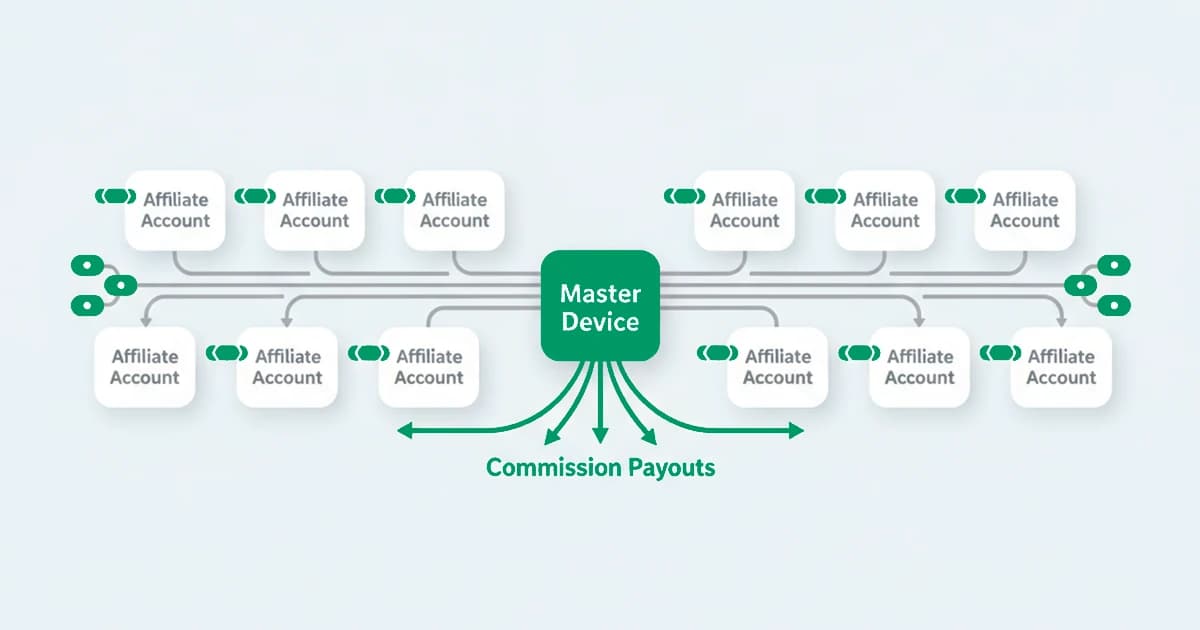
| Fake affiliate accounts and collusion | One operator runs many affiliate accounts, or a ring refers each other, to multiply payouts and stay under per-account limits |
These split into two different problems. Automated and bot-driven traffic is a traffic-quality problem, and click and bot filtering exists to handle it; automated traffic is no fringe issue, with Imperva's 2025 Bad Bot Report putting automated bot traffic at 51 percent of all web traffic. The rest share a human operator standing behind identities that are supposed to be independent: one person running several affiliate accounts and manufacturing the customers behind them. That second problem is where the device signal does its work.
Cookie stuffing, explained
Cookie stuffing, also called cookie dropping, is the affiliate-fraud technique of forcing an affiliate tracking cookie onto a visitor's browser without a genuine click on the affiliate link. The visitor loads an ordinary page, and an invisible iframe, a hidden image, or a pop-under quietly sets the affiliate's cookie. If that visitor later buys from the merchant entirely on their own, the affiliate is credited for the sale. No real referral happened, but the last-click attribution says one did.
It is one of the oldest tricks in the channel, and one of the few to draw criminal charges. In a well-documented case, an eBay affiliate ran a cookie-stuffing operation that claimed commissions on purchases he never drove, took millions of dollars from the program, and pleaded guilty to wire fraud in 2014. The point of the story is that cookie stuffing steals attribution at scale, not one sale at a time.
Cookie stuffing is an attribution-layer manipulation: it abuses how a browser stores and reports the last-click cookie, so catching the stuffed cookie itself belongs to the tracking platform. What survives across a stuffing operation, once the same actor runs it behind many affiliate accounts, is the device and infrastructure those accounts share.
What most affiliate fraud has in common
Strip away the tactics and most affiliate fraud reduces to one shape: a single operator wearing many faces. The fake affiliate accounts are supposed to be independent partners. The fake leads and self-purchases are supposed to be independent customers. In reality one person, or one small operation, sits on both sides, creating the affiliate and the conversion and pocketing the commission in between.
That is multi-accounting applied to a payout program, and it is the same shape that drives referral fraud and promo abuse. Each identity is built to look distinct, with a fresh email, a different name, and often a masked IP from a VPN or proxy. Checked individually, none of them looks wrong. What they genuinely share is the device they were created and operated on, and a device is far harder to swap than an email address.
How to prevent affiliate fraud
No single control stops affiliate fraud, so prevention combines program design with detection:
- Pay on qualified outcomes, not raw actions. Trigger commission on a validated sale that clears a return and chargeback window, or on a customer who stays active, so a stuffed cookie or a fake lead earns nothing.
- Vet publishers before and during the program. Review traffic sources, require clear disclosure that meets the FTC's endorsement rules, and watch for partners whose conversions spike without any matching engagement.
- Keep attribution honest. Shorten cookie windows, discount last-click credit from suspicious placements, and reconcile affiliate-reported conversions against real customer behavior.
- Link the affiliate to the customers it claims to have driven. The strongest single check is whether an affiliate account and the new customers behind its conversions trace back to one device or one operation.
- Watch anonymity and velocity. Conversions arriving over VPNs, proxies, and anti-detect browsers, or a burst of signups behind a single partner, are strong ring signals.
- Hold and review high-value payouts. A quick check before paying instant, high-velocity commissions catches the obvious rings before the money leaves.
Done together, these keep the program open for genuine partners while making manufactured conversions unprofitable.
Preventing affiliate fraud with ShieldLabs
ShieldLabs helps you prevent affiliate fraud by reading the device and network behind every affiliate signup and every conversion, then linking the two. You add one JavaScript snippet to your signup, lead, and checkout flows, and each visit returns persistent identification, built from device fingerprinting signals, that survives cleared cookies and a rotated IP. When an affiliate account and the customers behind its conversions resolve to one device, ShieldLabs detects Multi-accounting directly as a High-Risk Event, exposing the self-purchase and fake-lead rings behind it rather than leaving them for you to reconstruct.
When we ran this device read across a batch of affiliate accounts and the customers they claimed to have driven, the accounts that looked independent on every visible field, a new email, a different name, a VPN-masked address, still resolved to a single device identifier even after the cookies were wiped and the network swapped. Classic cookie stuffing is a different problem, an attribution trick played on genuine buyers that the tracking platform has to catch; what the device read exposes is the ring that manufactures both its affiliates and its customers, where the two sides collapse onto one machine.
Alongside it, each visit returns a risk score from 0 to 100 and the named risk signals, VPN, proxy, Tor, and anti-detect browser use, that an operator leans on to make one person look like many partners and many customers. Click-quality and bot filtering stay a complementary layer for automated traffic, and ShieldLabs adds the device-identity linkage underneath it. ShieldLabs scores the session and names the evidence, and you read the High-Risk Event and the score through the API and webhooks to choose the action for each conversion: pay, hold, or reject. The free tier covers your first 5,000 identifications.
Sources
- Federal Trade Commission: Disclosures 101 for Social Media Influencers
- Wikipedia: Affiliate marketing
- Wikipedia: Cookie stuffing
- Imperva: 2025 Bad Bot Report (2025)
Recommended
Frequently asked questions
- What is affiliate fraud?
- Affiliate fraud is the abuse of a pay-for-performance marketing program to collect commissions for clicks, leads, or sales that are not genuine. A registered affiliate manufactures conversions, through cookie stuffing, fake leads, or self-purchases, so the program pays out while the advertiser gains no real customer. Because each conversion looks like an ordinary one, the fraud is counted as performance until the accounts behind it are linked.
- Is affiliate fraud illegal?
- It depends on the scale and intent. Most affiliate fraud is handled as a breach of the program's terms, with commissions clawed back and the affiliate removed, rather than as a criminal case. Organized, high-value schemes are treated more seriously: cookie stuffing, for example, has led to a criminal wire-fraud conviction where an affiliate took millions from a program. Deliberately manufacturing conversions to extract commissions you did not earn is fraud, whether or not a given case reaches court.
- What is cookie stuffing?
- Cookie stuffing, or cookie dropping, is an affiliate-fraud technique that forces an affiliate tracking cookie onto a visitor's browser without a real click on the affiliate link, usually through a hidden iframe, image, or pop-under. If that visitor later buys on their own, the affiliate is credited for a sale they never drove. It steals last-click attribution, and at scale it lets one operator claim commissions across many purchases they had no part in.
- How do you detect affiliate fraud?
- By finding what the supposedly independent affiliates and customers share rather than what each one shows. The strongest signal is a shared device linking an affiliate account to the customers behind its conversions, followed by risk signals like VPN or anti-detect browser use, and behavioral links such as conversion velocity or shared payment details. No single check is conclusive, so detection correlates several signals to expose one operator behind many payouts.
- How does ShieldLabs help prevent affiliate fraud?
- ShieldLabs reads the device and network behind each affiliate signup and each conversion and links them, detecting Multi-accounting directly as a High-Risk Event, which gives away self-purchase and fake-lead rings. It returns persistent identification plus a risk score with the named risk signals, so your team chooses which conversions to pay or hold. It adds the device-identity layer underneath click-quality and bot filtering rather than running your affiliate program itself, and the free tier covers your first 5,000 identifications.
Related articles

Remember This Device for MFA With a Persistent Device ID
Design remember this device for MFA with a revocable trust credential, persistent device context, expiry and step-up authentication for sensitive actions.

How to Detect AI Agents on a Website
Detect AI agents on a website by separating operator identity, automation evidence and authorization. Protect accounts while permitting useful public crawling.

Fraud Detection API for Web Apps: From Browser Signal to Backend Decision
Integrate a fraud detection API into web signup and login with browser collection, verified server results, signed webhooks and clear timeout handling.